
Timing is everything, even for brain cells.
A clock that runs fast is still a broken clock. And it turns out some of the brain's support cells have a habit of ringing the alarm long before there's a fire - then setting one themselves. A new study in The Journal of Clinical Investigation built tiny lab-grown brains to watch this happen, and the culprit is a cell most of us were taught to ignore.
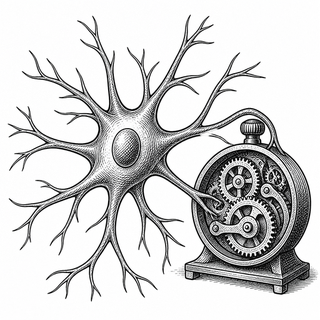
Meet the brain's maintenance crew
Astrocytes are the star-shaped cells that keep neurons fed, watered, and wired. Picture the building staff in a precision watch factory: they oil the gears, sweep the floor, and make sure the delicate parts never overheat. When they do their job, you never notice them. When they overreact, the whole mechanism seizes up.
The trouble starts with a gene called Progranulin (GRN), which works like a tiny regulator spring. Lose one good copy and you get frontotemporal lobar degeneration, a dementia that hits people in their 50s and 60s and dismantles personality and language. Lose both copies and a child develops a different, devastating disorder. Either way, the spring is missing, and the watch starts keeping terrible time.
Growing a brain to watch the gears turn
You cannot exactly pop the back off a living human brain to inspect the movement. So the researchers did the next best thing. They took human stem cells, knocked out the GRN gene, and grew cortical organoids - lentil-sized blobs of real human brain tissue, complete with neurons and astrocytes, ticking away in a dish.
Here is the unsettling part. In the GRN-deficient organoids, the astrocytes became reactive early. Precociously, the paper says, which is a polite scientific way of saying they clocked in for a crisis nobody called. Healthy astrocytes wait for trouble. These ones manufactured it, stressing nearby neurons and quietly stripping away synapses, the little junctions where neurons pass messages along. Fewer synapses means a noisier, slower circuit - the cognitive equivalent of a watch losing a few minutes every hour.
Following the wire to the alarm switch
When the team read out the activity of single cells, one pathway lit up like a stuck relay: TGF-beta signaling. TGF-beta is a normal messenger molecule, the kind of signal that usually tells cells to calm down and behave. In these mutant astrocytes it was jammed in the on position, driving immune-style activation and shutting down the cells' day job of supporting synapses.
And then the smoking gun. Inside those overactive astrocytes, the researchers found dense tangles of pTDP-43 - a protein that, when it clumps, is the molecular signature of this whole family of dementias. For years TDP-43 buildup was considered mostly a neuron problem. Finding it stuffed into the maintenance crew's cytoplasm is a bit like discovering the night janitor was the one jamming the gears all along.
The part that earns the headline
A broken-clock story is only interesting if you can fix the clock. So the team blocked TGF-beta signaling in the GRN-deficient organoids. The astrogliosis settled down. The toxic pTDP-43 fibrils dropped. Tap the right gear and the runaway mechanism eased back toward normal time.
Now, the honest caveats. An organoid is a sketch of a brain, not the real thing - no blood vessels, no immune cells wandering in, no decades of wear. A fix in a dish is a long, patient walk from a fix in a person. But it points a finger. If overactive astrocytes help kick off this disease rather than just cleaning up after it, then the TGF-beta pathway becomes a tempting place to slip in a wrench - early, before neurons start dying and the damage becomes irreversible.
That word, early, is the whole point. Most dementia drugs arrive after the movement is already shattered. This work suggests there may be a window when the spring is weak but the gears still turn, and a well-timed adjustment could keep the clock running for years longer.
The brain remains the most overengineered timepiece we know of. It is reassuring, in a strange way, to learn that some of its breakdowns start with a single cell that simply showed up to work too soon.
Disclaimer: The image accompanying this article is for illustrative purposes only and does not depict actual experimental results, data, or biological mechanisms.
References
-
Ramsey AC, Tang XY, Macias MJ, et al. TGFb signaling promotes astroglial activation and TDP-43 proteinopathy in organoid models of frontotemporal lobar degeneration. The Journal of Clinical Investigation. 2026. DOI: 10.1172/JCI190035. PMID: 42302828.
-
Marsan E, Velmeshev D, Ramsey A, et al. Astroglial toxicity promotes synaptic degeneration in the thalamocortical circuit in frontotemporal dementia with GRN mutations. The Journal of Clinical Investigation. 2023. DOI: 10.1172/JCI168215.
-
Gao J, Wang L, et al. (related organoid model). Granulin loss of function in human mature brain organoids implicates astrocytes in TDP-43 pathology. Cell Stem Cell / Stem Cell Reports. 2023. PMID: 36827976.
-
Rhinn H, Tatton N, McCaughey S, et al. Progranulin as a therapeutic target in neurodegenerative diseases. Trends in Pharmacological Sciences. 2022;43(8):641-652. DOI: 10.1016/j.tips.2021.11.015.
-
Diniz LP, Matias I, Garcia MN, Gomes FCA, et al. TGF-β as a Key Modulator of Astrocyte Reactivity: Disease Relevance and Therapeutic Implications. Biomedicines. 2022;10(5):1206. DOI: 10.3390/biomedicines10051206. PMID: 35625943.
-
Progranulin deficiency in the brain: the interplay between neuronal and non-neuronal cells. Translational Neurodegeneration. 2025. DOI: 10.1186/s40035-025-00475-8.