
We still don't know exactly how one brain region tells another what to learn. The brain is, after all, a wet democracy of roughly 86 billion cells, none of whom were elected, all of whom have opinions. But a new study in eLife gets us a little closer, and it does so by catching the cerebellum doing something it was absolutely not supposed to be doing: meddling in the affairs of the cerebral cortex.
A Quick Word About the Brain's Tidy Little Filing Cabinet
For about a century, the cerebellum had a reputation. That fist-sized lump at the back of your skull, the one that looks like a cauliflower having an existential crisis, was filed under "motor control." It keeps you upright. It stops you pouring tea into your lap. Useful, dependable, deeply unglamorous.
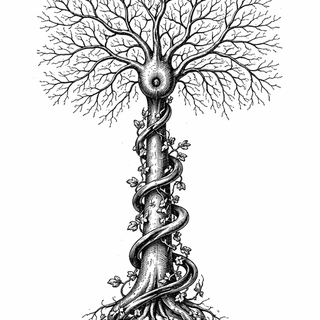
The star of the cerebellar show is a circuit involving climbing fibers, which wrap around large neurons called Purkinje cells like ivy around a lamppost. When a climbing fiber fires, it delivers what neuroscientists romantically call an "instructive signal" - essentially a stern note that says that was wrong, adjust accordingly. This is the cerebellum's version of supervised learning, and it is one of the cleanest examples of error-driven teaching anywhere in the nervous system. Decades of work have established it as the gold standard (Raymond & Medina, 2018, PMC6056176; Tsutsumi et al., 2024, PMC11088996).
What nobody had tested was whether those stern notes ever get forwarded outside the cerebellum.
Scientists Asked an Impertinent Question
Silbaugh, Koster, and Hansel decided to find out. They took awake mice and did the thing that has powered roughly half of modern neuroscience: they stroked their whiskers. Repeatedly. With purpose.
Normally, repeated whisker stimulation makes the responses in layer 2/3 of the primary somatosensory cortex grow stronger - a textbook case of experience-dependent plasticity, the cellular handshake behind "practice makes the signal louder." The cortex, given the same input over and over, leans in.
Then the researchers flipped on the climbing fibers using optogenetics, which is the polite term for installing light switches in living neurons. And the cortical strengthening simply... didn't happen. The cerebellum, from across the brain, had reached over and quietly cancelled the lesson.
Which raises the obvious question of how. The cerebellum and the somatosensory cortex are not exactly neighbors, and there is no direct wire between them.
The Plot Has Interneurons In It
Using two-photon imaging and chemogenetics - tools that let you watch and switch off specific cells like a very expensive dimmer board - the team found the cerebellum wasn't talking to the cortex's main cells directly. It was leaning on the interneurons, the local middle-management cells that decide who gets to fire and who gets told to pipe down. Two flavors in particular, the SST- and VIP-positive interneurons, were being nudged by climbing fiber activity. Tweak the supervisors, and you change what the whole office learns.
But there was still the matter of the missing wire. How does a signal get from the back of the brain to the sensory cortex at the front?
Transsynaptic labeling - a technique that lets a virus retrace a neural route like a determined bloodhound - pointed to an unglamorous waystation called the zona incerta, the "zone of uncertainty," a name so honest it borders on a confession. The zona incerta projects to the posterior medial thalamic nucleus, which feeds the cortex. When the researchers chemogenetically silenced the gatekeeper cells in the zona incerta, the cerebellum's veto vanished. No relay, no influence. The pathway was real.
Why You Should Care That a Mouse's Whiskers Didn't Learn
The headline here isn't really about whiskers. It's that the cerebellum's instructive signal - the "you got that wrong" teaching mechanism we assumed was a strictly in-house cerebellar affair - may be broadcasting to the rest of the brain. The teacher, it turns out, has been sending notes to other classrooms.
This matters because the cerebellum keeps turning up at the scene of decidedly non-motor crimes: attention, language, and a long list of psychiatric conditions where its connections to the cortex look subtly miswired (Strick et al., 2009, Annu. Rev. Neurosci.). If it helps decide when and how much the sensory cortex is allowed to learn, then a wonky cerebellum stops being a balance problem and starts being a learning problem. That is a meaningfully different thing to treat.
It's early, it's in mice, and the path from "interesting circuit in a rodent" to "useful in a human" is paved with the bones of overconfident press releases. But the architecture is now visible: an error signal from the back of the brain, routed through a region literally named for uncertainty, gently editing what the rest of the cortex takes away from experience.
The quiet, unglamorous lump at the back of your head has been the brain's silent editor all along. It just never told anyone.
Disclaimer: The image accompanying this article is for illustrative purposes only and does not depict actual experimental results, data, or biological mechanisms.
Reference
Silbaugh, A., Koster, K. P., & Hansel, C. (2025). Cerebellar climbing fibers impact experience-dependent plasticity in the mouse primary somatosensory cortex. eLife. https://doi.org/10.7554/eLife.109183 (PMID: 41427690; PMC12721708)
Further Reading
- Tsutsumi, S., et al. (2024). Climbing fibers provide essential instructive signals for associative learning. Nature Neuroscience. https://doi.org/10.1038/s41593-024-01594-7 (PMC11088996)
- Strick, P. L., Dum, R. P., & Fiez, J. A. (2009). Cerebellum and nonmotor function. Annual Review of Neuroscience. https://doi.org/10.1146/annurev.neuro.31.060407.125606
- Trageser, J. C., & Keller, A. (2004). Reducing the uncertainty: gating of peripheral inputs by zona incerta. Journal of Neuroscience. https://doi.org/10.1523/JNEUROSCI.3218-04.2004