
The experiment looked like it had gone sideways in the most annoying possible way: scientists removed a brain estrogen-making enzyme from male medaka fish, the fish ended up with more androgens in their brains, and yet their mating and aggression dropped like somebody yanked the aux cord mid-song. If testosterone and its fishy cousin 11-ketotestosterone were supposed to be the hype men for male-typical behavior, why did turning up the volume make the room quieter?
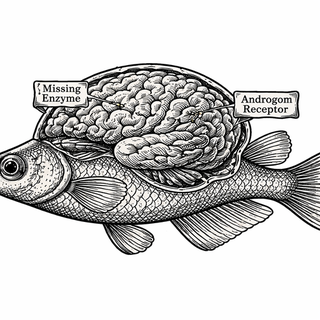
That is the chaos grenade in a new eLife study by Nishiike and colleagues, who studied medaka: rice fish with clear courtship, aggression, and excellent lab-organism manners.
Estrogen: Not Just Wearing the Pink Jersey
Most of us learn the hormone story in painfully simple cartoon form: testosterone equals male stuff, estrogen equals female stuff, end of lecture, please close your binders. Biology, being biology, immediately vandalizes that poster.
In many vertebrates, testosterone can be converted into estradiol by an enzyme called aromatase. That estradiol can then act inside the brain. In rodents, brain-made estrogens help organize and activate male-typical behaviors. Reviews of brain aromatase now frame it as part of a conserved social-behavior network, a neural DJ booth where steroid signals get sampled, remixed, and dropped into behavior at the right beat (Spool et al., 2022).
Teleost fish, though, seemed to be running a different playlist. In medaka and many other fish, androgens can act directly through androgen receptors. One big androgen, 11-ketotestosterone, cannot even be aromatized into estrogen. Case closed, right? Androgens drive the show, estrogen is backstage eating pretzels.
Not so fast.
The Missing Enzyme With Main Character Energy
Medaka have a brain-biased aromatase gene called cyp19a1b. Nishiike and colleagues created mutant males lacking it. The mutants had much less estradiol in the brain, while their peripheral estrogen system was mostly spared because this gene does its main work upstairs.
Then came the plot twist with a lab coat on: the mutant males had higher brain testosterone and much higher brain 11-ketotestosterone. If behavior were just a hormonal gas pedal, these fish should have been revving at a stoplight.
Instead, they struggled. Courtship slowed. Aggression dropped. They could still fertilize eggs, so this was not simply a broken reproductive plumbing problem. The issue looked behavioral, not mechanical.
The team then gave estradiol back. Courtship improved in the mutant males. Aggression stayed more complicated, because brains enjoy turning simple stories into group projects. But the rescue strongly suggested that brain-derived estrogen was not decorative. It was part of the operating system.
Androgen Receptors Need a Producer
The cleanest idea from the paper is not "estrogen replaces androgen." It is cooler than that. It is "estrogen helps androgen land."
The researchers found evidence that brain-derived estrogens boost androgen receptor signaling by increasing transcription of androgen receptor genes in behavior-related brain regions. Translation: estradiol may help build the molecular docking stations that androgens need.
Think of androgen as the rapper with bars, androgen receptor as the microphone, and brain-made estrogen as the producer making sure the mic is actually plugged in. Without estrogen, the rapper can shout all he wants. The crowd hears less.
That matters because it reframes the old hormone binary. The brain is not a vending machine where testosterone goes in and "male behavior" falls out. It is a remix desk. Signals stack. Receptors shift. Local chemistry decides whether a hormone message gets amplified, muted, or sent to voicemail like an unknown number during dinner.
Why This Tiny Fish Has Big Implications
No, this does not mean medaka are tiny humans with fins and commitment issues. The eLife reviewers also flagged that the broader claim still needs more testing, especially in females and across contexts. Good science keeps the receipt.
But the study gives researchers a sharper question: when androgens shape social behavior, how much depends on local estrogen tuning the receiver? That question could matter for understanding sex steroid signaling across species, including why aromatase, estrogen receptors, and androgen receptors show up in brain circuits tied to mating, aggression, motivation, cognition, and mood.
Recent reviews make the same wider point: brain-derived estradiol is not only a reproductive hormone cameo. It can influence synapses, plasticity, memory, neuroprotection, and social behavior (Brann et al., 2022). Circuit-level studies also show that motivation and mating come from specific neural pathways, not one magic hormone lever (Bayless et al., 2023).
So the medaka result lands with a nice thump. It says: stop treating estrogen as the "female hormone" and testosterone as the "male hormone." That shortcut is catchy, but so is a bad chorus. The brain is doing arrangement, mastering, and live mixing all at once, and apparently estrogen may be standing at the board helping androgen sound like itself.
Tiny fish. Big remix.
References
Nishiike Y, Maki S, Miyazoe D, Nakasone K, Kamei Y, Todo T, Ishikawa-Fujiwara T, Ohno K, Usami T, Nagahama Y, Okubo K. Brain-derived estrogens facilitate male-typical behaviors by potentiating androgen receptor signaling in medaka. eLife. 2026;13:RP97106. https://doi.org/10.7554/eLife.97106
Spool JA, Bergan JF, Remage-Healey L. A neural circuit perspective on brain aromatase. Frontiers in Neuroendocrinology. 2022;65:100973. PMCID: PMC9667830. https://doi.org/10.1016/j.yfrne.2021.100973
Brann DW, Lu Y, Wang J, Zhang Q, Thakkar R, Sareddy GR, Pratap UP, Tekmal RR, Vadlamudi RK. Brain-derived estrogen and neural function. Neuroscience and Biobehavioral Reviews. 2022;132:793-817. PMCID: PMC8816863. https://doi.org/10.1016/j.neubiorev.2021.11.014
Nishiike Y, Miyazoe D, Togawa R, Yokoyama K, Nakasone K, Miyata M, Kikuchi Y, Kamei Y, Todo T, Ishikawa-Fujiwara T, Ohno K, Usami T, Nagahama Y, Okubo K. Estrogen receptor 2b is the major determinant of sex-typical mating behavior and sexual preference in medaka. Current Biology. 2021;31(8):1699-1710.e6. https://doi.org/10.1016/j.cub.2021.01.089
Bayless DW, Davis CO, Yang R, Wei Y, Miessler de Andrade Carvalho V, Knoedler JR, Yang T, Livingston O, Lomvardas A, Martins GJ, Vicente AM, Ding JB, Luo L, Shah NM. A neural circuit for male sexual behavior and reward. Cell. 2023;186(18):3862-3881.e28. https://doi.org/10.1016/j.cell.2023.07.021
Disclaimer: The image accompanying this article is for illustrative purposes only and does not depict actual experimental results, data, or biological mechanisms.