
Before this study, the fruit fly brain looked like the boss of the body: tiny, busy, probably wearing a headset, issuing commands to legs, wings, guts, and whatever else a fly needs while ruining your banana. After it, the fly nervous system looks less like a throne room and more like a competent airport: local teams handle the immediate chaos, while the central office nudges, coordinates, and tries not to make everything worse.
That is the punchline of a new Nature paper by Bates and colleagues: the first densely reconstructed adult fruit fly connectome that links the brain with the ventral nerve cord, the fly's spinal-cord-ish command highway. The team mapped neurons and synapses across the central nervous system, then asked a dangerous question: who is actually in charge here? Bates et al., 2026
A Wiring Diagram With Legs
A connectome is a wiring diagram of a nervous system. Not a vague "this brain region talks to that brain region" diagram. A neuron-by-neuron, synapse-by-synapse map. It is the difference between saying "there is plumbing in this building" and finding every pipe, valve, leak, and questionable basement decision.
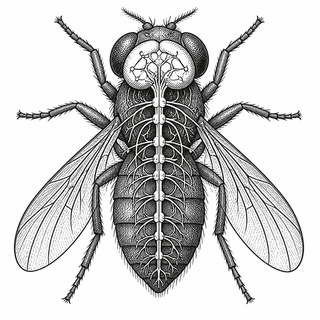
Fruit flies are perfect for this kind of madness. They have roughly 160,000 neurons, which is small compared with humans and still entirely too many if you are the person tracing them. They also do real behavior: walking, flying, learning, navigating, flirting badly, escaping danger. The usual Tuesday.
Recent work gave scientists the full adult fly brain connectome, with about 139,000 neurons and 50 million chemical synapses Dorkenwald et al., 2024. Other work mapped the female ventral nerve cord, with roughly 45 million synapses and 14,600 neuronal cell bodies Azevedo et al., 2024. The new BANC dataset joins brain and cord into one nervous-system map. Finally, the fly is not just a brain in a jar. It has a body. Rude of biology to require one.
Local Control Is Not a Bug
The surprise is not that the brain matters. It does. Please do not tell your brain I said otherwise.
The surprise is that many effectors - motor neurons, endocrine cells, and neurons controlling internal organs - seem to receive their strongest influence from sensory neurons in the same body part. A leg listens heavily to leg sensory feedback. Mouthpart circuits listen to mouthpart feedback. The viscera, those moody internal departments, also get local input.
This creates local feedback loops. The body part senses what is happening, adjusts nearby output, and keeps moving without waiting for the entire executive committee upstairs to schedule a meeting.
That makes sense. If your leg slips, you do not want a six-step approval process from headquarters. You want the local circuit to fix it before your fly body becomes modern art on a windowsill.
The Brain Still Gets to Be Weird
Local does not mean isolated. The study found that ascending and descending neurons link these loops into broader modules. Some of these long-range neurons are positioned to influence multiple body parts at once, plus the metabolic and visceral systems that support action.
That is the elegant part. Walking is not just "move legs." Flying is not just "flap wings." Escaping danger may need vision, touch, muscles, energy stores, and internal state all lined up before the fly launches itself into the room with the dramatic timing of a popcorn kernel.
The brain appears to supervise these modules, especially regions involved in learning and navigation. It may bias the system toward goals, contexts, and memories, while local circuits handle fast execution. Less puppet master. More air traffic control with anxiety.
This matches a broader trend in fly connectomics. The adult fly brain is highly interconnected and distributed, not a simple pile of command neurons Lin et al., 2024. Ascending and descending pathways also form complex cross-body circuits rather than one tidy cable labeled "behavior" Stuerner et al., 2025.
Why This Matters Beyond Flies
The immediate payoff is practical. A full brain-and-cord connectome lets researchers generate sharper hypotheses. Instead of poking random neurons and hoping the fly does something interpretable, scientists can trace likely routes from sensation to action, then test them in living animals.
The bigger payoff is conceptual. Nervous systems may not control behavior by sending orders from a single grand control room. They may build behavior from distributed modules: local loops for speed, long-range links for coordination, and brain regions for context. Nature, apparently, discovered edge computing before product managers did.
This also matters for AI and robotics. Animals move through messy worlds with bodies that push back. A connectome like BANC gives engineers a biological example of embodied control: intelligence spread across sensors, motors, feedback, and central planning. Not a chatbot taped to a Roomba. Something closer to a nervous system.
The Annoying Caveats, Because Science Has Rent Due
A connectome is powerful, but it is not the whole animal. Wiring does not automatically tell you synapse strength in every state, neuromodulator levels, cell physiology, development, learning history, or what the fly had for breakfast. It also comes from individual animals, while real nervous systems vary.
So no, this is not "we uploaded a fly." That claim needs more receipts than a tax audit. A wiring diagram is a map. It is not the traffic, the weather, the driver, and the argument happening in the back seat.
Still, this map changes the game. It shows a nervous system where control is distributed, embodied, and fast. The fly brain did not lose its job. It just stopped pretending it does everything itself.
References
- Bates AS, Phelps JS, Kim M, et al. Distributed control circuits across a brain-and-cord connectome. Nature. 2026. doi:10.1038/s41586-026-10735-w
- Dorkenwald S, Matsliah A, Sterling AR, et al. Neuronal wiring diagram of an adult brain. Nature. 2024;634:124-138. doi:10.1038/s41586-024-07558-y. PMCID: PMC11446842
- Azevedo A, Lesser E, Phelps JS, et al. Connectomic reconstruction of a female Drosophila ventral nerve cord. Nature. 2024;631:360-368. doi:10.1038/s41586-024-07389-x. PMCID: PMC11348827
- Lin A, Yang R, Dorkenwald S, et al. Network statistics of the whole-brain connectome of Drosophila. Nature. 2024;634:153-165. doi:10.1038/s41586-024-07968-y
- Stuerner T, Brooks P, Serratosa Capdevila L, et al. Comparative connectomics of Drosophila descending and ascending neurons. Nature. 2025;643:158-172. doi:10.1038/s41586-025-08925-z
- Winding M, Pedigo BD, Barnes CL, et al. The connectome of an insect brain. Science. 2023;379:eadd9330. doi:10.1126/science.add9330. PMCID: PMC7614541
Disclaimer: The image accompanying this article is for illustrative purposes only and does not depict actual experimental results, data, or biological mechanisms.