
Monday: normal brain. Tuesday: still normal. Wednesday: everything changed. Not because the brain suddenly grew a tiny villain mustache, but because scientists looked at fragile X syndrome with a sharper microphone and heard two neuron groups playing different mixes of the same song.
The new study, published in Neuron, focuses on fragile X syndrome, a genetic condition caused most often by silencing of the FMR1 gene. That gene normally makes FMRP, a protein that helps manage which messenger RNAs become proteins. Think of FMRP as a producer saying, "Maybe don't release all 400 tracks at once." When FMRP is missing, the playlist gets messy.
Fragile X can bring intellectual disability, autism-related traits, attention problems, sensory hypersensitivity, seizures, sleep issues, and neurological chaos nobody ordered as a family combo meal. Current care is mostly supportive and symptom-based: therapies, education plans, and medications for specific problems. Helpful, yes. A direct molecular fix? Not yet.
The Brain's Volume Knobs Are Arguing
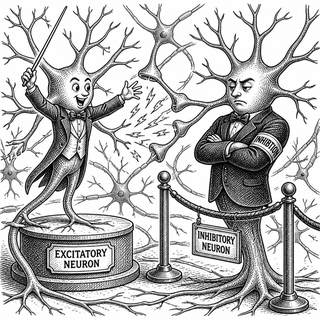
One big idea in fragile X research is excitation/inhibition imbalance. Excitatory neurons are the hype crew. They say "go." Inhibitory neurons are the bouncers. They say "please stop trying to crowd-surf off the hippocampus." A healthy brain needs both, because pure hype is a seizure and pure silence is not exactly cognition.
Suresh and colleagues used cell-type-specific translatome profiling in Fmr1 knockout mice. Translation: they asked which RNAs were actively being read by ribosomes in specific neuron types, like checking not the whole record collection but what is actually spinning on the turntable.
They focused on cortical excitatory Camk2a neurons and inhibitory Pvalb neurons. Pvalb cells are fast-spiking interneurons, the neural timekeepers that keep circuits crisp. If the brain were a drum machine, these cells would be the quantize button, silently judging everyone else's timing.
Same Disorder, Different Cell Drama
The twist was not simply that fragile X changed gene expression. Everyone expected molecular mess. The shocker was that many signaling pathways changed in opposite directions in excitatory versus inhibitory neurons.
That matters because "the fragile X brain is overexcited" is a useful headline, but biology loves to make headlines look written in crayon. A circuit can look imbalanced while different cell types compensate, overcorrect, undercorrect, and behave like a committee mixing an album with no shared headphones.
Among 184 genes dysregulated across both cell types, one stood out: Rapgef4, better known as EPAC2. It was upregulated in the fragile X mice, brain-enriched, linked to neurodevelopmental conditions, and an FMRP target. In other words, EPAC2 walked into the suspect lineup wearing a name tag.
EPAC2 helps relay cAMP signaling into Rap-family pathways and lives near synapses, where neurons pass messages like tiny overcaffeinated interns. Prior work connects EPAC2/RAPGEF4 to dendritic structure, learning, memory, and autism-related biology. That does not make it the master switch for fragile X. Brains do not have master switches. They have dimmers in locked closets.
Blocking EPAC2 Helped the Mice
Here is the part that makes this study more than molecular karaoke. When the researchers blocked EPAC2, either genetically or with a selective antagonist, fragile X mice showed improvements in cortical circuit function and several behaviors. UCLA's summary notes improvements in touch sensitivity, social interaction, and seizure susceptibility.
That is a strong preclinical signal. It is not a treatment for people yet. Mouse results have fooled fragile X researchers before, especially in the saga of mGluR-targeting drugs, where elegant animal data ran face-first into messy clinical trials. The brain, apparently, does not read grant proposals.
Still, EPAC2 may sit near a shared molecular bottleneck. The study also suggests EPAC2 levels rise as the brain matures, raising a practical hope: maybe some therapeutic windows extend beyond early development. That would matter for older children and adults, who are too often treated like the science bus already left without them.
Why This One Has Some Bass
The real power is the method. Cell-specific translatome profiling lets researchers hear separate tracks instead of one muddy whole-brain mix. Excitatory neurons, inhibitory neurons, shared genes, opposing pathways - suddenly the arrangement has depth.
If these findings reproduce, and if EPAC2 blockers can be made safe and brain-selective, the impact could be substantial. Not a cure-in-a-cape situation. More like a targeted way to reduce sensory overload, improve circuit stability, and maybe make daily life less like living inside a smoke alarm with opinions.
The cautious version: fragile X biology is complicated, EPAC2 is promising, and mice are not miniature people wearing lab coats. The exciting version is also true: researchers found a druggable signal, changed it, and saw circuits and behavior move in the right direction.
That is the kind of remix neuroscience needs. Same disorder. Better separation. Cleaner signal. A new target stepping up to the mic.
References
- Suresh A, Kourdougli N, Nomura T, et al. Translatome profiling reveals opposing alterations in inhibitory and excitatory neurons of fragile X mice and identifies EPAC2 as a therapeutic target. Neuron. 2026. https://doi.org/10.1016/j.neuron.2026.04.032
- Richter JD, Zhao X. The molecular biology of FMRP: new insights into fragile X syndrome. Nature Reviews Neuroscience. 2021;22:209-222. https://doi.org/10.1038/s41583-021-00432-0
- Tempio A, Boulksibat A, Bardoni B, Delhaye S. Fragile X Syndrome as an interneuronopathy: a lesson for future studies and treatments. Frontiers in Neuroscience. 2023;17:1171895. https://doi.org/10.3389/fnins.2023.1171895
- Protic D, Hagerman R. State-of-the-art therapies for fragile X syndrome. Developmental Medicine & Child Neurology. 2024;66:863-871. https://doi.org/10.1111/dmcn.15885
- Bülow P, Segal M, Bassell GJ. Mechanisms Driving the Emergence of Neuronal Hyperexcitability in Fragile X Syndrome. International Journal of Molecular Sciences. 2022;23:6315. https://doi.org/10.3390/ijms23116315
- Hipp H, Todd PK. FMR1 Disorders. GeneReviews. Updated May 16, 2024. https://www.ncbi.nlm.nih.gov/books/NBK1384/
Disclaimer: The image accompanying this article is for illustrative purposes only and does not depict actual experimental results, data, or biological mechanisms.