
There's a word in German that has no English translation: Kabelsalat, literally "cable salad," the tragic condition of cords turning into a knotty civilian disaster. This paper is about the cellular version. Neurons make very long RNA messages, full of introns that must be cut out cleanly. Situation report: a protein famous for causing heart trouble, RBM20, also operates in select neurons, where it may keep long RNA messages from becoming molecular spaghetti.
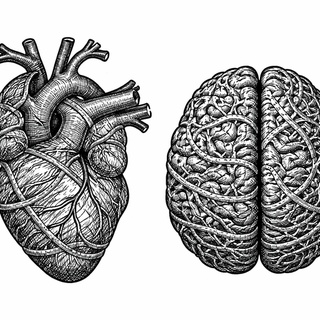
Situation Report: The Suspect Was Wearing Cardiac Boots
RBM20 is not a random protein wandering through biology with a clipboard. It is an RNA-binding protein, meaning it grabs RNA and helps decide what happens next. In the heart, RBM20 helps control alternative splicing, the editing process that lets one gene produce different RNA versions. When RBM20 goes bad, families can develop dilated cardiomyopathy, where the heart enlarges and pumps poorly. Not ideal. The heart prefers competent logistics.
Giulia Di Bartolomei and colleagues went looking for RNA-binding proteins in the mouse neocortex and found RBM20 where many people would not have placed it: in cortical parvalbumin interneurons and olfactory bulb mitral cells. Translation from cell-speak: the protein had left the heart briefing room and reported to specialized neurons with a badge and a serious expression.
Mission Objective: Keep the Long Messages Alive
Basic RNA drill: DNA stores instructions. Cells copy a gene into pre-mRNA, a rough draft with exons, the useful chunks, and introns, the parts to remove. The spliceosome performs the editing. It is a molecular film editor with no chair, no coffee, and terrifying accuracy requirements.
This matters because many neuronal genes are enormous. They often include very long introns and frequently encode synaptic proteins, the gear neurons use to talk. A synapse may look tiny, but in operational terms it is a strategic asset. Lose enough message traffic there and the circuit starts making decisions like a committee with no agenda.
The researchers mapped where RBM20 binds RNA. In neurons, RBM20 latched onto pre-mRNAs in distal intronic regions, away from the usual obvious edit points. Then they removed neuronal RBM20 and looked at what changed. The surprise was not a huge explosion of alternative splice isoforms. Instead, many mature mRNAs dropped in the neuronal cytoplasm, especially messages from long-intron genes involved in synapses.
That suggests RBM20 may act less like a flashy editor and more like quality control. Its job may be to suppress nonproductive splicing events, the RNA equivalent of stapling the battle plan to a lunch receipt.
Why This Is Odd, and Therefore Useful
The brain and heart share biological problems. Both need precise timing. Both hate electrical chaos. Both dislike sloppy maintenance. Still, seeing a major cardiomyopathy-associated protein regulate neuronal RNA gives the story teeth.
It also fits a bigger trend. Modern neuroscience keeps finding that RNA regulation is not backstage paperwork. It is front-line command. Alternative splicing changes how neurons build receptors, channels, scaffolds, and signaling machinery. Recent work links splicing defects to neurodevelopmental and neurodegenerative disorders, while RNA-based therapies are moving from clever idea to clinical strategy.
So RBM20 showing up in neurons is not a trivia answer. It is a warning label: genes we classify as "heart genes" may have moonlighting assignments in the nervous system. Biology loves a side hustle. Human naming systems do not.
Assessment: What Happens If This Holds Up?
If the finding proves reproducible and expands beyond mouse systems, it could change how researchers think about RBM20 mutations. A person with an RBM20 variant may not only face cardiac risk. The variant might also alter RNA handling in specific neural circuits. That does not mean RBM20 causes autism or any particular brain condition by itself. Nobody gets to declare that from one mouse study.
But the connection is worth pursuing. The affected neuronal transcripts included synapse-related genes, and synaptic regulation sits near the center of many neurodevelopmental questions. Newer long-read sequencing studies also show that cell-type-specific splicing in human neural models is more complex than older short-read approaches could see. The transcriptome has been running a classified annex.
The immediate real-world impact is not a treatment. The impact is better targeting. Which human neurons express RBM20? Which variants disturb its brain role? Do patients with RBM20 cardiomyopathy show subtle neurological patterns? Could RNA-focused tools eventually correct bad processing without rewriting DNA?
Final Orders
This study makes RBM20 look like a dual-service officer. In heart muscle, it helps manage splicing programs tied to contraction and rhythm. In select neurons, it appears to defend long pre-mRNAs so mature synaptic messages survive the trip to the cytoplasm.
That is a small molecular job with large consequences, which is how the brain usually operates. Tiny parts. High stakes. Too many cables. Requisition a label maker.
References
-
Di Bartolomei G, Ortiz R, Schreiner D, Falkner S, Creemers EEJM, Scheiffele P. Dilated cardiomyopathy-associated RNA-binding motif protein 20 regulates long pre-mRNAs in neurons. eLife. 2026;14:RP104808. DOI: 10.7554/eLife.104808
-
Nikom D, Zheng S. Alternative splicing in neurodegenerative disease and the promise of RNA therapies. Nature Reviews Neuroscience. 2023;24(8):457-473. DOI: 10.1038/s41583-023-00717-6
-
Bauer KE, Bargenda N, Schieweck R, et al. RNA supply drives physiological granule assembly in neurons. Nature Communications. 2022;13:2781. DOI: 10.1038/s41467-022-30067-3, PMCID: PMC9120520
-
Martini M, Bueno Marinas M, Rigato I, Pilichou K, Bauce B. Clinical insights in RNA-binding protein motif 20 cardiomyopathy: a systematic review. Biomolecules. 2024;14(6):702. DOI: 10.3390/biom14060702, PMCID: PMC11202118
-
Yang Y, Yang R, Kang B, Qian S, He X, Zhang X. Single-cell long-read sequencing in human cerebral organoids uncovers cell-type-specific and autism-associated exons. Cell Reports. 2023;42(11):113335. DOI: 10.1016/j.celrep.2023.113335, PMCID: PMC10842930
Disclaimer: The image accompanying this article is for illustrative purposes only and does not depict actual experimental results, data, or biological mechanisms.