
So here's what nobody tells you about the male and female brains we've been comparing for decades: a lot of the differences we so confidently catalogued may have been less about how those brains learn and more about how their owners pace the room before the lesson even begins. A new study in eLife walks into that fog, turns on the lights, and finds that one of neuroscience's tidiest little sex differences was mostly a trick of the weather - a draft of restlessness moving through the cage.
Valence, or the Art of Deciding What Matters
Before we get to the mice, a word about the thing they were learning. Valence is the brain's oldest verdict: good or bad, come closer or back away. It is the gut-level grade your nervous system slaps on everything before you've finished thinking. A smell, a sound, a face - each gets stamped approach or avoid in the time it takes a cloud to cross the sun. Scientists study this with Pavlovian conditioning, where a neutral cue learns to predict either a reward or a shock, and the animal slowly learns to care.
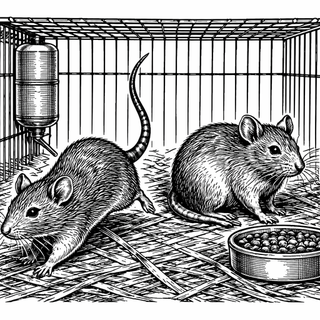
For a long time, the field ran these experiments mostly on males, on the well-worn excuse that females were "noisier" subjects. That excuse, it turns out, was a myth dressed as caution - a meta-analysis of nearly 5,000 data points found males were actually the more variable sex, especially in studies of learned fear (Kaluve et al., 2022; DOI: 10.1016/j.neubiorev.2022.104962).
When the Sexes Seemed to Disagree
Schuler and colleagues set up three flavors of the task: reward only, shock only, and a mixed paradigm where mice had to sort the sweet cues from the scary ones. Then they let a data-driven approach pick out the behaviors that actually signaled learning, rather than deciding in advance what learning should look like - which is the scientific equivalent of letting the witness talk instead of feeding her the lines.
And there it was, the classic plot point. In the single-valence tasks, males and females looked like they were learning differently. Females in the shock-only world froze more and seemed to blur the line between the dangerous cue and the harmless one. Males in the reward-only world took a different route to the same destination. A clean sex difference, the kind that launches a thousand follow-up grants.
Except the climax of this story is a quiet one.
The Twist Is in the Footsteps
When the researchers looked underneath the learning curves, the supposed difference dissolved into something far more ordinary: baseline exploration. Males, before any cue meant anything, simply wandered more. Females wandered less. That single trait - how much an animal pokes around an unfamiliar space - was enough to bend the entire learning trajectory.
The restless males, busy investigating, drifted onto a different path toward the cue-reward association. The more reserved females, holding still, were primed to freeze when the shocks arrived, and all that shock-driven stillness smeared over their ability to show they could tell one cue from another. The freezing wasn't confusion. It was a temperament being read as a transcript. (This tracks with older work showing female mice and males differ in plain old locomotion in a new room - Borbélyová et al., 2019; DOI: 10.33549/physiolres.934348.)
Here's the part that should make you sit up: in the mixed-valence task, where mice juggled reward and threat together, the sex difference vanished. Both sexes learned, clearly and comparably. Give the animals a richer problem, and their explorer-versus-homebody styles stopped masquerading as a difference in intelligence.
Why a Wandering Mouse Should Worry You (A Little)
This is the kind of finding that is humbling in the best way. If a behavioral quirk as innocent as "likes to walk around more" can counterfeit a sex difference in learning, then how many other published differences are really differences in mood, motion, or method? The brain didn't change. The room did, and the way we measured it did.
The practical lesson lands like clearing skies after a storm: single-valence tasks can flatter your hypothesis, while mixed-valence designs give a truer reading of what males and females actually do. It's a reminder that this whole enterprise of including both sexes isn't box-checking - it's the price of doing science that's actually rigorous (Shansky & Murphy, 2021; DOI: 10.1038/s41593-021-00806-8). For everything from depression to PTSD, where men and women genuinely differ, getting the baseline right is the difference between a real signal and a very confident shadow.
The mice were never confused. We were. And the fix was simply to watch them wander before we decided what their wandering meant.
References
- Schuler, H., Iyer, E. S., Siemonsmeier, G., Weinbaum, A. M., Vitaro, P., Shen, S., & Bagot, R. C. (2025). Sex-specific exploration accounts for differences in valence learning in male and female mice. eLife. DOI: 10.7554/eLife.108498 (PMID: 41385396)
- Kaluve, A. M., Le, J. T., & Graham, B. M. (2022). Female rodents are not more variable than male rodents: A meta-analysis of preclinical studies of fear and anxiety. Neuroscience & Biobehavioral Reviews. DOI: 10.1016/j.neubiorev.2022.104962
- Shansky, R. M., & Murphy, A. Z. (2021). Considering sex as a biological variable will require a global shift in science culture. Nature Neuroscience. DOI: 10.1038/s41593-021-00806-8
- Borbélyová, V., Janišová, K., Mysliveček, J., & Riljak, V. (2019). Sex-related differences in locomotion and climbing of C57Bl/6NTac mice in a novel environment. Physiological Research, 68(Suppl 3), S353-S359. DOI: 10.33549/physiolres.934348
Disclaimer: The image accompanying this article is for illustrative purposes only and does not depict actual experimental results, data, or biological mechanisms.