
When you were a kid and smelled pancakes before you saw the plate, your body probably started making plans before your brain had finished yelling syrup. That pre-meal flutter is not just nostalgia with butter on it. Your nervous system can cue your pancreas before blood sugar rises, like a drummer clicking the sticks before the first downbeat. A new Cell Reports study suggests that the opening rhythm depends on an unexpected player: pancreatic alpha cells, usually cast as insulin's pushy opposite number.
Wait, Alpha Cells Do What Now?
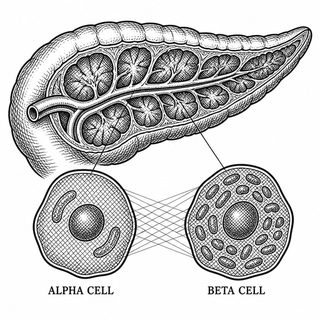
Most of us learn the pancreas as a tidy two-button control panel. Beta cells release insulin, which helps move sugar out of the blood. Alpha cells release glucagon, which tells the liver to put sugar back in. Simple, right? Biology disagreed and knocked over a cymbal stand.
Trimigliozzi and colleagues asked how insulin can rise before glucose does, especially during the cephalic phase of insulin release, the anticipatory insulin pulse triggered by taste, smell, and chewing. Your body is lowering blood sugar before the sugar has technically arrived, which is either elegant preparation or metabolic clairvoyance with snacks.
The team focused on two pre-glucose signals. One came from the nervous system, especially cholinergic signaling, the acetylcholine-flavored language of "rest and digest." The other came from immune signaling, especially interleukin-1 beta, or IL-1β, a cytokine better known for inflammation than for politely helping with lunch. Earlier work showed that IL-1β can modulate cephalic-phase insulin release through neuronal pathways Wiedemann et al., 2022.
The Glucagon Detour
Here is the twist: alpha cells were necessary for these immune and neuronal signals to trigger insulin secretion at fasting glucose levels. In mice, blocking cholinergic signaling prevented glucagon-stimulated insulin secretion. Removing alpha cells abolished the cephalic-phase insulin response. Islets from alpha-cell-deficient mice also failed to secrete insulin in response to IL-1β or muscarinic receptor activation.
That is a lot of cellular finger-pointing, but the plot resolves neatly. When the researchers added glucagon back, insulin secretion could be rescued. Glucagon seemed to act through glucagon receptors and GLP-1 receptors on beta cells, giving beta cells the biochemical nudge they needed. Alpha cells may be less like insulin's enemy and more like the bass player who makes the whole band sound better, then gets blamed for being too loud.
This fits a growing rethink of alpha cells. A 2024 Nature Communications study highlighted alpha-cell signaling pathways as possible therapeutic targets Liu et al., 2024. A 2025 Science Advances paper found that alpha cells can process proglucagon into both glucagon and GLP-1-related peptides, with human islet GLP-1 levels linked to insulin secretion Cui et al., 2025. Alpha cells, apparently, contain multitrack recording equipment.
Your Pancreas Takes Requests From the Brain
The cephalic phase is not some fringe biological kazoo solo. A major review in Physiological Reviews describes it as an early insulin response tied to head and mouth signals before absorbed glucose rises Langhans et al., 2023. The vagus nerve and parasympathetic system help carry these "food incoming" messages, and acetylcholine can act through muscarinic receptors. The new work adds a better arrangement: the brain does not simply shout at beta cells. It may ask alpha cells to pass the microphone.
The immune angle matters too. IL-1β usually has a reputation like a smoke alarm: useful, loud, and not what you want screaming all day. But in the right context, immune signals can participate in metabolism. The pancreas is not just a sugar calculator. It is listening to nerves, immune cues, local hormones, and probably the faint emotional soundtrack of the pastry aisle.
Why This Could Matter
If this result holds up in humans and disease models, it could sharpen how researchers think about early insulin failure in type 2 diabetes, obesity, and conditions where autonomic or inflammatory signaling goes sideways. Diabetes care already leans heavily on GLP-1 biology, as GLP-1 receptor agonists improve insulin secretion, reduce glucagon, slow gastric emptying, and affect appetite Zhao et al., 2024. This study does not say "go stimulate alpha cells" or "treat dinner smells as medicine," tempting as that sounds for bakeries. It says early insulin choreography may depend on alpha cells translating immune and neural cues into beta-cell action.
There are limits. Much of the mechanistic work used mice and isolated islets. Human islets differ from mouse islets in architecture, peptide processing, innervation, and probably in how much nonsense they will tolerate from experimentalists.
Still, the idea is beautiful in the way physiology often is: not a solo instrument, but a small ensemble tuning itself before the meal begins. The alpha cell, once filed under "raises glucose, please monitor," may be helping insulin arrive on beat. Biology loves a plot twist, especially when it has a backbeat.
References
Trimigliozzi KA, Wiedemann SJ, Ostinelli G, Rachid L, Méreau H, Böni-Schnetzler M, Rutter GA, Meier DT, Donath MY. Pancreatic α-cells integrate immune and neuronal stimuli for insulin secretion. Cell Reports. 2026;45(7):117586. https://doi.org/10.1016/j.celrep.2026.117586
Wiedemann SJ, Trimigliozzi K, Dror E, et al. The cephalic phase of insulin release is modulated by IL-1β. Cell Metabolism. 2022;34(7):991-1003.e6. https://doi.org/10.1016/j.cmet.2022.06.001
Langhans W, Watts AG, Spector AC. The elusive cephalic phase insulin response: triggers, mechanisms, and functions. Physiological Reviews. 2023;103(2):1423-1485. https://doi.org/10.1152/physrev.00025.2022
Liu L, El K, Dattaroy D, et al. Intra-islet α-cell Gs signaling promotes glucagon release. Nature Communications. 2024;15. https://doi.org/10.1038/s41467-024-49537-x
Cui C, Leander DC, Gray SM, et al. α cells use both PC1/3 and PC2 to process proglucagon peptides and control insulin secretion. Science Advances. 2025;11(38). https://doi.org/10.1126/sciadv.ady8048
Zhao X, Wang M, Wen Z, et al. Glucagon-like peptide-1 receptor: mechanisms and advances in therapy. Signal Transduction and Targeted Therapy. 2024. https://doi.org/10.1038/s41392-024-01931-z
Disclaimer: The image accompanying this article is for illustrative purposes only and does not depict actual experimental results, data, or biological mechanisms.