
The problem with studying spinal muscular atrophy is that the disease does not just weaken muscles - it keeps changing the rules while children are still trying to grow, play, and do basic kid things like reach for cereal or launch themselves dramatically onto a couch. That makes treatment a bit like repairing a roller coaster while it is still carrying passengers. And now, researchers are testing a wearable robot that helps children with SMA generate more strength. Which, yes, sounds like the opening scene of a very wholesome cyborg movie.
First: what is SMA, and why is lifting your arm such a big deal?
Spinal muscular atrophy, or SMA, is a genetic disease that damages motor neurons - the nerve cells in the spinal cord that tell muscles what to do. When those neurons falter, muscles weaken and shrink from lack of use. Thanks to newer treatments that boost survival motor neuron protein, many children with SMA are living longer and doing better than in the past. That is great news. It also creates a very 2020s problem: kids may survive and stabilize, but they still need help with movement, strength, and day-to-day independence.
And upper-limb function really matters. We are not talking only about waving heroically into the middle distance. We are talking about eating, using a tablet, brushing teeth, playing, and doing schoolwork. Basically, all the little actions that quietly run your day while your brain pretends it is focused on higher ideals.
Enter the wearable robot
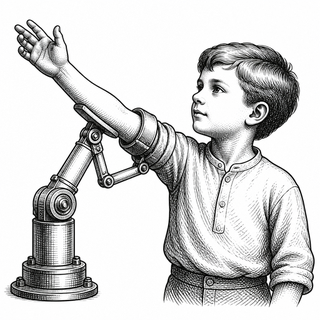
The Nature news piece by Liam Drew describes a wearable robotic device designed to boost strength in children with SMA by assisting arm movement [1]. Think less Iron Man, more gentle backstage crew member. The device supports movement so kids can do tasks that would otherwise be tiring or impossible.
That matters because SMA care is shifting. Drug therapies now target the biology of the disease, but rehabilitation and assistive technology target the lived experience. You can rescue neurons and still have a child who struggles to lift a cup. Biology is only part of the ride - function is the part families actually feel every day.
Wearable robotics, including soft exoskeletons and powered orthoses, aim to bridge that gap. They can reduce effort, improve range of motion, and potentially encourage more practice of useful movements. In neurorehab, repetition is king. Or at least the annoying middle manager who keeps CC-ing everybody. The more a child can move comfortably, the more chances they have to build skill, confidence, and endurance.
Why this is actually a big deal
Here is the intriguing part: for children with neuromuscular disease, even small boosts can have outsized effects. A modest improvement in shoulder or elbow movement can translate into feeding yourself, drawing, using communication tools, or playing without constant help. That is not flashy in a movie-trailer way. It is better. It is real life.
This work also points to a larger shift in neuroscience and medicine. We are getting better at combining treatments. Not drug versus device. Drug plus device. Molecular therapy plus rehab. Gene-targeted medicine plus engineering. The brain, spinal cord, and muscles are not a neat little vending machine where one button fixes everything. They are more like a theme park built by raccoons - complicated, interconnected, and occasionally alarming.
If these robotic systems keep proving useful, they could become part of long-term care for children who now have far more therapeutic possibilities than patients did a decade ago.
The catch - because there is always a catch
Before we all start ordering robot sleeves online, there are real challenges.
First, devices have to fit children comfortably and adapt as they grow. Pediatric rehab technology cannot be bulky, frustrating, or exhausting to put on. If the setup feels like assembling IKEA furniture during a fire drill, families will not use it.
Second, researchers need solid clinical evidence. Does the robot help only during use, or does it lead to lasting gains in strength, coordination, or participation? Does it reduce fatigue? Improve quality of life? Work at home, not just in a lab where everyone is behaving unusually well because clipboards are present?
Third, access matters. Fancy robotics can become one more cool thing that exists mainly for well-funded centers unless cost, training, and distribution get real attention.
The bigger picture in SMA research
Recent reviews highlight how dramatically SMA care has changed with disease-modifying therapies, but they also stress persistent unmet needs in motor function, rehabilitation, and long-term support [2,3]. Other papers argue that assistive and adaptive technologies should be integrated more deliberately into neuromuscular care, especially as treated children grow into new functional stages [4,5].
So this wearable robot is not a gimmick. It fits into a serious and expanding conversation: once you help children survive and preserve motor neurons, how do you help them live more fully in their bodies?
That is the question hanging over this whole field, and honestly it is a good one. Medicine used to be thrilled just to keep the roller coaster from flying off the tracks. Now it also wants to make the ride smoother, safer, and a lot more fun.
References
-
Drew L. Wearable robot boosts strength of children with spinal muscular atrophy. Nature. 2026. doi:10.1038/d41586-026-01573-x
-
Kirschner J, Butoianu N, Goemans N, et al. European ad-hoc consensus statement on gene replacement therapy for spinal muscular atrophy. Eur J Paediatr Neurol. 2020;28:38-43. doi:10.1016/j.ejpn.2020.07.001 | PMCID: PMC7496278
-
Mercuri E, Deconinck N, Mazzone ES, et al. Safety and efficacy of nusinersen in later-onset spinal muscular atrophy: final results of the phase 3 CHERISH study. Muscle Nerve. 2021;63(4):547-556. doi:10.1002/mus.27187
-
Trucco F, Pedemonte M, Fiorillo C, et al. Rehabilitation in spinal muscular atrophy: a systematic review of the literature. Neuromuscul Disord. 2024;34(1):3-15. doi:10.1016/j.nmd.2023.10.012
-
Wang Y, de Groote F, Meyns P, et al. Wearable robotic exoskeletons for pediatric neuromotor rehabilitation: a systematic review. J Neuroeng Rehabil. 2023;20:109. doi:10.1186/s12984-023-01235-0 | PMCID: PMC10545678
Disclaimer: The image accompanying this article is for illustrative purposes only and does not depict actual experimental results, data, or biological mechanisms.