
The adolescent who tries a beer at fifteen does not, in that moment, decide to become a person who drinks. No switch flips. No future self signs a contract. There is no dramatic fork in the road with a glowing sign reading "this way to trouble." And yet, when researchers follow hundreds of young people for years, the roads diverge anyway. Some drift toward heavy use, some peak early and pull back, some never really start. The strange and slightly unsettling finding is that you can see hints of which road a brain is on before the person has walked very far down it.
I have been thinking about this because of a study I cannot quite stop turning over. A team tracked 802 young people, ages 12 to 30, across more than 6,000 visits, which is the kind of patience that makes the rest of us look like we give up on everything by Tuesday. They were trying to answer a question that sounds simple and is not: why do some teenagers slide into trouble with substances while others, sitting in the same classrooms with the same questionable judgment, do not?
The Brain Paints in Iron
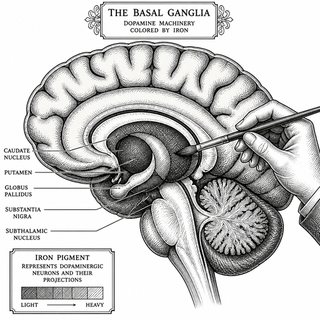
Here is the part that surprised me. One of the strongest clues turned out to be iron. Not the kind in your spinach. The kind quietly accumulating in a deep cluster of brain regions called the basal ganglia, the part of the brain that handles motivation, habit, and the eternal internal argument between "I want that" and "maybe don't."
Tissue iron sounds like rust, like something gone wrong. It is actually closer to pigment. Iron is a required cofactor for the enzyme that builds dopamine, the brain's currency of wanting and reward. Where there is more tissue iron, there tends to be healthier dopamine machinery underneath. Researchers can read these iron levels with an ordinary MRI, no needles, which means they can watch the brain lay down its pigment year after year, the way you might watch an artist slowly build up the darker tones in a sketch (Larsen et al., 2024, PMC11494441).
And across adolescence, that pigment is supposed to deepen. Iron rises. Inhibitory control, the brain's ability to not do the thing, gets stronger. Impulsivity, the brain's ability to absolutely do the thing immediately, fades. The whole portrait matures.
When the Picture Develops Too Slowly
The young people who ran into the most trouble with substances, especially the ones who peaked early in the teenage years, tended to share a quiet signature: lower tissue iron, higher impulsivity, weaker inhibitory control. Their dopamine systems looked, in a sense, like they were sketched a little faintly during the years that mattered most (Parr et al., 2026).
This is not a story about bad kids. It is closer to a story about timing. If the reward system is running a touch under-resourced precisely when the world starts offering chemical shortcuts to feeling good, you can imagine why a faint dopamine portrait might reach for a brighter color. The same logic shows up in work on cannabis, where lower subcortical tissue iron tracks with heavier adolescent use (Neuropsychopharmacology, 2026).
It also fits decades of less glamorous findings. Inhibitory control matures slowly and unevenly, and the teens whose brakes come in late are more vulnerable to substance problems (Tervo-Clemmens et al., 2020, PMC7038454). The new piece is the biology underneath the brakes: not just behavior, but the dopaminergic scaffolding that behavior is painted on.
Why This Matters More Than the Usual "Just Say No"
For most of my life, the public conversation about teenage substance use has been roughly as nuanced as a fire alarm. This research quietly suggests something kinder and more useful. Vulnerability is not a moral failing or a fixed destiny. It is, partly, a developmental window where some brains are still filling in their reward circuitry, and that window is observable.
If you can see a slow-developing portrait early, you can imagine focusing prevention where it would actually help, instead of spraying it indiscriminately at every fifteen-year-old in the building. Adolescence stops being the problem and starts being the opportunity.
None of this is a verdict on any one person. Iron is one brushstroke in an enormous painting that also includes family, stress, friends, and plain luck. But it is a brushstroke we can finally see while the paint is still wet, and that is more than we had before.
Disclaimer: The image accompanying this article is for illustrative purposes only and does not depict actual experimental results, data, or biological mechanisms.
References
- Parr, A. C., Ojha, A., Petrie, D. J., Calabro, F. J., Tervo-Clemmens, B., Foran, W., Fitzgerald, D., Tapert, S. F., Nooner, K., Thompson, W., Goldston, D. B., Clark, D., & Luna, B. (2026). Developmental variation in basal ganglia tissue iron, neurocognitive functioning, and impulsivity is associated with substance use trajectories in youth. Nature Communications. https://doi.org/10.1038/s41467-026-73611-1
- Larsen, B., et al. (2024). Multivariate and regional age-related change in basal ganglia iron in neonates. PMCID: PMC11494441
- The role of subcortical brain tissue iron as an indicator of dopamine neurophysiology in adolescent cannabis use. (2026). Neuropsychopharmacology. https://doi.org/10.1038/s41386-026-02444-9
- Tervo-Clemmens, B., et al. (2020). Adolescent development of inhibitory control and substance use vulnerability: A longitudinal neuroimaging study. Developmental Cognitive Neuroscience. PMCID: PMC7038454