
I have good news and bad news about the little molecular machine keeping every one of your neurons in the game.
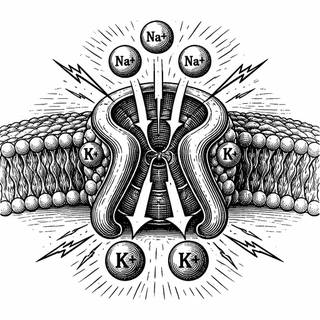
Good news: the sodium-potassium pump, the unsung equipment manager working the sidelines of every nerve cell you own, is doing exactly what it should. It hauls three sodium ions out for every two potassium ions it drags in, resetting the field after every play so the next signal can fire clean. Bad news: that 3-for-2 swap is not an even trade. It moves a net positive charge out the door every cycle, which means the pump is not a neutral referee. It is quietly nudging the scoreboard. And in cells that fire at a blistering pace, that quiet nudge can throw off the whole offense.
That is the headline from a slick computational study in eLife by Liz Weerdmeester, Jan-Hendrik Schleimer, and Susanne Schreiber, who built a mathematical model to ask a question most of us never thought to ask: what happens when your most reliable role player starts subtly changing the rules of the game?
The Pump Has a Vote, and Nobody Asked For It
Here is the thing about being "electrogenic." Because the pump exports more positive charge than it imports, it generates its own little hyperpolarizing current. Think of a defensive lineman who is supposed to just hold his gap but keeps drifting half a step into the backfield. Useful for stopping a runaway play, sure. The pump genuinely helps slam the brakes on overexcited cells.
But the harder a cell works, the more sodium piles up inside, and the harder the pump cranks. The harder the pump cranks, the more it hyperpolarizes the cell, which makes it less likely to fire. So you get this beautiful, maddening paradox: a neuron burning enormous energy yet going quiet, like a star player gassing himself on defense until he has nothing left for the shot clock. The pump that runs on up to three-quarters of a neuron's entire energy budget can end up benching the very cell it serves (Pulver & Griffith, Frontiers in Physiology, 2014; PMC4274886).
Enter the Electric Fish, the Ultimate Two-Minute Drill
To stress-test the idea, the team turned to weakly electric fish. These are the showboats of the river. They generate an electric organ discharge from specialized cells called electrocytes, modified muscle cells that fire action potentials hundreds of times per second to send signals, find prey, and basically text other fish in a language made of voltage (Markham, Journal of Experimental Biology, 2013; doi:10.1242/jeb.082396).
When a fish suddenly changes its discharge rate to fire off a communication signal, that is a no-huddle audible at full speed. And the model showed the electrogenic pump fumbles the timing. The activity-dependent drag shifts the cell's baseline firing right when precision matters most, smearing the signal and knocking the network out of sync. The cells try to compensate with sodium leak channels, but that is like running the heater and air conditioning at once: equal charges flowing opposite directions, burning fuel to stand still. Energetically, it is a turnover.
The Adjustment at Halftime
So how does a cell win anyway? The researchers found a few coaching moves. Buffering potassium outside the cell helps. Strong synaptic coupling between cells helps them stay on the same page. But the slickest play of all is a pump whose strength depends on voltage itself. A voltage-dependent pump can ease off at exactly the wrong moments, dodging both the excitability slump and the wasted energy. It is the difference between a player who runs one speed all game and one who reads the situation and adjusts.
The bigger point, and why this matters beyond fish: the pump's electrogenicity is "an additional axis of vulnerability." When this machine misfires, you get real disease. Mutations in the neuronal pump gene ATP1A3 cause rapid-onset dystonia-parkinsonism and alternating hemiplegia of childhood, and pump dysfunction shows up in epilepsy and migraine (Calderon-Garciduenas et al., Frontiers in Cellular Neuroscience, 2023; PMC9972585). The role player, it turns out, can lose you the season.
Why You Should Care
We have spent decades treating the sodium-potassium pump as background staff, the guy who refills the water cooler. This work argues it is a genuine player in computation, with its own bias baked into the physics. If we want to understand why fast-firing brain circuits glitch in disease, we may need to stop ignoring the pump's vote on every play.
Not bad for a molecule that just wanted to move some ions around.
Disclaimer: The image accompanying this article is for illustrative purposes only and does not depict actual experimental results, data, or biological mechanisms.
References
-
Weerdmeester L, Schleimer J-H, Schreiber S. The electrogenicity of the Na+/K+-ATPase poses challenges for computation in highly active spiking cells. eLife. 2025. doi:10.7554/eLife.103781. PMID: 41335475; PMCID: PMC12674616.
-
Pulver SR, Griffith LC. The sodium-potassium pump is an information processing element in brain computation. Frontiers in Physiology. 2014;5:472. doi:10.3389/fphys.2014.00472. PMCID: PMC4274886.
-
Markham MR. Electrocyte physiology: 50 years later. Journal of Experimental Biology. 2013;216(13):2451-2458. doi:10.1242/jeb.082396.
-
Calderon-Garciduenas L, et al. The role of ATP1A3 gene in epilepsy: We need to know more. Frontiers in Cellular Neuroscience. 2023;17:1143956. doi:10.3389/fncel.2023.1143956. PMCID: PMC9972585.