
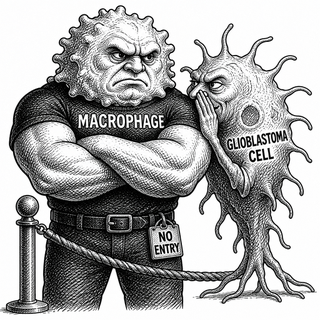
If one immune cell in a glioblastoma is a bouncer, and half the tumor is packed with bouncers, what are the odds the party is about to get weird? Alarmingly high. This brain cancer remodels the room, dims the oxygen, hires macrophages as security, then whispers, "No T cells on the list."
The new study from Li and colleagues in The Journal of Clinical Investigation asks why immune cells near dead zones inside glioblastoma start acting less like defenders and more like the tumor's clingy situationship. Their answer: podoplanin, or PDPN, on glioma cells grabs CLEC5A on macrophages, lighting up Syk-JAK-STAT3 signaling and pushing those macrophages toward immune suppression (Li et al., 2026).
The Dead Zone Is Not Dead Boring
Glioblastoma often contains necrotic regions, patches where tumor tissue has died because the fast-growing mass outstrips its oxygen supply. Around those patches sits the peri-necrotic niche: the worst table at the restaurant, with low oxygen, bad lighting, suspicious smells, and everyone influential seated there.
That "everyone" includes tumor-associated macrophages, or TAMs. Macrophages normally clean up messes and coordinate immune responses. In tumors, though, they can be reprogrammed. Instead of yelling "intruder," they mutter, "Maybe we should all calm down," while cancer steals the silverware.
That is a big deal because TAMs can dominate the GBM immune landscape, sometimes accounting for up to half of the tumor mass and driving therapy resistance (Khan et al., 2023).
Meet CLEC5A, the Bad Influence Receptor
The study found that CLEC5A was strongly linked to poor clinical outcome among immune-related genes in GBM. Even more suspiciously, it showed up preferentially in hypoxic, peri-necrotic TAMs. That is like finding your ex's hoodie in the most chaotic corner of the apartment.
When the researchers increased CLEC5A activity, macrophages shifted toward an immunosuppressive phenotype. When they removed CLEC5A from bone marrow-derived immune cells in mouse GBM models, tumors slowed, immunosuppression eased, and the animals lived longer. The tumor's immune fog machine started running out of juice.
The mechanism is the fun part, assuming your definition of fun includes receptor-ligand binding. Glioma cells displayed PDPN. PDPN engaged CLEC5A on macrophages. CLEC5A triggered Syk, JAK, and STAT3 signaling. STAT3 is already tied to GBM growth and immune suppression, so seeing it here is less "plot twist" and more "of course he texted back" (Fu et al., 2023).
Why Immunotherapy Keeps Getting Ghosted
Glioblastoma has resisted many immunotherapies that work in other cancers. One reason is location: the brain has unique immune rules and delivery barriers. Another is personality: GBM is heterogeneous, invasive, and about as cooperative as a dinner-planning group chat.
But the tumor microenvironment may be one of the biggest reasons. Reviews describe GBM as hypoxic, immunosuppressive, and packed with feedback loops that protect tumor survival (Bayona et al., 2025; Weller et al., 2024). Hypoxia can also interfere with cytotoxic T cell activity (Yekula et al., 2024). Translation: the tumor turns down the oxygen and everyone starts making worse decisions.
That makes this study useful because it names a specific conversation in a specific neighborhood: PDPN on glioma cells talking to CLEC5A on peri-necrotic macrophages. "Fix the immune system" is a bumper sticker. "Interrupt PDPN-CLEC5A-Syk-STAT3 signaling" is at least a therapeutic address.
A Possible Way to Ruin the Tumor's Date Night
The researchers also tested pharmacologic Syk inhibition. Blocking Syk suppressed glioma growth, reduced TAM infiltration and polarization, eased immunosuppression, and prolonged survival in vivo. That does not mean a Syk inhibitor is ready to waltz into the clinic wearing sunglasses. These were preclinical models, and GBM makes promising ideas sit through awkward second dates.
Still, the logic is attractive. If TAMs are being coached near necrosis, targeting that signal may re-open the tumor to immune attack. The field is moving from "delete all macrophages" toward "reprogram the specific ones causing trouble," which feels less like carpet bombing and more like finally blocking the correct toxic contact.
If this pathway holds up in human studies, clinicians might eventually combine a CLEC5A/Syk-directed therapy with radiation, chemotherapy, checkpoint blockade, vaccines, or cell therapies. Not a magic wand. More like taking the tumor's fake mustache off so the immune system recognizes the guy causing problems all season.
The Takeaway
This paper gives glioblastoma's peri-necrotic niche a clearer script. Dead tumor regions are active neighborhoods where low oxygen, tumor cells, and macrophages negotiate immune silence. PDPN and CLEC5A appear to be part of that negotiation, with Syk-STAT3 signaling acting like the group chat where bad plans become policy.
If future work confirms the pathway in patients and finds a safe way to interrupt it, GBM treatment may gain a new angle: not only attacking tumor cells, but breaking the tumor's ability to sweet-talk immune cells into doing its emotional labor.
References
- Li J, Wang X, Tong L, et al. The Peri-necrotic Niche of Glioblastoma Drives Tumor-associated Macrophage Polarization and Immunosuppression via Podoplanin-mediated CLEC5A Activation. Journal of Clinical Investigation. 2026. DOI: 10.1172/JCI199228. PMID: 42228429.
- Khan F, Pang L, Dunterman M, et al. Macrophages and microglia in glioblastoma: heterogeneity, plasticity, and therapy. Journal of Clinical Investigation. 2023;133(1):e163446. DOI: 10.1172/JCI163446.
- Bayona C, Randelovic T, Ochoa I. Tumor microenvironment in glioblastoma: The central role of the hypoxic-necrotic core. Cancer Letters. 2026;639:218216. DOI: 10.1016/j.canlet.2025.218216.
- Weller M, Wen PY, Reifenberger G, et al. Glioma. Nature Reviews Disease Primers. 2024;10:34. DOI: 10.1038/s41572-024-00524-y.
- Fu W, Hou X, Dong L, Hou W. Roles of STAT3 in the pathogenesis and treatment of glioblastoma. Frontiers in Cell and Developmental Biology. 2023;11:1098482. DOI: 10.3389/fcell.2023.1098482.
- Yekula A, et al. Hypoxia within the glioblastoma tumor microenvironment: a master saboteur of novel treatments. Frontiers in Immunology. 2024;15:1384249. DOI: 10.3389/fimmu.2024.1384249.
Disclaimer: The image accompanying this article is for illustrative purposes only and does not depict actual experimental results, data, or biological mechanisms.