
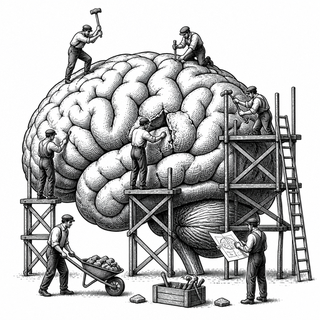
For a long time, science treated the maternal brain a bit like the family minivan after the first kid arrives: obviously changed, probably sticky, but not something anyone bothered to inspect closely. Now a new Trends in Neurosciences piece asks a wonderfully specific question - what happens when the brain goes through pregnancy again? Not metaphorically. Not spiritually. Literally, structurally, biologically: does a second pregnancy reshape the brain the way a first one does? And the answer seems to be: yes, the renovation crew comes back.
Motherhood is not a one-season show
Researchers have spent the last several years showing that first-time pregnancy is linked to changes in brain structure, especially in regions involved in social thinking, emotion, and self-processing. Think of it this way: the brain is not "breaking." It is remodeling. Less like a collapse, more like taking down a wall so the kitchen and living room can finally talk to each other.
The new article by Perrykkad, Siddiqui, and Jamadar discusses findings from Straathof and colleagues suggesting that a second pregnancy also brings measurable brain change, rather than the brain shrugging and saying, "Been there, done that, already bought the tiny socks." That matters because a lot of motherhood research quietly centers first pregnancies, as if the sequel could not possibly be interesting. Which is rude to sequels, honestly. The Godfather Part II would like a word.
Wait - brain changes? In a good way?
Yes, brain changes. And no, that does not automatically mean damage.
One of the most discussed findings in this area is that pregnancy can be associated with changes in gray matter volume in specific brain networks. That sounds alarming if you hear "volume loss" and imagine your brain leaking out like soup. But the better way to think about it is fine-tuning. During development, the brain often gets more efficient by pruning and reorganizing. Parenthood may involve a similar kind of specialization - especially in circuits that help a mother notice, interpret, and respond to social cues from a baby.
That idea lines up with earlier work showing long-lasting postpartum brain changes and altered responses to infant-related signals. In other words, the maternal brain is not a passive bystander. It is more like a sleep-deprived startup doing emergency rewiring while the boss keeps screaming in vowels.
Why a second pregnancy is such a big deal
A second pregnancy lets researchers ask a much smarter question than "does motherhood change the brain?" The better question is: how repeatable is this process, and what kind of plasticity are we actually looking at?
If the brain changes again during a second pregnancy, that suggests matrescence - the transition into motherhood - is not a one-off event with a ceremonial ribbon-cutting. It may be a recurring biological process, shaped by hormones, caregiving demands, prior experience, and changes in identity.
And that "identity" part is not fluff. The paper explicitly includes the sense of self, which is refreshing because becoming a parent does not just change your calendar and laundry volume. It can change how you think, what grabs your attention, and where your mental boundaries live. Many mothers describe this shift before science has neat language for it. Research is finally catching up and saying: no, you did not imagine it, your brain was in fact doing construction at odd hours.
The part science is still bad at
Here is the awkward bit: we still do not have enough large, longitudinal studies following people before, during, and after multiple pregnancies. A lot of the field relies on small samples, different imaging methods, and wildly different definitions of cognition and postpartum timing. That makes comparisons messy.
There is also the classic problem that "pregnancy" does not happen in a vacuum. Sleep loss, stress, breastfeeding, depression, social support, partner involvement, prior births, and sheer logistical chaos all matter. If you want to know what changes the brain, it helps to note whether the participant has slept since 2019.
So this line of work is exciting, but it is also a reminder that maternal neuroscience has been underbuilt for years. Which is strange, considering reproduction is not exactly a niche hobby.
Why this could matter in real life
If these findings hold up, they could help reframe how clinicians, families, and mothers themselves think about cognitive and emotional changes around pregnancy. Instead of reducing everything to the lazy cliché of "baby brain," we might talk more precisely about adaptive plasticity, shifting priorities, and the brain's way of preparing for caregiving.
That could eventually improve postpartum care, mental health screening, and support for mothers having second or later children - a group that often gets less attention because everyone assumes they already know the drill. But knowing how to install a car seat does not mean your neurobiology clocks out.
It may also help explain why some changes feel familiar in a later pregnancy, while others do not. The brain, like a toddler, rarely follows instructions in a straight line. It learns, improvises, and occasionally throws the whole schedule into the sea.
The bigger takeaway
This paper adds to a growing view of pregnancy as a period of serious adult neuroplasticity. Not a side note. Not a hormonal footnote. A major brain transition.
That is worth paying attention to because motherhood is often discussed either in syrupy clichés or in panic mode. The neuroscience offers a third option: motherhood as a real biological transformation, with structural brain changes, cognitive shifts, and a moving sense of self that deserves careful study rather than hand-waving.
Your brain does not just survive pregnancy. It adapts. And apparently, if pregnancy happens again, the adaptation may not be over. The sequel has plot.
References
-
Perrykkad K, Siddiqui MN, Jamadar S. Transformation, again? Impact of a second pregnancy on the brain, cognition, and sense of self. Trends Neurosci. 2026;S0166-2236(26)00075-0. doi:10.1016/j.tins.2026.04.005
-
Hoekzema E, Barba-Müller E, Pozzobon C, et al. Pregnancy leads to long-lasting changes in human brain structure. Nat Neurosci. 2017;20(2):287-296. doi:10.1038/nn.4458
-
Martínez-García M, Paternina-Die M, Pretus C, et al. The mother brain in the postpartum period: a systematic review of structural MRI studies. Neurosci Biobehav Rev. 2021;129:36-49. doi:10.1016/j.neubiorev.2021.07.018
-
Orchard ER, Rutherford HJV, Holmes AJ, et al. Pregnancy and the human brain: a systematic review of neuroimaging studies. Biol Psychiatry. 2023;93(1):e1-e14. doi:10.1016/j.biopsych.2022.08.020
-
Luders E, Kurth F. The neuroanatomy of pregnancy and postpartum: a systematic review. Trends Cogn Sci. 2020;24(8):617-629. doi:10.1016/j.tics.2020.05.004
Disclaimer: The image accompanying this article is for illustrative purposes only and does not depict actual experimental results, data, or biological mechanisms.