
Consumer exoskeletons are having a very 2026 moment: Wired has been testing hiking boosters, CES has been parading wearable motors, and the future apparently wants us all to arrive at brunch looking like bargain Iron Man. But the best exoskeleton news this month is not about making healthy adults slightly less theatrical on stairs. It is about six children with spinal muscular atrophy using a knee-worn robot to build strength after gene therapy.
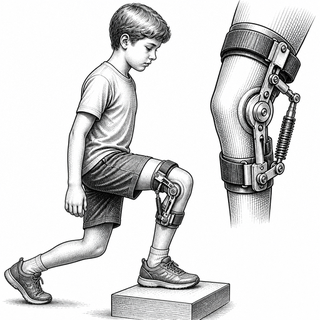
The Nature news item by Liam Drew covers a new Nature study from Yuebing Li and colleagues: a lightweight, 0.96 kg wearable robot designed for children with spinal muscular atrophy type II (SMA type II) [1,2]. Instead of simply moving the child's leg for them, the device adds controlled resistance during knee exercises. In gym terms, it is less "chauffeur" and more "personal trainer with excellent manners."
SMA: When the Wiring Fades
Spinal muscular atrophy is a genetic neuromuscular condition, usually caused by problems with the SMN1 gene. That gene helps make survival motor neuron protein, which motor neurons need if they are going to keep sending useful messages from the spinal cord to muscles. When motor neurons falter, muscles weaken and waste. It is not laziness. It is the body's movement department losing staff, paperwork, and eventually the office lights.
Modern SMA care has changed dramatically. Treatments such as nusinersen, risdiplam, and onasemnogene abeparvovec can raise SMN protein or replace the missing gene function, and earlier treatment often means better motor outcomes [3,4]. That is the good news. The awkward bit, because medicine always keeps one awkward bit in its pocket, is that saving motor neurons does not automatically rebuild every weakened muscle or restore every motor skill.
So rehabilitation matters. After the biological fire is partly under control, someone still has to rebuild the house.
The Robot Does Not Carry You. It Argues With Your Knee.
Li and colleagues built a portable isokinetic training robot for knee rehabilitation. "Isokinetic" means the movement happens at a controlled speed while resistance adapts. That lets children work against a manageable challenge without the device suddenly becoming a medieval contraption with a battery pack.
The trial was tiny: six children aged 6 to 10 with SMA type II. They trained for six weeks with the robot, while researchers measured function, joint mechanics, muscle size, and nerve signalling. The results were striking, with the obvious caveat that six participants is not a crowd. It is barely a dinner reservation.
After training, the children improved their ability to move from sitting to standing with hands on knees and without external support. Knee joint function rose sharply: peak torque increased by 130%, range of motion by 51%, and work by 97% [2]. MRI measurements suggested quadriceps growth, including a 19% increase in muscle volume, and femoral nerve tests showed a 19% increase in compound muscle action potential [2]. Translation: muscles looked bigger, knees produced more useful force, and the nerve-muscle conversation got louder.
Most intriguingly, the gains persisted after the children stopped the robot training and returned to conventional physiotherapy routines [2]. That is the part that makes rehabilitation scientists sit up, spill a little tea, and pretend they meant to do that.
Why Resistance May Be the Point
Many assistive robots help people move in the moment. That can be valuable, especially when walking or standing is otherwise impossible. But assistance alone can become a bit like having someone finish your crossword: technically progress, spiritually suspicious.
This robot takes a different approach. It makes the child do active work against resistance, scaled to what they can manage. That matters because muscles and motor circuits respond to challenge. Earlier pediatric exoskeleton research in SMA has suggested possible improvements in strength, range of motion, fatigue, and function, though much of the evidence has come from small case studies or case series [5,6]. The new Nature study adds a more detailed physiological picture: torque, MRI muscle measures, nerve conduction, and sit-to-stand performance all pointing in the same encouraging direction.
Outside experts were pleased but cautious. Science Media Centre Spain noted the study's novelty and its mix of mechanical, imaging, electrophysiological, and functional measures, while also emphasizing the extremely small sample size and lack of a randomized control group [7]. That is not pessimism. That is science wearing its seatbelt.
The Real Promise: After the Miracle Headline
Gene therapy and other SMA drugs have shifted expectations. Children who once might not have survived infancy or gained motor milestones can now have new possibilities. But possibility is not the same as strength, endurance, independence, or standing up without turning the room into a group project.
If these findings hold up in larger, controlled trials, wearable resistance robots could become part of the next phase of SMA care: not just preserving life, but helping children build usable movement. The device is light, targeted, and potentially suitable for repeated training beyond highly specialized clinics. Rehabilitation works best when it is not treated like a rare ceremonial event.
Still, this is early. We need larger studies, longer follow-up, comparisons with conventional physiotherapy, home-use data, safety monitoring, and clarity about which children benefit most. The future may involve gene therapy, drugs, robotics, and physiotherapy working together - less silver bullet, more well-organized committee. Annoying, perhaps, but committees have done worse.
For now, the study offers a quietly exciting idea: after modern SMA treatments rescue some of the nervous system's capacity, the right kind of robotic training may help children turn that capacity into strength. Not a robot suit that replaces the child's effort. A robot that asks the knee to try again, then makes the attempt count.
References
- Drew L. Wearable robot boosts strength of children with spinal muscular atrophy. Nature. 2026. https://doi.org/10.1038/d41586-026-01573-x
- Li Y, Ren J, Shu T, Yuan F, Feng Y, et al. Spinal neuromotor rehabilitation using a portable isokinetic training robot. Nature. Published May 20, 2026. https://doi.org/10.1038/s41586-026-10642-0
- Yeo CJJ, Tizzano EF, Darras BT. Challenges and opportunities in spinal muscular atrophy therapeutics. Lancet Neurology. 2024;23(2):205-218. https://doi.org/10.1016/S1474-4422(23)00419-2
- Hjartarson HT, Nathorst-Boos K, Sejersen T. Disease modifying therapies for the management of children with spinal muscular atrophy (5q SMA): an update on the emerging evidence. Drug Design, Development and Therapy. 2022;16:1865-1883. https://doi.org/10.2147/DDDT.S214174
- Cumplido-Trasmonte C, Ramos-Rojas J, Delgado-Castillejo J, et al. Effects of ATLAS 2030 gait exoskeleton on strength and range of motion in children with spinal muscular atrophy II: a case series. Journal of NeuroEngineering and Rehabilitation. 2022;19:75. https://doi.org/10.1186/s12984-022-01055-x
- Garces E, Puyuelo G, Sanchez-Iglesias I, et al. Using a robotic exoskeleton at home: an activity tolerance case study of a child with spinal muscular atrophy. Journal of Pediatric Nursing. 2023;68:e95-e101. PMID: 36192285. https://pubmed.ncbi.nlm.nih.gov/36192285/
- Science Media Centre Spain. A robotic device aids neuromuscular recovery in children with spinal muscular atrophy. May 20, 2026. https://sciencemediacentre.es/en/robotic-device-aids-neuromuscular-recovery-children-spinal-muscular-atrophy
Disclaimer: The image accompanying this article is for illustrative purposes only and does not depict actual experimental results, data, or biological mechanisms.