
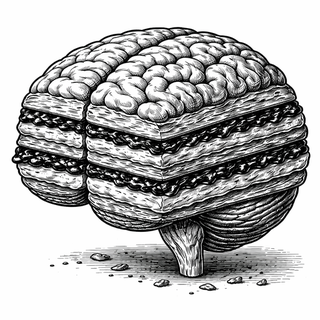
The weird clue in this paper is the title: "interlaminar signal flow" sounds less like science and more like plumbing for a layer cake. Which is not a terrible metaphor. Zhu and colleagues used Neuropixels probes in macaque primary visual cortex, or V1, to ask how signals move between layers when the brain decides which side of an edge belongs to an object Zhu et al., 2026. I am eating toast while writing this, so yes, we are calling this cortical mille-feuille.
The Edge Is Not the Whole Meal
V1 has a reputation as the brain's early visual prep cook. Light hits your eyes, signals pass through the thalamus, and V1 chops the world into edges, orientations, contrasts, and locations. Very chef with a ruler.
But vision is not just detecting an edge. If you see a dark line between a mug and the table, your brain has to decide: mug, table, shadow, or evidence that you should wash dishes more often? That problem is border ownership. The visual system assigns a border to the object that "owns" it, separating figure from background.
The new study focuses on a sneaky version of this problem. The object information sat outside the neuron's classical receptive field, the tiny patch of visual space that usually gets that neuron excited. Yet neurons still showed border ownership modulation. In kitchen terms, V1 was tasting garlic from across the room.
The Cortex Has Floors, and They Gossip
V1 is layered. Some layers receive incoming visual signals, while others handle horizontal connections or feedback from higher visual areas. The old cartoon says information marches upward: retina, thalamus, V1, fancier cortex, recognition. Nice story. Too neat. The brain saw that flowchart and spilled soup on it.
Zhu's team recorded large local populations of V1 neurons while stimuli probed either the classical receptive field or the nonclassical surround. Neurons in one cortical column tended to prefer the same side of an object outside the classical receptive field. Nearby neurons were not just detecting line bits, they were leaning together about object layout.
Then comes the more flavorful part. Cross-correlations between neurons in different layers changed depending on whether the stimulus hit the classical receptive field or the contextual surround. Stronger border ownership modulation also went along with more information flow from feedback/horizontal layers toward input layers. Translation: the layers that know more about the wider scene seemed to season the layers handling incoming visual ingredients.
Why This Is Such a Good Sauce
Vision feels instant, but it is more like reduction sauce: the brain simmers raw input with memory, context, expectation, and neighborhood gossip until something coherent thickens. This paper gives a circuit-level hint about how that happens inside V1. It asks which cortical layers are talking, in what direction, and how that conversation tracks a perceptual signal.
Recent work points the same way. A 2024 Neuron study found that spatial context changes interlaminar information flow in macaque V1 Xu et al., 2024. A Nature paper showed that feedback can engage active dendrites in V1, letting top-down input poke computation at the branch level Fişek et al., 2023. Mouse work in Science Advances put recurrent processing near the center of figure-ground perception Kirchberger et al., 2021. And a 2025 Nature Communications study reported that V4 feedback helps parse visual scenes Li et al., 2025.
So V1 is not a camera sensor. It is more like a line cook with opinions, taking orders from upstairs while adjusting the pan in real time.
The Real-World Payoff, If the Recipe Holds
No one should expect a new vision therapy next Tuesday. Science does not work like meal delivery, which is rude but true. Still, if these findings replicate and expand, they could help explain why perception breaks down when context integration goes sideways. Visual crowding, developmental visual disorders, altered perception in neuropsychiatric conditions, and machine vision failures all orbit the same problem: seeing is not just sensing pixels. It is deciding what pixels mean together.
It also nudges artificial vision researchers. AI systems classify objects impressively, then fail at scene understanding in ways that make you want to confiscate their driver's license. Biological V1 suggests a design lesson: early processing should not be sealed off from context. The appetizer talks to dessert.
Measuring "information flow" in cortex is hard. Correlations are not tiny courtroom confessions. They suggest relationships, but they do not prove every causal step. Next: does this happen during natural vision, attention, eye movements, and real-world clutter? Does changing the feedback flow change perception itself?
The takeaway is deliciously unsettling. V1 is already negotiating with the rest of the scene. Your brain is asking, "Whose edge is this, and does it pair with the background?"
References
Zhu S, Oh YJ, Trepka EB, Chen X, Moore T. Dependence of contextual modulation in macaque V1 on interlaminar signal flow. eLife. 2026;13:RP103255. doi:10.7554/eLife.103255. PMCID: PMC12774416.
Xu X, Morton MP, Denagamage S, Hudson NV, Nandy AS, Jadi MP. Spatial context non-uniformly modulates inter-laminar information flow in the primary visual cortex. Neuron. 2024;112(24):4081-4095.e5. doi:10.1016/j.neuron.2024.09.021. PMCID: PMC11659041.
Fişek M, Herrmann D, Egea-Weiss A, et al. Cortico-cortical feedback engages active dendrites in visual cortex. Nature. 2023;617:769-776. doi:10.1038/s41586-023-06007-6. PMCID: PMC10244179.
Li W, et al. A central and unified role of corticocortical feedback in parsing visual scenes. Nature Communications. 2025;16. doi:10.1038/s41467-025-62279-8. PMID: 40721589.
Kirchberger L, Mukherjee S, Schnabel UH, et al. The essential role of recurrent processing for figure-ground perception in mice. Science Advances. 2021;7(27):eabe1833. doi:10.1126/sciadv.abe1833. PMCID: PMC8245045.
Disclaimer: The image accompanying this article is for illustrative purposes only and does not depict actual experimental results, data, or biological mechanisms.