Mental health keeps showing up in the news, but usually in the form of long waiting lists, blunt medications, and the same grim fact: for a lot of people, treatment still feels like trial and error with better branding. So this new schizophrenia study lands at a good moment. Scientists aimed magnets at a patch of brain just above the eyes and, in a very technical plot twist, found that making one network mind its own business a little better might ease some symptoms.
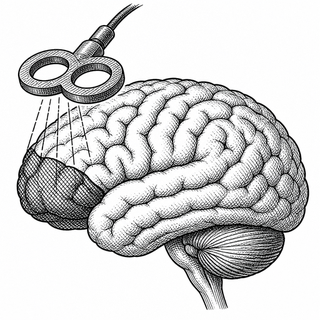
That brain patch is the orbitofrontal cortex, or OFC. If the brain were a chaotic office, the OFC would be the manager trying to assign value to everything - rewards, choices, social cues, probably your third coffee too. In schizophrenia, those calculations can go sideways. The result can include positive symptoms like hallucinations and delusions, plus attention problems that make daily life feel like trying to read a novel in a room full of leaf blowers.
Magnets, but make it medical
The treatment here was repetitive transcranial magnetic stimulation - rTMS. That means a magnetic coil sits on the scalp and nudges brain activity without surgery. No, it does not upload kung fu into your cortex. It is already used clinically for depression, and researchers have been testing whether it can help in other psychiatric conditions too.
In this randomized, double-blind, sham-controlled trial, people with schizophrenia received 4 weeks of low-frequency rTMS to the right OFC. Some got the real stimulation. Some got sham treatment, which is science’s way of asking, “Is this actually working, or are we all just very suggestible mammals?”
The main clinical trial had already hit its primary endpoint. This paper focused on the brain imaging side of the story - specifically, what happened to network modularity.
The brain is a social network with boundary issues
Modularity sounds like a word invented to ruin brunch, but the basic idea is simple. The brain works through networks. Some regions need to cooperate. Some need a bit of distance. Healthy function depends on both.
So when researchers say modularity improved, they mean the brain’s networks showed clearer organization over time - less random mingling, more sensible grouping. Think of a party where the guests finally stop shouting over each other and drift into conversations that actually make sense.
The study found that stimulation changed the relationship between the OFC and the default mode network, or DMN. The DMN is active during inward-looking thought - self-reflection, memory, mind-wandering, that sort of thing. Useful, yes. But if it throws its weight around at the wrong moment, it can interfere with attention and task-focused processing like an overconfident coworker replying-all to your brain.
After rTMS, the OFC and DMN became more dynamically “modularized” across time. That shift was linked to improvements in positive symptoms and better alertness/attention.
Why that matters more than it sounds
Schizophrenia treatment often helps some symptoms more than others. Positive symptoms may improve while cognition keeps limping along. Attention deficits, meanwhile, can quietly wreck school, work, and daily functioning even when the louder symptoms calm down.
That is why this paper is interesting. It does not just say, “Here is a treatment and maybe it helps.” It suggests a mechanism. The OFC may influence how strongly the DMN pushes on downstream attention systems. In exploratory analyses, the stimulated brain showed weaker causal influence from the DMN onto attention networks. In plain English: the internal chatter may have become less bossy, letting attention do its job.
That is a pretty good deal for a few weeks of noninvasive stimulation.
The gene angle, because the brain enjoys being extra
The researchers also found that the spatial pattern of these effects lined up with schizophrenia-related gene expression and markers of excitatory neurotransmission. That does not mean we have solved schizophrenia with one elegant magnet and a spreadsheet. It does mean the observed brain changes were not random decorative fMRI noise.
This matters because schizophrenia is not one thing wearing one hat. It is a messy cluster of symptoms and biology. The idea that brain network patterns could act as an intermediate phenotype - a bridge between genes and behavior - is useful. It points toward more targeted treatment, especially for people with positive symptoms and attention deficits, the subgroup that seemed most relevant here.
Not a miracle wand. A promising tool.
A few brakes should stay on. This was not a universal cure. The imaging findings were secondary outcomes. The causal-network analysis was exploratory. And as with most neuroscience, replication is not optional - it is the cover charge.
Still, the broader idea fits with where the field is heading. Reviews in recent years have highlighted the importance of brain-network dysfunction in schizophrenia and the growing interest in circuit-based treatments, including neuromodulation and precision psychiatry approaches.12 Research on noninvasive stimulation has also been building, though results vary by target, symptom domain, and patient subgroup.34
So no, this is not “magnets fix schizophrenia.” The brain is never that polite. But it is a strong clue that targeting the OFC might help retune dysfunctional network dynamics in a way that actually matters for symptoms people live with.
And honestly, any study that says a better-organized conversation between brain networks could reduce psychotic symptoms deserves at least a raised eyebrow and a fresh grant.
References
-
Zeng N, Wang M, Zheng H, et al. OFC-induced network modularity improves positive symptoms and attentional alertness in schizophrenia: a combined rTMS-fMRI study. Nat Commun. 2026;17. doi:10.1038/s41467-026-72917-4
-
McCutcheon RA, Krystal JH, Howes OD. Dopamine and glutamate in schizophrenia: biology, symptoms and treatment. World Psychiatry. 2020;19(1):15-33. doi:10.1002/wps.20693 PMCID:PMC6955311
-
Sendi MSE, Zendehrouh E, Sui J, Fu Z. Dynamic functional connectivity in schizophrenia: state of the art and future directions. Mol Psychiatry. 2024;29:review. doi:10.1038/s41380-024-02501-0
-
Slotema CW, Blom JD, Hoek HW, Sommer IEC. Should we expand the toolbox of repetitive transcranial magnetic stimulation in schizophrenia? A meta-review of recent evidence. Neurosci Biobehav Rev. 2022;137:104663. doi:10.1016/j.neubiorev.2022.104663
-
Rolls ET. The orbitofrontal cortex and emotion-related psychiatric disorders. Psychiatry Clin Neurosci. 2021;75(4):review. doi:10.1111/pcn.13159
Disclaimer: The image accompanying this article is for illustrative purposes only and does not depict actual experimental results, data, or biological mechanisms.