
On a long June evening, when your body clock is pretending bedtime is a rumour started by cowards, your cerebellum is still doing its quiet night shift: keeping your steps smooth, your hands accurate, and your speech from turning into a dropped bag of cutlery. Spinocerebellar ataxia type 1, or SCA1, is what happens when that timing system wobbles. Scientists usually blame Purkinje cells, the cerebellum's grand old conductors. A new study in The Journal of Clinical Investigation suggests the support staff may have been holding a suspiciously large wrench all along.
The Usual Suspects Had Company
SCA1 is a rare inherited neurodegenerative disease caused by an expanded CAG repeat in the ATXN1 gene, which produces a stretched-out version of ataxin-1. The result is progressive trouble with balance, coordination, eye movements, speech, and swallowing. It often begins in adulthood and runs through families because one affected parent has a 50% chance of passing it on.
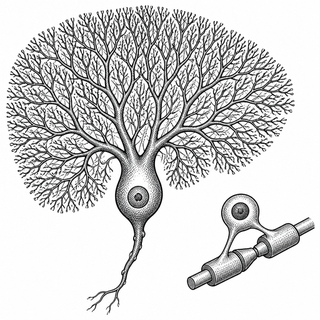
For decades, Purkinje cells have received most of the attention. Fair enough: they are huge cerebellar neurons first described in the 19th century, when brain science involved drawings and fewer ethics committees. They coordinate movement with timed inhibitory signals. When they misbehave, walking across a room can become less "casual stroll" and more "auditioning for a shipwreck."
But Lee and colleagues asked a sharper question: what if damage starts not in the famous neurons, but in oligodendrocytes, the cells that wrap axons in myelin?
Meet The Brain's Cable Department
Oligodendrocytes are glial cells in the central nervous system. Their main job is to make myelin, a fatty insulating sheath that helps signals travel quickly along axons. Think of myelin as cable insulation, except alive, metabolically helpful, and less likely to be found behind your television in a moral crisis.
The new study used a mouse model that expressed mutant ataxin-1 specifically in oligodendroglia. That matters because it let the researchers ask whether these cells could cause SCA1-like problems without putting the mutation directly into Purkinje cells. The answer was awkward for the old neuron-only story: yes, oligodendrocyte dysfunction alone was enough to produce motor coordination problems, abnormal myelination, shrinkage of Purkinje cell axons, and swollen axonal structures called torpedoes.
Torpedoes are not as fun as the name suggests. In neuropathology, they mean an axon is in trouble. Biology enjoys naming distress signals like rejected naval equipment.
The Wires Fray Before The Light Goes Out
One of the most interesting parts of this paper is timing. The mice showed axonal pathology and motor impairment without obvious Purkinje cell loss. That fits a broader idea gaining ground in ataxia research: some symptoms may come from neurons that are still alive but functioning badly, like an orchestra in which everyone has turned up but the percussion section is reading last week's programme.
Using transcriptomics, the researchers found distinct subtypes of cerebellar oligodendrocytes with altered abundance and gene-expression patterns. One cerebellum-specific subtype seemed to lose neuroprotective functions over time. In plain English: not all oligodendrocytes are identical little insulation bots. Some appear specialised for cerebellar care, and in SCA1 that care plan starts to fail.
The team also identified TCF7L2 and huntingtin, or HTT, as possible upstream regulators of oligodendroglial dysfunction. HTT is especially intriguing because Huntington's disease is another polyglutamine disorder. That raises the possibility that different repeat-expansion diseases may share damage routes through myelin and glial biology. The brain, apparently, has recurring plot devices. Not all of them are charming.
Why This Matters Outside A Mouse Room
No mouse paper cures a human disease. Mice have been tragically overpromoted in press releases before, and they have yet to file a formal complaint. Still, this study changes the map. If oligodendrocytes help drive SCA1 pathology, then treatments aimed only at rescuing Purkinje neurons may miss part of the problem.
That matters because SCA1 has no curative therapy. Reviews describe work on lowering mutant ataxin-1, modulating disease pathways, and exploring cell-based approaches. Clinical-trial experts also point out the usual rare-disease headaches: small patient groups, slow progression, variable symptoms, and biomarkers sensitive enough to detect whether a drug is doing anything useful before everyone has aged several grant cycles.
The real-world stakes are not abstract. Ataxia affects walking, handwriting, speech, swallowing, independence, and family planning. Patient stories describe people adapting careers, homes, mobility, and identity around a body that can feel slightly unsubscribed from its own instructions.
If these findings hold up and translate to humans, they suggest new therapeutic angles: protect myelin, support oligodendrocyte health, track white-matter changes as biomarkers, and rethink SCA1 as a disorder of neuron-glia teamwork rather than a solo Purkinje tragedy. The conductor may still matter. But if the stage crew cuts the power, the symphony is going to have a difficult evening.
References
- Lee C, Grijalva RM, Tejwani L, Bae E, Chase A, Ro H, Kim H, Olmos V, Orengo JP, Lim J. Oligodendrocyte dysfunction contributes to motor deficits and Purkinje cell axonopathy in spinocerebellar ataxia type 1. Journal of Clinical Investigation. 2026;136(12):e195723. https://doi.org/10.1172/JCI195723
- Opal P. Beyond neuronal degeneration: oligodendroglial dysfunction as a driver of spinocerebellar ataxia type 1 pathogenesis. Journal of Clinical Investigation. 2026;136(12):e209207. https://doi.org/10.1172/JCI209207
- Putka AF, Mato JP, McLoughlin HS. Myelinating Glia: Potential Therapeutic Targets in Polyglutamine Spinocerebellar Ataxias. Cells. 2023;12(4):601. PMCID: PMC9953858. https://doi.org/10.3390/cells12040601
- Kerkhof LMC, et al. Therapeutic Strategies for Spinocerebellar Ataxia Type 1. Biomolecules. 2023;13(5):788. https://doi.org/10.3390/biom13050788
- Kapfhammer JP, Shimobayashi E. Spinocerebellar ataxias as diseases of Purkinje cell dysfunction rather than Purkinje cell loss. Frontiers in Molecular Neuroscience. 2023;16:1182431. PMCID: PMC10323145. https://doi.org/10.3389/fnmol.2023.1182431
- Brooker SM, Edamakanti CR, Akasha SM, Kuo S, Opal P. Spinocerebellar ataxia clinical trials: opportunities and challenges. Annals of Clinical and Translational Neurology. 2021;8(7):1543-1556. PMCID: PMC8283160. https://doi.org/10.1002/acn3.51403
Disclaimer: The image accompanying this article is for illustrative purposes only and does not depict actual experimental results, data, or biological mechanisms.