
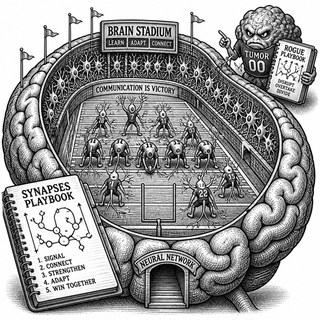
On a noisy night inside the body, the brain and nerves look less like a command center and more like a sports team improvising under stadium lights. Neurons are the players, synapses are the plays, and every chemical signal is a pass that might set up a goal or bonk the referee. Cancer neuroscience asks a strange question: what happens when a tumor wanders onto the field and starts calling audibles?
That is the mood of a new Cancer Cell perspective by Alexander Birbrair, David Simon, Sebastien Talbot, and Shengtao Zhou. Their point is sharp: neural signaling shapes tumor progression, but it is not automatically a villain twirling a tiny mustache. Nerve activity can push cancer forward in one setting, restrain it in another, and do something complicated in a third.
The Nerve Signal Is Not the Villain. The Scene Matters.
For the past decade, cancer neuroscience has been gathering thunderclouds in the best possible way. Tumors and nerves can talk through neurotransmitters, growth factors, electrical activity, immune cells, and the backstage chaos known as the tumor microenvironment.
Reviews in Cell and Annual Review of Neuroscience describe how nervous-system activity can influence cancer growth, invasion, metastasis, inflammation, immune escape, and treatment resistance (Winkler et al., 2023; Keough and Monje, 2022). In brain tumors, researchers are also testing therapies guided by circuitry, not genetics alone (Venkataramani et al., 2025).
But Birbrair and colleagues wave a caution flag before everyone sprints toward “block the nerves” as the universal strategy. A nerve signal is a message, not a moral category. Whether it helps or hurts depends on who hears it, what receptors they carry, what the immune system is doing, and what treatments have rearranged the room.
Context is the meal.
The Tumor Neighborhood Has Opinions
The tumor microenvironment is the neighborhood around a cancer: immune cells, blood vessels, fibroblasts, extracellular matrix, nerves, signaling molecules, and assorted cellular busybodies. In tidy terms, it is the ecosystem surrounding a tumor, changing as cancer and nearby tissues influence each other.
Nerve signals do not float into a blank room. They land on cells with specific receptors. A neurotransmitter receptor is basically a molecular doorbell: when the right chemical presses it, the cell responds. But two houses can have the same doorbell and very different residents.
That is why the authors emphasize “receptor and target-cell topology,” which sounds like a phrase assembled by a very serious committee but means something simple: where are the receptors, and which cells receive the signal? Tumor cells may hear one message. Immune cells may hear another.
Same Play, Different Scoreboard
The paper argues for a reporting framework for precision neuromodulatory oncology. Translation: if scientists want to manipulate neural signals to treat cancer, they need to report conditions clearly enough that another team can understand what happened.
That includes tumor kinetics, tissue architecture, neural state, receptor layout, immune-host biology, and treatment history. It is less glamorous than a miracle drug headline, but much more useful. Dampening one neural pathway might help in one cancer type, fail in another, and backfire in a third if the signal was supporting anti-tumor immunity. Biology loves plot twists.
A Cancer Discovery perspective makes a similar case for cancers outside the central nervous system: tissue-specific work beats a one-size-fits-all nervous-system story (Amit et al., 2024). A Nature Reviews Cancer review adds that nerves and immune cells can cooperate, conflict, or quietly pass notes (Amit et al., 2025).
Why This Could Matter in Real Life
If this framework holds up, the payoff could be practical. Doctors might one day sort patients not only by tumor mutations, but by neural context: which nerves are active, what receptors tumor and immune cells express, and whether a signal feeds the storm or clears the fog.
That could open the door to repurposing nervous-system drugs, designing cleaner neuromodulation trials, or predicting when blocking a signal might help versus kick the immune system in the shins. It could also prevent trials built on the assumption that “nerve equals bad,” a sentence biology hears and immediately starts sharpening knives.
The big challenge is measurement. Nerves are dynamic. Tumors evolve. Treatments reshape tissue. Immune cells change moods like Victorian characters entering a parlor. To make neural oncology useful, researchers need spatial maps, receptor data, immune profiling, and honest treatment histories.
So the story is not “nerves cause cancer” or “nerves fight cancer.” The story is moodier and better: cancers live in weather systems of signals, and nerves are part of the wind. Sometimes they fan the fire. Sometimes they shift the smoke. Sometimes they reveal which way the storm is moving.
Disclaimer: The image accompanying this article is for illustrative purposes only and does not depict actual experimental results, data, or biological mechanisms.
References
Birbrair A, Simon DJ, Talbot S, Zhou S. Context dependency in cancer neuroscience. Cancer Cell. 2026. doi: 10.1016/j.ccell.2026.05.016. PMID: 42314663.
Winkler F, Venkatesh HS, Amit M, et al. Cancer neuroscience: State of the field, emerging directions. Cell. 2023;186(8):1689-1707. doi: 10.1016/j.cell.2023.02.002. PMID: 37059069. PMCID: PMC10107403.
Keough MB, Monje M. Neural signaling in cancer. Annual Review of Neuroscience. 2022;45:199-221. doi: 10.1146/annurev-neuro-111020-092702. PMID: 35259916.
Amit M, Anastasaki C, Dantzer R, et al. Next directions in the neuroscience of cancers arising outside the CNS. Cancer Discovery. 2024;14(4):669-673. doi: 10.1158/2159-8290.CD-23-1495. PMID: 38571430.
Venkataramani V, Yang Y, Ille S, et al. Cancer neuroscience of brain tumors: From multicellular networks to neuroscience-instructed cancer therapies. Cancer Discovery. 2025;15(1):39-51. doi: 10.1158/2159-8290.CD-24-0194. PMID: 39801234.
Amit M, Eichwald T, Roger A, et al. Neuro-immune cross-talk in cancer. Nature Reviews Cancer. 2025;25(8):573-589. doi: 10.1038/s41568-025-00831-w. PMID: 40523971.