
Not a bigger brain network. Not a hidden mini-committee of neurons. Not some magical AI dust sprinkled on the striatum. The real answer, according to a new modeling study, is weirder and more fun: a single neuron may be able to do a job we usually assign to a whole crowd - if its dendrites get a little dramatic.
Situation report: the neuron was never “just one cell”
A lot of neuroscience still carries around an old mental shortcut: one neuron takes inputs, adds them up, and either fires or doesn’t. Very tidy. Very spreadsheet-brained. Very wrong, or at least incomplete.
In this eLife paper, Zahra Khodadadi and colleagues built a detailed computer model of a striatal projection neuron - the main output cell of the striatum, a brain region involved in action selection, reward learning, and habit formation. Their mission was simple to state and annoying to solve: can a single neuron learn to bind combinations of features in a nonlinear way, instead of acting like a glorified adding machine? Their answer was yes - if local calcium signals, reward signals, and dendritic nonlinearities work together under the right synaptic learning rule Khodadadi et al., 2024.
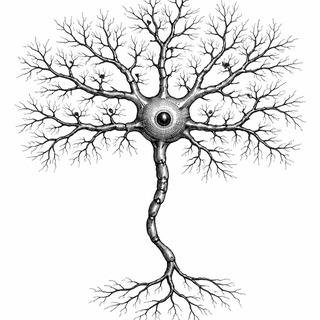
That sounds technical because it is technical. But the big idea is clean. A neuron is not just a bulb at the end of a wire. It is more like a tree full of little decision posts. The branches - dendrites - do local processing. Some of those branches can generate plateau potentials, which are prolonged depolarizations that act like temporary “all units stay sharp” orders. That local event changes how incoming signals matter.
The tactical problem: feature binding is rude
Feature binding means combining pieces of information into a meaningful whole. In machine learning terms, this is a nonlinear classification problem. In normal-person terms, it means detecting a pattern that is not obvious from any single input alone.
Think of it like this: ketchup alone tells you nothing. A hot dog alone tells you little. But hot dog plus ketchup plus baseball stadium plus somebody yelling from three rows back - now you have a very specific scene. The brain has to detect combinations, not just totals.
Classic models often hand this job to networks of many neurons. This paper asks whether one neuron, with the right branch-level machinery, can do more of that work itself. Plot twist: yes. The neuron may have been undersold. Badly.
Execution: calcium, reward, and picky branches
The authors used a biophysically detailed multicompartment model of a striatal projection neuron. Translation: they did not model the neuron as one blob. They gave it sections, channels, dendrites, and realistic electrical behavior.
Their proposed learning rule depends on local calcium in dendrites, especially calcium entering through NMDA receptors and L-type calcium channels, plus a dopaminergic reward signal. That matters because dopamine is the striatum’s favorite way of saying, “Good job, keep doing that,” or occasionally, “Absolutely not, soldier.”
Here’s the clever part: synapses did not all learn based on a global neuron-wide signal. They learned locally, based on what happened in their neighborhood. If a dendritic branch produced a plateau potential, that branch became a strategic asset. Inputs arriving there could be strengthened in a way that supported nonlinear computation. The model also included metaplasticity, which is the brain’s version of adjusting the thermostat on how easily plasticity happens. Without that, synapses can behave like interns with admin access and ruin the whole operation.
The team also added inhibitory plasticity. That helped compartmentalize dendrites, meaning branches could preserve their local identity instead of all blurring together electrically. That, in turn, improved the neuron’s ability to perform complex computations.
Why this matters outside the simulation bunker
This was an in silico study. No mice took the field. No human volunteers sat in an fMRI tube contemplating their life choices. So we should not pretend this paper proves that actual striatal neurons do all of this exactly as modeled.
But the implications are real.
First, it challenges the idea that intelligence in the brain mostly comes from huge populations and their network interactions. Those matter, obviously. Still, individual neurons may be carrying more computational load than we give them credit for. Some cells are not simple relays. They are more like tiny branchy command centers.
Second, it sharpens how we think about the striatum, reward, and learning. Disorders involving these systems - addiction, Parkinson’s disease, compulsive behaviors, and some psychiatric conditions - all involve messed-up learning signals and plasticity mechanisms. Better models of how reward reshapes local synapses could help explain why brains sometimes learn the wrong lesson with military efficiency.
Third, it speaks to AI. Neuroscience and machine learning keep borrowing each other’s homework. If single biological neurons can solve richer nonlinear problems through branch-specific learning, that could inspire more efficient or biologically grounded AI architectures Richards et al., 2019, Cichon and Gan, 2015.
The larger campaign
This paper fits into a growing view that dendrites are not passive cables. They are active computational subunits. Reviews over the last few years have pushed this point hard: dendrites shape perception, learning, and memory in ways older neuron models flattened out Stuart and Spruston, 2015, Gidon et al., 2020, Bartol et al., 2024.
So the assessment is this: if the model holds up experimentally, a single striatal neuron may be able to learn complex feature combinations using local calcium events, reward signals, and branch-specific plasticity. That does not make networks obsolete. It just means each neuron may arrive at the fight with more equipment than we thought.
Which, honestly, feels on brand for the brain. Every time we think we found a simple part, it opens a side office and starts running covert operations.
References
- Khodadadi Z, Trpevski D, Lindroos R, Hellgren Kotaleski J. Local, calcium- and reward-based synaptic learning rule that enhances dendritic nonlinearities can solve the nonlinear feature binding problem. eLife. 2024;13:RP97274. doi: 10.7554/eLife.97274
- Gidon A, Zolnik TA, Fidzinski P, et al. Dendritic action potentials and computation in human layer 2/3 cortical neurons. Science. 2020;367(6473):83-87. doi: 10.1126/science.aax6239
- Richards BA, Lillicrap TP, Beaudoin P, et al. A deep learning framework for neuroscience. Nat Rev Neurosci. 2019;20(12):759-773. doi: 10.1038/s41583-019-0203-5
- Stuart GJ, Spruston N. Dendritic integration: 60 years of progress. Nat Rev Neurosci. 2015;16(10):613-628. doi: 10.1038/nrn4007
- Cichon J, Gan WB. Branch-specific dendritic Ca2+ spikes cause persistent synaptic plasticity. Nature. 2015;520(7546):180-185. PMCID: PMC4620130
- Bartol TM, Bromer C, Kinney J, et al. Dendrites as computational units in learning and memory. Nat Rev Neurosci. 2024. doi: 10.1038/s41583-024-00835-9
Disclaimer: The image accompanying this article is for illustrative purposes only and does not depict actual experimental results, data, or biological mechanisms.