
Every day, your brain does some extremely quiet outsourcing without telling you. It sends orders through nerves and delegates cleanup to support cells like a tiny middle manager. In pancreatic cancer, that wiring can become part of the neighborhood drama.
A new study in Gut asks a sharp question: how do Schwann cells, the helper cells that wrap and repair peripheral nerves, get pushed into helping pancreatic cancer? The answer involves fibrosis, stiffness, and nuclei getting squeezed like overstuffed luggage Stupakov et al., 2026.
The Pancreas Builds a Bad Apartment Complex
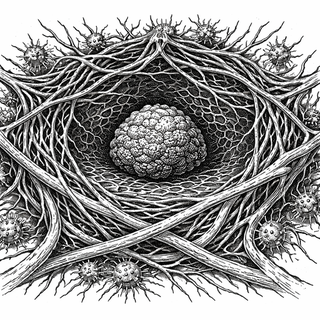
Pancreatic ductal adenocarcinoma, or PDAC, is notorious for building a dense fibrotic shell around itself. Think scar tissue, collagen, and cellular scaffolding packed like a renovation project run by someone who has never heard of exits. That stiff tissue can block drugs, confuse immune cells, and make the tumor harder to treat.
PDAC also loves nerves. Perineural invasion, where cancer cells move along or into nerves, happens often in pancreatic cancer and links to pain, recurrence, and worse outcomes. The American Cancer Society puts overall 5-year relative survival for pancreatic cancer at about 13%, a statistic that makes everyone stop pretending this is a tidy problem ACS, 2026.
Schwann cells usually do honorable work. They support peripheral nerves, help repair injury, and wrap nerve fibers in myelin when needed. They are basically the nervous system's road crew. Unfortunately, tumors have a long history of hiring useful cells for terrible jobs. Recent work shows Schwann cells can nudge pancreatic cancer cells and cancer-associated fibroblasts toward more aggressive behavior Xue et al., 2023. Other studies suggest Schwann cell autophagy can help pancreatic cancer invade nerves through NGF/ATG7 signaling, because even cellular recycling can be drafted into villainy Zhang et al., 2022. Cancer neuroscience now treats nerves and tumors not as awkward strangers, but as active conversationalists Hanahan and Monje, 2023.
The Nucleus Gets Squished, Then the Cell Gets Ideas
Stupakov and colleagues studied human samples, mouse models, atomic force microscopy, live imaging, and lab systems where they could apply force to Schwann cells. Translation: they poked the system from several angles, because biology rarely confesses after one polite question.
They found that nerves surrounded by stiffer stroma had more activated Schwann cells. The marker they tracked involved c-Jun phosphorylation. c-Jun is part of AP-1, a transcription factor complex that helps cells change gene expression after stress, growth signals, and other "we need a meeting immediately" events.
Here is the fun part, by which I mean the slightly rude part. The force did not activate Schwann cells only through the usual membrane-first route. Instead, compression affected the nucleus itself. The nucleus sensed the squeeze, and that nuclear mechanosensing triggered a non-canonical route involving phospholipase A2, a pro-inflammatory enzyme. The command center got physically pressured and changed the cell's behavior. Office politics, but microscopic.
Even more striking: fibrosis alone, without cancer cells present, could activate Schwann cells. That suggests the stiff pancreatic environment may prime nerve-support cells before tumor cells even need to charm them. Imagine the neighborhood becoming so tense that the road crew starts laying escape routes for the wrong team.
Why This Is More Than Cellular Gossip
Pancreatic cancer therapy often focuses on the cancer cell itself, which makes sense, since the cancer cell is technically the villain. But PDAC is more like a badly organized group project where fibroblasts, immune cells, nerves, extracellular matrix, and cancer cells all contribute something awful and somehow get credit.
The study suggests that mechanical features of the tumor microenvironment can directly change nerve-associated cells. That widens the target list. If future studies confirm these findings, therapies might aim not only at tumor mutations or immune checkpoints, but also at fibrosis-driven nerve activation. Maybe you do not have to silence every harmful conversation in the tumor. Maybe you change the room acoustics.
There is a caution sign here, naturally. These findings need more validation, especially in human disease and treatment settings. The tumor microenvironment is famously slippery. Drugs that simply "remove stroma" have not always helped, partly because some stromal features restrain tumors while others help them. Biology enjoys loopholes. It probably has a legal department.
Still, this paper gives a clean mechanistic link between stiffness, Schwann cell activation, and pancreatic cancer nerve biology. It also points beyond cancer, because pancreatic fibrosis occurs in non-malignant diseases too. If Schwann cells are unusually sensitive to mechanical activation, stiff tissue could influence nerve behavior in more places than oncology.
So the next time you hear "scar tissue," do not picture inert packing foam. In the pancreas, fibrosis may be more like a hand on the thermostat, quietly changing how nearby nerve-support cells behave. And in pancreatic cancer, quiet changes can become very loud problems.
Disclaimer: The image accompanying this article is for illustrative purposes only and does not depict actual experimental results, data, or biological mechanisms.
References
Stupakov P, Sadatrezaei G, Velazquez Quesada I, et al. Pancreatic cancer fibrosis activates protumorigenic Schwann cells through a nuclear mechanosensing mechanism. Gut. 2026. DOI: 10.1136/gutjnl-2025-337316
Xue M, Zhu Y, Jiang Y, et al. Schwann cells regulate tumor cells and cancer-associated fibroblasts in the pancreatic ductal adenocarcinoma microenvironment. Nature Communications. 2023;14:4600. DOI: 10.1038/s41467-023-40314-w. PMCID: PMC10390497
Zhang W, He R, Yang W, et al. Autophagic Schwann cells promote perineural invasion mediated by the NGF/ATG7 paracrine pathway in pancreatic cancer. Journal of Experimental & Clinical Cancer Research. 2022;41:48. DOI: 10.1186/s13046-021-02198-w
Hanahan D, Monje M. Cancer hallmarks intersect with neuroscience in the tumor microenvironment. Cancer Cell. 2023;41(3):573-580. DOI: 10.1016/j.ccell.2023.02.012. PMCID: PMC10202656
Winkler F, Venkatesh HS, Amit M, et al. Cancer neuroscience: State of the field, emerging directions. Cell. 2023;186(8):1689-1707. DOI: 10.1016/j.cell.2023.02.002
American Cancer Society. Survival Rates for Pancreatic Cancer. Updated 2026. https://www.cancer.org/cancer/types/pancreatic-cancer/detection-diagnosis-staging/survival-rates.html