
A middle-aged patient comes down with a nasty inflammatory illness and, within days, something feels off in a way that goes beyond being sick. He is slower. Food tastes less rewarding. Friends text, and he cannot quite summon the energy to care. He is not exactly depressed, not exactly delirious, but his brain has clearly started running on weird software. That gray zone is where this paper lives - and honestly, it is one of the more interesting plot twists in modern neuroscience.
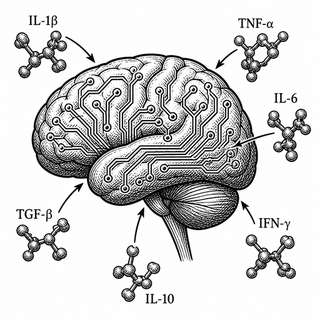
A new review by Daniel Martins and Neil Harrison argues that cytokines - the immune system's chemical messengers - are not just there to yell "infection!" like tiny molecular town criers. They also act as neuromodulators, meaning they help tune how brain circuits fire, adapt, and communicate.1 In other words, the molecules that organize your body's defense strategy may also be quietly leaning over the brain's shoulder, rearranging the playlist.
Not just inflammation - brain settings
Most people hear "cytokines" and think inflammation, fever, maybe a miserable weekend under a blanket with soup and bad television. Fair enough. But this review makes a broader point: cytokines can shape normal brain function too.
Experimental studies in humans and nonhuman primates show that when cytokine levels rise, people often develop a recognizable cluster of symptoms - anhedonia, social withdrawal, slower movement, slower thinking, and cognitive fog.1 If that sounds familiar, it should. Those features show up across depression, neurodegenerative disease, chronic infection, and other brain disorders. The paper's argument is basically: maybe inflammation is not just background chaos. Maybe it is one of the knobs turning the whole system.
That matters because psychiatry has spent years sorting people into diagnostic boxes, while the brain keeps acting like a messy shared apartment where several problems use the same kitchen. Cytokines may help explain why.
Your immune system has opinions about dopamine
One of the most useful ideas in the paper is that cytokines do not affect the brain in one simple way. They can alter several major signaling systems at once.
They can disrupt dopamine pathways, which help drive motivation and reward. That could help explain why inflammation makes normally enjoyable things feel oddly flat.[^1,^2] They can also interfere with serotonin signaling, and they modulate glutamate and GABA, the brain's main excitatory and inhibitory systems. If neurons are the office workers, glutamate is the "reply all" guy and GABA is the one begging everyone to please calm down.
Cytokines also influence synaptic plasticity - the brain's ability to strengthen or weaken connections - plus neurogenesis, myelination, and even sleep-related cortical states.[^1,^3] So this is not one immune molecule bonking one sad little neuron on the head. It is a systems problem. More like changing the Wi-Fi, lighting, staffing, and coffee supply in the same building and then acting surprised that productivity tanks.
Why scientists love immune challenge studies
A lot of this field has been driven by clever experimental studies where researchers temporarily activate the immune system in controlled ways - using endotoxin, vaccines, or interferon-related paradigms - and then track mood, behavior, and brain activity.[^2,^4,^5]
That approach lets scientists move past vague correlation. Instead of just noticing that sick people feel bad, they can ask: what happens to motivation, attention, or brain connectivity right after cytokines rise?
The answer, increasingly, is that inflammation can nudge the brain into a low-motivation, low-social-engagement mode that probably made evolutionary sense during infection. If your body is fighting microbes, "stay in bed and stop trying to network" is not terrible advice. Evolution, as usual, is practical but not especially charming.
The next big idea: cytokine codes
The review also pushes back on a common habit in the field - treating cytokines one at a time, like each is a lone villain in a detective show. In reality, the immune system works through combinations. The authors call for studying combinatorial cytokine codes, which is a much better description of biology's actual behavior: messy, interactive, and mildly rude to anyone hoping for a clean spreadsheet.1
That systems-level view may be especially important for precision psychiatry. If different inflammatory signatures map onto different symptom patterns - say, motivation problems in one person, cognitive slowing in another - clinicians might eventually use immune profiles to guide treatment.[^1,^3]
Could this change treatment?
Potentially, yes - though nobody should start treating cytokines like a magic master switch.
There is already growing interest in anti-inflammatory and cytokine-targeting therapies for subsets of patients with depression and related disorders, especially when inflammatory markers are elevated.[^3,^6] The hope is not that inflammation explains everything. The hope is that, for some people, it explains enough to matter clinically.
The catch is that cytokines also help regulate normal brain plasticity and immune defense, so long-term intervention could have trade-offs.1 Biology loves balance and hates simplistic hero narratives. Every time we think we found a villain, it turns out the villain also helps run plumbing.
The big takeaway
This paper asks us to stop thinking of cytokines as mere smoke from the fire of illness. They may be active participants in how the brain shifts mood, motivation, attention, and behavior - in health, during infection, and in psychiatric disease.
That is a big conceptual upgrade. It means the immune system is not just protecting the brain from the outside. It is in the conversation, editing the tone, muting some channels, boosting others, and occasionally making the whole meeting weird.
And if that sounds unsettling, well, welcome to neuroscience - the field where every cell turns out to have a side hustle.
References
Disclaimer: The image accompanying this article is for illustrative purposes only and does not depict actual experimental results, data, or biological mechanisms.
-
Martins D, Harrison NA. Cytokines as neuromodulators: Insights from experimental studies with humans and nonhuman primates. Biol Psychiatry. 2025. doi:10.1016/j.biopsych.2025.06.037 ↩↩↩↩
-
Lasselin J, Lekander M, Axelsson J, Karshikoff B. Sex differences in how inflammation affects behavior: What we know and what we should know. Neuropsychopharmacology. 2020;45(1):27-46. doi:10.1038/s41386-019-0458-7 PMCID:PMC6879295 ↩
-
Nettis MA, Pariante CM, Mondelli V. Early-life adversity, systemic inflammation and comorbid physical and psychiatric illnesses of adult life. Curr Top Behav Neurosci. 2020;44:207-225. doi:10.1007/7854_2020_145 ↩
-
Harrison NA, Voon V, Cercignani M, Cooper EA, Pessiglione M, Critchley HD. A neurocomputational account of how inflammation enhances sensitivity to punishments versus rewards. Biol Psychiatry. 2016;80(1):73-81. doi:10.1016/j.biopsych.2015.07.018 PMCID:PMC4918845 ↩
-
Brydon L, Harrison NA, Walker C, Steptoe A, Critchley HD. Peripheral inflammation is associated with altered substantia nigra activity and psychomotor slowing in humans. Biol Psychiatry. 2008;63(11):1022-1029. doi:10.1016/j.biopsych.2007.12.007 ↩
-
Khandaker GM, Zuber V, Rees JMB, et al. Shared mechanisms between coronary heart disease and depression: Findings from a large UK general population-based cohort. Mol Psychiatry. 2020;25(7):1477-1486. doi:10.1038/s41380-019-0395-3 ↩