
Remember being a kid and bargaining with bedtime like a tiny lawyer? One more glass of water, one more story, one more trip to check for monsters. You'd have done anything to stay awake. Then you grew up, and the cruel joke revealed itself: now you'd trade a kidney for an uninterrupted eight hours, and you still can't get them. Funny how that works.
It turns out your inability to sleep might not be entirely your fault. A new framework published in Cell Reports Medicine argues that sleep has been quietly outgrowing your bedroom for years, and we've only just noticed the size of the problem.
Sleep Has a Plus-One Nobody Invited
For a long time, sleep science treated bad sleep like a personal failing. Drink less coffee. Put the phone down. Stop doomscrolling at midnight like a raccoon rummaging through a digital dumpster. All reasonable advice, and all aimed squarely at you.
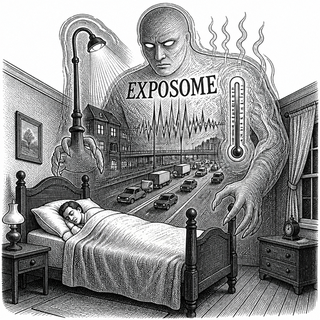
The new "One Sleep Health" framework, proposed by Masoud Tahmasian and colleagues, flips the camera around to show the whole room. Your sleep, they argue, is shaped by your exposome - the grand pile-up of everything you're exposed to over a lifetime. Think of it as the uninvited roommate who controls the thermostat, the lights, and the noise, and never chips in for rent.
The team sorts these influences into a few buckets. There's the physical exposome: rising temperatures from climate change, plus light, air, and noise pollution. (Your body evolved to sleep in dark, cool, quiet caves. It did not sign up for a streetlamp shining through the curtains and a freeway humming like a tired refrigerator.) Then there's the social exposome: shift work, the tyranny of being reachable 24/7, and plain old inequality. Some people simply live in louder, hotter, more stressful places, and their sleep pays the tab.
One Health, Now With Pajamas
The clever twist is borrowing from a concept called One Health, the idea that the wellbeing of humans, animals, and the planet are tangled together in one big knot. Usually that conversation is about pandemics or antibiotic resistance. Tahmasian's team drags it, yawning, into the bedroom.
Their point is genuinely interesting: the same environmental forces wrecking your sleep are wrecking the sleep of animals sharing your ecosystem. Artificial light at night confuses migrating birds and insomniac humans alike. A warming world keeps everyone tossing and turning. We're not separate sleepers - we're roommates with the whole biosphere, all squinting at the same too-bright night. Treating human sleep as an isolated medical issue, the authors suggest, is like fixing one leaky faucet while the whole building floods.
Sleep Capital, or Why Your Boss Should Care
Here's the part that should get politicians to actually look up from their phones. The framework folds in an idea called sleep capital - the cumulative health, social, and economic payoff of sleeping well, developed in earlier work by some of the same researchers.
The logic is refreshingly blunt. A well-rested population thinks better, makes fewer mistakes, gets sick less, and produces more. Poor sleep, meanwhile, quietly drains economies through accidents, lousy decisions, and stacked-up health costs. So sleep stops being a lifestyle luxury you feel vaguely guilty about and becomes a national resource, like clean water or breathable air. The authors even nudge toward "sleep diplomacy," which sounds like a joke until you realize light pollution and climate change don't politely stop at borders.
Why This Is Worth Staying Up For (Briefly)
The honest catch is that this is a framework, not a finished instruction manual. The researchers are upfront that we still don't fully understand how sleep, whole-body health, and all these environmental factors actually wire together. They're proposing a map, not handing you the treasure.
But it's a useful map. If sleep is a planetary health issue, then the fixes scale up to match: darker, quieter, cooler cities; labor rules that respect human biology; urban design that treats rest as infrastructure instead of an afterthought. That reframing matters, because you can't lifestyle-tip your way out of a problem baked into your whole environment. No amount of chamomile tea fixes a city that never turns its lights off.
So the next time you're staring at the ceiling at 2 a.m., you can at least feel a little less guilty. You're not just a bad sleeper. You're one node in a vast, glowing, overheating, perpetually buzzing network that forgot how to switch off. The good news? Now that scientists are finally treating it that way, the lights might - eventually - start to dim.
References
-
Tahmasian, M., Küppers, V., Genon, S., Eickhoff, S. B., Golombek, D. A., & Ibanez, A. (2026). Elevating sleep to a global health priority: The One Sleep Health framework. Cell Reports Medicine. DOI: 10.1016/j.xcrm.2026.102828 — PubMed
-
Ibanez, A., et al. (2025). Sleep Capital: Linking Brain Health to Wellbeing and Economic Productivity Across the Lifespan. The American Journal of Geriatric Psychiatry, 33(1), 92–106. DOI: 10.1016/j.jagp.2024.07.011
-
Linking the exposome to the brain–behaviour phenotype. (2026). Nature Reviews Neuroscience. DOI: 10.1038/s41583-026-01049-x
-
Sleep disturbances and Alzheimer's disease: a multiscale approach from exposome to neurobiology and precision medicine. (2026). GeroScience. DOI: 10.1007/s11357-026-02152-8
Disclaimer: The image accompanying this article is for illustrative purposes only and does not depict actual experimental results, data, or biological mechanisms.