
Somewhere in a lab in Rochester, a scientist is rearranging a mouse's dinner schedule like an overprotective parent enforcing a curfew. No snacks after bedtime. Eat only during the right hours. It sounds like the world's pettiest diet plan. It turns out it might be one of the more promising ideas in stroke recovery we've seen in years.
Let me back up.
The cleanup crew you've never thanked
Your brain runs a waste-disposal service called the glymphatic system. Think of it as the night-shift janitor who shows up after the office empties out, mops up the metabolic garbage your neurons leave lying around, and clocks out before you wake. Cerebrospinal fluid gets pushed through brain tissue, flushes out the gunk (including the sticky proteins linked to Alzheimer's), and hauls it away. This crew does its best work while you sleep, which is one more reason your all-nighters were a bad relationship decision (Xie et al., 2013).
Here's the plot twist that set up this whole study: the janitor doesn't just follow sleep. He follows the clock. Earlier work from the same lab showed glymphatic flow rises and falls on a daily rhythm even when you control for sleep itself, all tied to your circadian system, the internal 24-hour timekeeper that runs everything from your body temperature to why you get hungry at suspiciously consistent times (Hablitz et al., 2020).
So the janitor has a schedule. Which means he can be thrown off it. Which is exactly what a stroke does.
Stroke: the worst possible breakup
A stroke is basically your brain getting ghosted by its own blood supply. Oxygen stops showing up, tissue gets damaged, and inflammation moves in like a roommate who never leaves. To make it worse, a stroke scrambles your circadian rhythm too. The clock breaks, the janitor stops showing up on time, and the trash just sits there. The researchers had a hunch this cleanup failure was part of why recovery stalls.
Their question was refreshingly blunt: if timing is broken after a stroke, what happens if you fix the timing?
Four ways to nudge a clock
So they tried to manually wind the watch. The team tested four different interventions in mice, each a different lever on the circadian system: KL001, a small molecule that tweaks the molecular clock directly; high-dose melatonin, the hormone your brain uses to announce bedtime; pulses of light, the original circadian cue; and active-phase time-restricted feeding, which is the fancy term for "only let them eat during the hours they should naturally be awake."
All four cranked up glymphatic flow. The janitor came back to work. That alone is a neat result, but it's the kind of thing that's easy to do in a healthy animal under ideal conditions.
The part that actually matters
Then they did the harder experiment. They waited until three days after a stroke to start treatment. This detail is the whole ballgame. Most stroke drugs are divas about timing, the clot-busters only work in a window of a few hours, after which you're mostly out of luck. Starting three days late is supposed to be a lost cause.
It wasn't. Mice given either KL001 or active-phase time-restricted feeding showed better motor recovery, smaller brain lesions, more glymphatic flow, and lower levels of inflammatory molecules. By simply reinforcing a normal daily rhythm, days after the damage was done, the brain cleaned up its own mess and healed better (Waight et al., 2026).
Why a mouse meal plan might matter to you
Now the obligatory reality check: these are mice, not people, and a tidy result in a rodent has a long road before it becomes a hospital protocol. The brain has humbled smarter people than me plenty of times.
But here's why this one is exciting. The standout intervention, time-restricted feeding, is just deciding when to eat. No new drug, no surgery, no narrow treatment window. It's already being studied for diabetes and heart disease, so we have a head start on knowing it's reasonably safe. As the lead researcher put it, these are interventions you could imagine running not just in a hospital but at home.
The deeper idea is the real keeper: maybe part of healing isn't adding something fancy to the brain, but getting out of its way and letting its own rhythms run. Your internal clock isn't just telling you when to be sleepy. It might be scheduling the repairs. The least we can do is stop messing up its calendar.
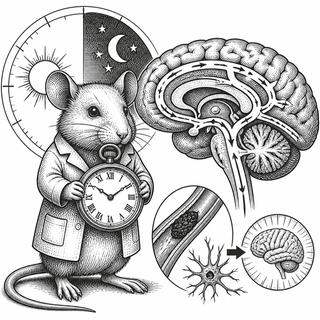
Disclaimer: The image accompanying this article is for illustrative purposes only and does not depict actual experimental results, data, or biological mechanisms.
References
- Waight, E., Zhu, Y., Caudell, A., Vizcarra, V. S., Newbold, E., Giannetto, M. J., Duyvestyn, E., Balbuena, E., Song, W., Arefin, T. M., Mori, Y., Nedergaard, M., & Hablitz, L. M. (2026). Chronotherapy to reinforce circadian rhythms improves poststroke outcomes and glymphatic function in mice. The Journal of Clinical Investigation. https://doi.org/10.1172/JCI201800 (PMID: 42294892)
- Hablitz, L. M., Plá, V., Giannetto, M., Vinitsky, H. S., Stæger, F. F., Metcalfe, T., Nguyen, R., Benrais, A., & Nedergaard, M. (2020). Circadian control of brain glymphatic and lymphatic fluid flow. Nature Communications, 11, 4411. https://doi.org/10.1038/s41467-020-18115-2
- Xie, L., Kang, H., Xu, Q., Chen, M. J., Liao, Y., Thiyagarajan, M., O'Donnell, J., Christensen, D. J., Nicholson, C., Iliff, J. J., Takano, T., Deane, R., & Nedergaard, M. (2013). Sleep drives metabolite clearance from the adult brain. Science, 342(6156), 373-377. https://doi.org/10.1126/science.1241224 (PMCID: PMC3880190)
- Iliff, J. J., Wang, M., Liao, Y., Plogg, B. A., Peng, W., Gundersen, G. A., Benveniste, H., Vates, G. E., Deane, R., Goldman, S. A., Nagelhus, E. A., & Nedergaard, M. (2012). A paravascular pathway facilitates CSF flow through the brain parenchyma and the clearance of interstitial solutes, including amyloid β. Science Translational Medicine, 4(147), 147ra111. https://doi.org/10.1126/scitranslmed.3003748