
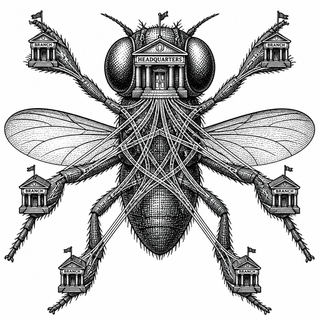
We have all been told the same bedtime story about the body: the brain sits up top like a king on a throne, barking orders down the spine, and the rest of you scrambles to obey. It is a tidy fable. It is also, according to one of the most ambitious wiring diagrams ever assembled, mostly wrong. A new map of an entire fruit fly nervous system - brain and cord, every neuron, every connection - reveals a creature run less like a monarchy and more like a co-op, where the local branches handle most of the daily business and only call headquarters when something big comes up.
What They Actually Built
There is an old saying that you cannot understand a city by studying its mayor. You have to walk the streets. For decades, neuroscientists could study the mayor - poke a brain region here, record a neuron there - but the full street map stayed out of reach. A connectome fixes that. It is a complete diagram of who connects to whom, drawn neuron by neuron from electron microscope images so detailed they make a phone book look like a haiku.
Until recently, the only animals with truly complete connectomes were tiny worms with a few hundred neurons. The fruit fly is a serious step up: roughly 140,000 neurons in the brain and another 20,000 in the ventral nerve cord, its version of a spinal cord, stitched together by something on the order of a hundred million synapses (Bates et al., 2026, Nature). Earlier projects had mapped the brain alone, or the cord alone. This one connected the two into a single circuit you can trace from a sensory hair on the leg all the way up to the bits that learn and remember - the first time anyone has done that for the whole central nervous system of an animal that walks, flies, courts, and learns.
The Plot Twist: Local Branches Run the Show
Here is where the monarchy story falls apart. The team followed the wiring out to the effector neurons - the muscle-movers, the gland-pokers, the cells that actually do things - and asked who whispers in their ears. The loudest voices were not coming from some grand command center in the brain. They were coming from sensory neurons in the same body part. Your leg, more or less, talks to your leg. These tight little feedback loops handle a lot of the moment-to-moment work locally, the way a good shop floor does not email the CEO every time it needs to tighten a bolt.
So is the brain just decoration? Not quite. The long-range wiring - the ascending neurons carrying news upstairs and the descending neurons sending word back down - turned out to be organized into neat behavior-centric bundles, like departments. There is a flying group, a walking group, a grooming group. Headquarters does not micromanage the bolts. It decides which factory runs today, and lets the local loops sweat the details. Control is distributed, not hoarded.
Why a Fly's Wiring Diagram Should Make You Curious
You are not a fly, and your nervous system has a few billion more neurons than this one. Fair. But the wiring logic - local feedback loops for fast reflexes, long-range channels for coordination and choice - is a blueprint that shows up across the animal kingdom, including in the spinal cords of mammals (Dorkenwald et al., 2024, Nature). Understanding how a small brain divides labor between local and central control is exactly the kind of principle that travels.
And the whole map is open to anyone with a laptop. That matters more than it sounds. A researcher in a small lab can now trace a circuit that would once have taken a decade and a microscope budget to reconstruct alone. The companion connectome efforts that mapped the fly brain have already become some of the most-used tools in the field (Schlegel et al., 2024, Nature). Give a thousand curious people a complete street map, and they will find alleys the cartographers never noticed.
They say the brain is the seat of the self. Maybe. But this diagram suggests the self is more of a committee than a throne - and the committee, it turns out, gets most of its work done out in the limbs, long before anyone upstairs has cast a vote.
References
- Bates, A. S., Phelps, J. S., Kim, M., et al. (2026). Distributed control circuits across a brain-and-cord connectome. Nature. https://doi.org/10.1038/s41586-026-10735-w (PMID: 42259917; PMCID: PMC12324551)
- Dorkenwald, S., Matsliah, A., Sterling, A. R., et al. (2024). Neuronal wiring diagram of an adult brain. Nature, 634, 124-138. https://doi.org/10.1038/s41586-024-07558-y
- Schlegel, P., Yin, Y., Bates, A. S., et al. (2024). Whole-brain annotation and multi-connectome cell typing of Drosophila. Nature, 634, 139-152. https://doi.org/10.1038/s41586-024-07686-5
Disclaimer: The image accompanying this article is for illustrative purposes only and does not depict actual experimental results, data, or biological mechanisms.