
Somewhere back in the primate playbook, evolution made a bet. It decided that an animal swinging through wet branches at 3 a.m. needed more than dumb, smooth pads on its hands. It needed grip. It needed to feel the difference between a sturdy branch and a rotting one before committing its whole body weight. So it etched tiny ridges into our fingertips, the way a tire gets tread, and along the way handed us a sensory superpower we have spent the last century failing to fully explain.
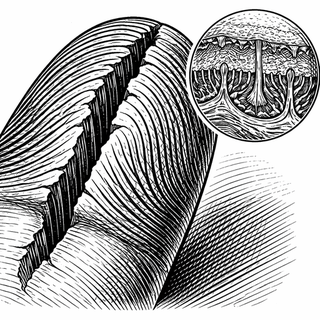
Here is the part that should keep you up at night: we have known that fingerprints make us better at feeling things for ages. We never actually knew how. The ridges are right there, on the ends of your arms, available for inspection 24/7, and the mechanism underneath them stayed a closed file.
The Suspect We Assumed Was Guilty
For years the working theory was tidy and, it turns out, mostly wrong. The assumption went like this: when your finger drags across a surface, the whole ridge bends, like a tiny speed bump getting flattened by a passing car. That bending was supposed to be the signal your nerves read.
It is a clean story. It is also the kind of clean story a detective should distrust.
The trouble is that the glabrous skin on your fingertip is not a simple speed bump. It is a layered, multi-story building. There is the tough outer shell (the stratum corneum), the living layer beneath it (the viable epidermis), and tucked into that architecture are your mechanoreceptors, the nerve endings that actually file the reports your brain reads. Nobody had ever watched what individual ridges do below the surface while you touch something. The witnesses were all underground.
Going Underground with a Light Beam
So a team led by Giulia Corniani and Hannes Saal did what good investigators do when the witnesses won't talk: they got a better camera. They used optical coherence tomography, which is essentially an ultrasound that uses light instead of sound, to peer beneath the skin of ten volunteers and track hundreds of individual ridges in real time, in living people, while four different kinds of contact events played out (eLife, 2025; DOI: 10.7554/eLife.93554).
Static presses. Sliding in different directions. That tense little moment right before your finger slips, which is the same physics your brain quietly solves every time you almost drop your phone. They mapped the strain in each layer of skin, ridge by ridge.
And here is where it gets weird.
The Ridges Weren't Bending. They Were Shearing.
The ridges barely did the one thing everyone expected. There was almost no horizontal shear, no neat sideways bending of the bumps. Instead, the ridges stretched, compressed, and most dramatically, sheared vertically, with their flanks sliding up and down relative to each other like tectonic plates grinding past one another.
Think of it less like a speed bump getting squashed and more like the walls of a canyon shifting. The action isn't the top of the ridge tipping over. The action is in the sides of the ridge and how they move against their neighbors. The signal your nervous system reads is built from those flank deformations and their relative motion, not from the cartoonish bending we all imagined.
This matters because your mechanoreceptors aren't scattered randomly. They sit at specific spots across the ridge, and it turns out those spots are perfectly placed to read these strain gradients, like detectives stationed at exactly the right intersections to catch the suspect moving. Evolution, the original micromanager, put the sensors where the information actually lives.
Why You Should Care About Your Own Canyons
The twist with real consequences: the team suggests your fingertip may have finer mechanical resolution than the width of a single ridge. Your skin might be reading detail at a sub-ridge scale, which is wilder than anyone budgeted for. We have long known touch receptors can resolve features on the scale of a single ridge (J Neurosci, 2021; PMC8055081) and that skin afferents flag the exact moment of slip (eLife, 2021; PMC8169108). This pushes the resolution dial even higher.
Get this right and you change things downstream. Prosthetic hands that actually feel texture instead of just gripping. Robots that can handle an egg and a wrench with the same hand. Touchscreens and haptics designed around how skin genuinely deforms rather than how engineers assumed it did. Biomimetic sensors built on the principle that fingerprints tune surface vibrations to the sweet spot of our nerves (Science, 2009; 10.1126/science.1166467).
Not bad for a case that was sitting on the ends of your fingers the entire time, waiting for someone to bring a light.
Disclaimer: The image accompanying this article is for illustrative purposes only and does not depict actual experimental results, data, or biological mechanisms.
References
- Corniani G, Lee ZS, Carré MJ, Lewis R, Delhaye BP, Saal HP. Sub-surface deformation of individual fingerprint ridges during tactile interactions. eLife. 2025. DOI: 10.7554/eLife.93554. PMID: 41342686.
- Jarocka E, Pruszynski JA, Johansson RS. Human touch receptors are sensitive to spatial details on the scale of single fingerprint ridges. Journal of Neuroscience. 2021;41(16):3622-3634. PMCID: PMC8055081.
- Pruszynski JA, et al. High-resolution imaging of skin deformation shows that afferents from human fingertips signal slip onset. eLife. 2021;10:e64679. PMCID: PMC8169108.
- Scheibert J, Leurent S, Prevost A, Debrégeas G. The role of fingerprints in the coding of tactile information probed with a biomimetic sensor. Science. 2009;323(5920):1503-1506. DOI: 10.1126/science.1166467.