
Bad things that happen to a kid can change the kid's brain. That's the whole idea, stated the way a ten-year-old would get it. Now the grown-up version: a massive new review in JAMA Psychiatry argues that poverty, neglect, loneliness, and discrimination don't just make life harder for people heading toward schizophrenia. They leave measurable marks on the actual tissue between the ears.
The fancy term is "biological embedding." Social hardship goes in. Brain changes come out. The hardware keeps the receipts.
What they actually did
Two researchers, Jessica Hua and Kaitlyn Dal Bon, did the thing nobody wants to do at a party: they read everything.
The numbers are absurd.
- They screened 14,500 articles.
- They kept 114 that met strict criteria.
- Those studies pooled 10,921 people across the entire schizophrenia spectrum - from folks at genetic risk, to first-episode patients, to people living with chronic schizophrenia.
Then they sorted what each study looked at. Most of the science (95 of 114 papers) was obsessed with one thing: early life adversity. The childhood stuff. Social disconnection, racism, poverty, and food insecurity got scraps by comparison. Hold that thought - it matters later.
The "social determinants of health," minus the jargon
Social determinants of health (SDOHs) are the non-medical conditions you're born into and live inside. Where you grow up. Whether dinner shows up. Whether people are cruel to you for reasons you can't change. Whether anyone's around at all.
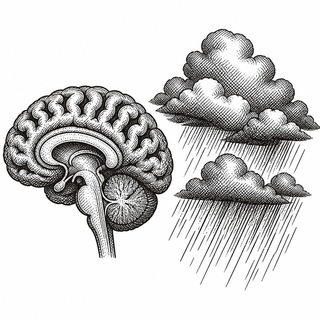
Think of them as the weather system your brain develops under. You don't pick the weather. But you grow up shaped by it anyway.
What showed up in the scans
This is where it gets uncomfortably concrete. Across the studies, greater exposure to adverse social conditions lined up with a consistent set of brain differences:
- Cortical thinning - the brain's outer layer, the part doing your heavy thinking, ran measurably thinner.
- Smaller regional volumes - certain areas just had less to them.
- Weaker structural connectivity - the wiring between regions, fraying at the seams.
- Reduced functional activation - regions that should light up staying suspiciously dim.
- Off-kilter neurochemistry - the brain's internal chemistry running out of spec.
The pattern is grimly tidy: harder circumstances, thinner cortex. One study on first-episode psychosis found that childhood adversity and the illness itself seem to compound on the same brain regions, like two leaks pooling in the same corner of the ceiling (Psychological Medicine, Cambridge Core). Stress hormones look like a plausible middleman - thinner cortical areas have tracked with higher cortisol, the body's "everything is on fire" chemical.
Why this is a bigger deal than it sounds
For years, the link between rough circumstances and worse mental health outcomes sat in an awkward spot. Everyone agreed it was real. Nobody could fully explain how a thing as abstract as "poverty" turned into a thing as physical as "psychosis."
This review hands over a candidate mechanism: the brain is the bridge. Social adversity isn't just bad luck that correlates with bad outcomes. It may physically reshape the organ that produces those outcomes.
That reframes the whole problem. If the path runs through biology, then the things we usually file under "policy" - housing, food, safety, belonging - start looking like neuroscience too. Your social worker and your neurologist might be working the same case from opposite ends.
The honest caveats
A good review tells you where the floor is thin, and this one does.
- The evidence is lopsided. Ninety-five studies on childhood adversity, one on food insecurity, zero on neuroplasticity. We've been staring at one corner of the room with the lights off in the rest.
- Association isn't a confession. These are linked patterns, not proof that hardship causes each brain change. Brains are stubborn about revealing cause and effect.
- It cuts both ways, hopefully. If adversity can shape a developing brain, the optimistic flip side is that support, stability, and early intervention might shape it too. The review can't prove that yet. But it's the question worth funding.
The takeaway isn't despair. It's a map. We've spent decades treating schizophrenia as something that happens in a person. This says a lot of it happens to a person first - and the brain has been quietly documenting the whole thing.
The lights are finally on in more of the room. Time to look at the rest of it.
Disclaimer: The image accompanying this article is for illustrative purposes only and does not depict actual experimental results, data, or biological mechanisms.
References
- Hua JPY, Dal Bon K. Social Determinants of Health and Neurobiology Across the Schizophrenia Course: A Systematic Review. JAMA Psychiatry. 2026. DOI: 10.1001/jamapsychiatry.2026.1312. PMID: 42307922.
- Dickerson F, et al. Review of Major Social Determinants of Health in Schizophrenia-Spectrum Psychotic Disorders: III. Biology. Schizophrenia Bulletin. 2023;49(4):867. Link.
- Review of Major Social Determinants of Health in Schizophrenia-Spectrum Psychotic Disorders: I. Clinical Outcomes. Schizophrenia Bulletin. 2023. PMCID: PMC10318890.
- Social Determinants of Health, the Developing Brain, and Risk and Resilience for Psychopathology. PMCID: PMC12323808.
- Childhood trauma and inflammatory biomarker effects on cortical thinning in schizophrenia spectrum disorders. Schizophrenia Research (ScienceDirect). Link.
- Addressing social determinants of health in individuals with mental disorders in clinical practice: review and recommendations. Translational Psychiatry. 2025. DOI: 10.1038/s41398-025-03332-4.