
166 million sepsis cases in 2021 sounds like a fake number invented by a villain in a spreadsheet cape, but it is the latest global estimate. Sepsis is what happens when infection becomes a whole-body emergency broadcast. Blood pressure wobbles. Organs panic. Fluids go wrong. Clinicians reach for antibiotics, fluids, vasopressors, labs, and the calm voice people use when alarms are not decorative.
One lab test in that storm is procalcitonin, or PCT, a bacterial-infection signal that can help guide antibiotic decisions. Usually, PCT gets treated like a messenger. This new Cell Reports paper asks a sharper question: what if the messenger is remixing the track?
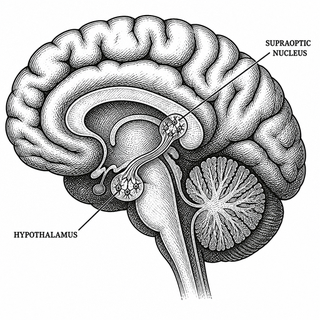
PCT: Not Just the Infection Receipt
PCT is the precursor to calcitonin, a hormone better known for calcium regulation. In healthy blood, PCT is usually barely detectable. During bacterial infection and sepsis, it can rise dramatically, which is why hospitals use it as part of the sepsis toolkit. Not alone, because one lab value making solo medical decisions would be a terrible DJ.
Lin and colleagues wanted to know whether high PCT might actively help produce sepsis physiology. Their focus: fluid imbalance and cardiovascular instability. Too much fluid can worsen swelling and organ stress. Too little can starve tissues of blood flow. Disaster movie, but make it hydration.
The Brain Has Entered the Group Chat
The team reports that systemic PCT can cross the blood-brain barrier and activate calcitonin receptors in a specific hypothalamic population: Oprk1-expressing neurons in the ventromedial preoptic nucleus, abbreviated VMPO. The hypothalamus is the brain's homeostasis producer, adjusting temperature, thirst, hormones, and blood pressure like it is mixing a live set with no bathroom break.
When PCT depolarized these VMPO Oprk1 neurons, the animals drank more and peed more. That combo sounds like the body stepping on the gas and brake at the same time. Scientists then used chemogenetics, basically a remote control for engineered neurons, to stimulate the same cells. Same fluid-balance beat, same bassline.
VMPO to SON: The Hormone Drop
The circuit did not stop at the VMPO. Those neurons projected to the supraoptic nucleus, or SON, another hypothalamic hub packed with arginine vasopressin neurons. Vasopressin, also called antidiuretic hormone, tells kidneys to conserve water and helps regulate blood vessel tone. It is tiny, powerful, and frankly a little bossy.
Activating the VMPO-to-SON pathway stimulated vasopressin-expressing neurons and increased blood pressure. So the proposed chain goes like this: infection raises PCT, PCT reaches the brain, VMPO Oprk1 neurons get excited, SON vasopressin neurons respond, and fluid plus cardiovascular systems shift. A blood biomarker becomes a neural circuit trigger. Plot twist, but with more pipettes.
Why This Lands
Sepsis care already treats fluid as a moving target. Guidelines recommend crystalloids, dynamic reassessment, vasopressors, and PCT plus clinical evaluation when deciding whether to stop antimicrobials. Sepsis is a control board, and half the sliders are sticky.
This paper adds a possible brain-centered slider. Fluid imbalance in sepsis often gets framed around blood vessels, kidneys, inflammation, and cardiac function. Those are still major players. But the brain may be coordinating part of the mess. The hypothalamus is not sitting in the balcony eating popcorn. It may be calling cues.
Recent neuroimmune work has been pointing this way. Preoptic neurons can shape fever and appetite during sickness. Reviews of thirst biology show how deeply the brain manages salt, water, and survival math. The Lin study plugs PCT into that idea: immune molecules can talk to neural circuits, and those circuits can push the body into new states.
The Mouse Caveat, Wearing a Lab Coat
This is mouse work, so no one should sprint from this paper to a bedside intervention. Mice are excellent for circuit biology and less excellent at being tiny humans with ICU comorbidities, renal disease, antibiotics, ventilation, and families asking very fair questions at 2 a.m.
The next questions are obvious and juicy. Does this pathway operate the same way in human sepsis? Do PCT levels map onto vasopressin release, thirst, urine output, or blood pressure patterns? Could blocking parts of it help some patients and hurt others? Sepsis is famously heterogeneous, which is science-speak for "the same diagnosis can arrive wearing twelve different outfits."
If the finding holds up, it could change how researchers think about PCT. Not only "how high is the smoke alarm?" but "is the smoke alarm also setting off the sprinklers?" That is a different kind of question. More mechanistic. More dangerous. More useful.
For now, the headline is simple: a molecule clinicians already measure may have a backstage pass to the hypothalamus, where it can nudge vasopressin circuits and scramble fluid balance. The brain, as usual, refuses to be a side character. Even during sepsis, it wants producer credit.
References
- Lin W, Liu T, Huang J, et al. A hypothalamic VMPO-supraoptic vasopressin circuit mediates procalcitonin-induced fluid imbalance. Cell Reports. 2026;45(6):117516. https://doi.org/10.1016/j.celrep.2026.117516
- GBD 2021 Global Sepsis Collaborators. Global, regional, and national sepsis incidence and mortality, 1990-2021: a systematic analysis. The Lancet Global Health. 2025;13(12):e2013-e2026. https://doi.org/10.1016/S2214-109X(25)00356-0
- Wheeler MA, et al. The neuroimmune connectome in health and disease. Nature. 2025;638:333. https://doi.org/10.1038/s41586-024-08474-x
- Osterhout JA, et al. A preoptic neuronal population controls fever and appetite during sickness. Nature. 2022;606:937-944. https://doi.org/10.1038/s41586-022-04793-z
- Grove ME, et al. The neurobiology of thirst and salt appetite. Neuron. 2024;112:3999-4021. https://doi.org/10.1016/j.neuron.2024.10.028
- Evans L, Rhodes A, Alhazzani W, et al. Surviving Sepsis Campaign: international guidelines for management of sepsis and septic shock 2021. Critical Care Medicine. 2021;49(11):e1063-e1143. https://doi.org/10.1097/CCM.0000000000005337
- Lajoye J, et al. Vasopressin and its analogues in patients with septic shock: holy Grail or unfulfilled promise? Critical Care. 2025;29:333. https://doi.org/10.1186/s13054-025-05540-2
Disclaimer: The image accompanying this article is for illustrative purposes only and does not depict actual experimental results, data, or biological mechanisms.