
A person with Alzheimer's can wake up in a familiar room and still feel the day arrive without labels. The mug is there, the hallway is there, the face across the table is loved but briefly misplaced, as if the mind has set down its glasses and then forgotten glasses exist. It is frightening, ordinary, and unfairly patient with everyone except the person living inside it.
The Brain Is Not Working Alone
This is going to sound strange, but Alzheimer's research is becoming less brain-only and more whole-body detective story. The brain is still the main stage, obviously. But the older picture, where Alzheimer's was mostly plaques, tangles, and neurons losing the plot, now looks a little too tidy.
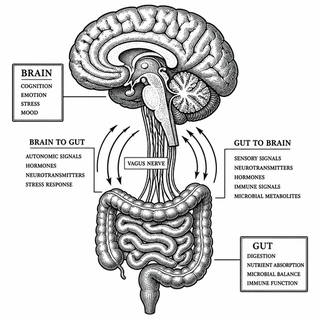
Zuffa and colleagues built a large metabolomics atlas in two Alzheimer's mouse models, 3xTg and 5xFAD. Metabolomics is chemical bookkeeping: scientists measure small molecules that show what cells have been eating, making, hoarding, or dramatically flinging into the biological group chat. This team profiled 2,271 samples across organs and paired that with 666 metagenomic samples, meaning they also looked at the gut microbes carrying molecular paintbrushes of their own.
Their question was elegant: if Alzheimer's is shaped by genes and environment, can we see disease-related chemistry changing across the body, not just inside the skull?
A Molecular Atlas, Not a Treasure Map
The atlas found clusters of altered molecules across tissues, including carnitines, bile acids, B vitamins, neurotransmitters, and N-acyl lipids. That list sounds like someone emptied a nutrition label into a lab coat pocket, but each class matters. Carnitines help shuttle fatty acids into mitochondria, the cell's energy furnaces. Bile acids process fats and act as signals. B vitamins and neurotransmitters sit closer to the everyday business of nerves and repair.
The researchers also saw microbial shifts. In the 3xTg model, they reported depletion of Akkermansia muciniphila and enrichment of Mucispirillum schaedleri. Those are bacteria, not rejected spell names, although biology does enjoy making us say things in italics at parties.
The clever part is that the team did not stop with mice. They developed tissueMASST, a mass spectrometry search tool for comparing animal findings against human molecular data. Using it, they traced phenylacetyl-carnitine in human plasma and serum from 1,470 samples and found associations with aging, cognitive impairment, and lower memory performance.
That does not mean phenylacetyl-carnitine causes Alzheimer's. Association is not destiny. It is a clue pinned to a corkboard with red string and a scientist quietly whispering, "Well, that's rude."
Why This Is More Than Mouse Chemistry
Alzheimer's has been painfully difficult to treat because it is not one neat problem. Amyloid plaques and tau tangles matter, but inflammation, metabolism, immune signaling, vascular health, aging, diet, and microbes may all help shape the final painting. The canvas is crowded. Someone spilled bile acids near the hippocampus.
Recent reviews argue that the microbiota-gut-brain axis may influence Alzheimer's through immune signaling, microbial metabolites, blood-brain barrier effects, and metabolic changes, while also warning that the field is young and messy Seo and Holtzman, 2024. Another 2024 review focused on gut-derived metabolites and immunity Chandra and Vassar, 2024. A related Neurotherapeutics review framed gut microbial metabolism as a serious piece of Alzheimer's and related dementia biology, not just wellness-blog confetti Kang et al., 2024.
Human studies are inching the same way. A 2023 Science Translational Medicine study reported that gut microbiome composition may mark preclinical Alzheimer's disease Ferreiro et al., 2023. Earlier metabolomics work linked altered bile acid profiles with cognitive impairment and Alzheimer's biomarkers MahmoudianDehkordi et al., 2019. The pattern is not "your gut causes dementia," because science is difficult and slogans usually wear fake mustaches. The better version is: body-wide metabolism may reveal vulnerability, disrupted pathways, and possible intervention points.
The Catch, Because Biology Loves a Catch
This used mouse models. Useful models, but still mice. The 3xTg and 5xFAD models mimic parts of Alzheimer's biology, yet no mouse wakes up worried about missing a grandchild's birthday. Translating mouse chemistry into human disease is hard, which is why tissueMASST is interesting. It builds a bridge instead of just admiring the canyon.
If these findings reproduce and expand, the impact could be practical. Blood metabolites might help track risk, disease stage, or treatment response. Microbial pathways might point to diet, prebiotic, probiotic, or drug strategies that nudge metabolism without pretending yogurt is a neurologist. Multi-organ atlases could help researchers ask how liver, gut, blood, and brain sketch the disease together.
That is the charm of this paper. It does not announce a cure. It offers a better map: not a single X on the brain, but a layered drawing of organs, microbes, and molecules. Alzheimer's may still steal memory, but studies like this make the route less invisible.
References
Zuffa S, Allaband C, Charron-Lamoureux V, et al. A multi-organ metabolomics atlas reveals molecular dysregulations in Alzheimer's disease mouse models. Cell Reports. 2026;45(6):117499. https://doi.org/10.1016/j.celrep.2026.117499
Seo DO, Holtzman DM. Current understanding of the Alzheimer's disease-associated microbiome and therapeutic strategies. Experimental & Molecular Medicine. 2024;56:86-94. https://doi.org/10.1038/s12276-023-01146-2
Chandra S, Vassar RJ. Gut microbiome-derived metabolites in Alzheimer's disease: Regulation of immunity and potential for therapeutics. Immunological Reviews. 2024;327(1):33-42. https://doi.org/10.1111/imr.13412
Kang JW, Vemuganti V, Kuehn JF, Ulland TK, Rey FE, Bendlin BB. Gut microbial metabolism in Alzheimer's disease and related dementias. Neurotherapeutics. 2024;21(6):e00470. https://doi.org/10.1016/j.neurot.2024.e00470
Ferreiro AL, Choi J, Ryou J, et al. Gut microbiome composition may be an indicator of preclinical Alzheimer's disease. Science Translational Medicine. 2023;15:eabo2984. https://doi.org/10.1126/scitranslmed.abo2984
MahmoudianDehkordi S, Arnold M, Nho K, et al. Altered bile acid profile associates with cognitive impairment in Alzheimer's disease: An emerging role for gut microbiome. Alzheimer's & Dementia. 2019;15(1):76-92. https://doi.org/10.1016/j.jalz.2018.07.217
Disclaimer: The image accompanying this article is for illustrative purposes only and does not depict actual experimental results, data, or biological mechanisms.