
Boomers had TV static, millennials had loading screens, and Gen Z has TikTok buffering for 0.7 seconds and calling it a crisis. A newborn mouse retina has its own pre-game problem: the lights are not even on yet, but the visual system still needs to get ready for motion, depth, and the chaos of not walking into things. So before vision begins, the retina runs waves of activity across itself, like a tiny stadium crowd doing the wave with higher stakes and worse concessions.
The Pregame Nobody Sees
Retinal waves are bursts of spontaneous electrical activity that sweep across the developing retina before the animal can see. No images. No scenery. No highlight reel. Just cells firing in patterns, practicing the playbook before game day.
The brain is a notorious over-preparer. It does not wait for the world to arrive with a clipboard and a whistle. It starts organizing circuits early, using internal activity as rehearsal tape. Earlier work showed that some waves in young mice flow in a direction resembling future optic flow, the motion pattern you get when moving forward. The retina is watching film of an opponent it has not technically met yet.
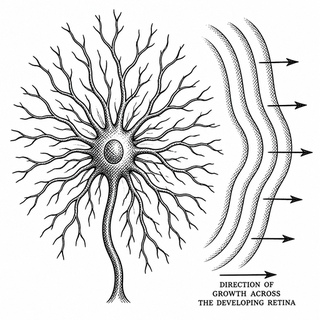
The new Cell Reports study by Pitcher, Gonzales, Habib, and Feller asks a sharper question: can wave direction tell dendrites how to grow? Not just "be active," but "grow more over there." That is the difference between a coach shouting "hustle" and drawing the play.
Meet the Starburst Squad
The stars here are starburst amacrine cells, retinal interneurons with dendrites radiating outward like a microscopic firework. These cells help compute direction-selective motion. In plain English: they help the retina tell where something is moving.
Their dendrites do not just sit there like decorative fringe on a championship banner. Each branch can act like a local computing unit. Prior work shows that starburst dendrites respond strongly when motion runs from the cell body outward toward the dendrite tip. Each branch gets a directional preference, like a defender who only bites on one kind of crossover.
Pitcher and colleagues found that developing starburst cells use that same directional machinery before vision starts. Spontaneous waves in the mouse retina have a nasal propagation bias, and starburst dendrites can read it. Then the cells translate biased activity into asymmetric dendrite growth. The wave is not background noise. It is a scouting report.
Dendrites With a Sense of Direction
This matters because dendrites are the receiving and computing arms of neurons. Their shape helps decide which signals a cell hears and how it processes them. If axons are the long passes, dendrites are the hands, footwork, and court spacing.
Neuroscientists already knew that neural activity can influence dendrite development. The harder problem was whether the pattern of activity across space and time could instruct growth. This paper makes the case that it can. A directional wave moves across the retina; starburst dendrites compute it; growth becomes biased. That links a moving signal to cell structure.
No, this does not mean baby retinas are secretly doing trigonometry while the rest of us are struggling with passwords. But it does mean the developing visual system may use internal simulations to build itself.
Why the Scoreboard Cares
The broader win is conceptual. If reproducible and expanded, this work helps explain how nervous systems build circuits that are ready for the world before full sensory experience begins. That could matter for developmental neuroscience, retinal disease modeling, and maybe one day for improving how lab-grown retinal tissue or repaired circuits mature.
Keep the champagne corked, though. This is mouse retina work, not a clinic-ready treatment. The human visual system is bigger, slower, and less cooperative, which is very on brand for humans. Still, early activity patterns may not merely keep neurons synchronized. They may carry instructions about circuit geometry.
That could matter when early neural activity or dendrite development goes off schedule. Retinal repair strategies also face a brutal practical question: if you replace or rescue cells, how do you get them to wire correctly? You need more than players on the court. You need spacing, timing, and someone who knows where the ball is going.
Post-Game Analysis
The retina is often sold as a camera, but that comparison keeps losing in the first round. A camera records. A retina computes. Before it even sees, it practices motion-like patterns, recruits starburst amacrine cells, and shapes dendrites with directional information.
The takeaway: spontaneous activity is not necessarily random warm-up noise. In this study, retinal waves behave more like a structured training drill, and starburst dendrites act like players converting the drill into body position. Before vision arrives, the retina may already know which way the game tends to move.
References
- Pitcher MN, Gonzales ASB, Habib R, Feller MB. Retinal waves shape starburst amacrine cell dendrite development through a direction-selective dendritic computation. Cell Reports. 2026;45(6):117476. DOI: 10.1016/j.celrep.2026.117476. PMID: 42224079.
- Ge X, Zhang K, Gribizis A, Hamodi AS, Martinez Sabino A, Crair MC. Retinal waves prime visual motion detection by simulating future optic flow. Science. 2021;373(6553):eabd0830. DOI: 10.1126/science.abd0830. PMCID: PMC8841103.
- Tiriac A, Bistrong K, Pitcher MN, Tworig JM, Feller MB. The influence of spontaneous and visual activity on the development of direction selectivity maps in mouse retina. Cell Reports. 2022;38(2):110225. DOI: 10.1016/j.celrep.2021.110225. PMCID: PMC8805704.
- Tiriac A, Feller MB. The roles of visually evoked and spontaneous activity in the development of retinal direction selectivity maps. Trends in Neurosciences. 2022;45(7):529-538. DOI: 10.1016/j.tins.2022.04.002. PMCID: PMC12751088.
- Acaron Ledesma H, Ding J, Oosterboer S, Huang X, Chen Q, Wang S, Lin MZ, Wei W. Dendritic mGluR2 and perisomatic Kv3 signaling regulate dendritic computation of mouse starburst amacrine cells. Nature Communications. 2024;15:1819. DOI: 10.1038/s41467-024-46234-7. PMCID: PMC10901804.
Disclaimer: The image accompanying this article is for illustrative purposes only and does not depict actual experimental results, data, or biological mechanisms.