
A neurologist walks into a bar and says, "Okay, buckle up: the yellow stuff doctors usually side-eye during jaundice may also help protect the brain's wiring after stroke." The yellow stuff is bilirubin, a breakdown product of old red blood cells, and in the right physiological range it may act less like toxic sludge and more like a tiny backstage engineer with a clipboard.
White Matter Is the Roller Coaster Track
When people talk about stroke, they often picture neurons dramatically fainting because blood flow got cut off. Fair. But your brain is also packed with white matter, the insulated cable system that lets brain regions send messages fast enough for you to walk, talk, and remember your keys.
White matter gets its pale look from myelin, the fatty insulation around axons. After ischemic stroke, those cables can fray, feeding motor trouble and post-stroke cognitive decline. The roller coaster may still have cars, but if the track is warped, nobody is having a normal Tuesday.
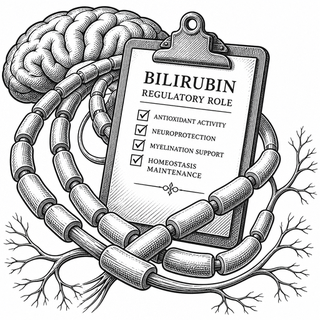
The Immune System Enters With a Clipboard and a Flamethrower
The new Cell Reports paper by Chen and colleagues asks a spicy question: could mild bilirubin levels help limit ischemic white matter injury by changing how immune cells behave? The team combined cohort data, Mendelian randomization, mouse experiments, B-cell assays, and single-cell profiling. Translation: they did not poke one mouse brain and sprint to the press office.
They found that higher bilirubin within a physiological range tracked with less severe white matter injury. Mechanistically, bilirubin seemed to calm B cells by targeting TFRC, the transferrin receptor. TFRC is basically a cellular iron turnstile. B cells need iron, glucose, and healthy mitochondria to power up and join the inflammatory group chat. Bilirubin reduced iron overload, steadied glucose metabolism, and helped mitochondria stop acting like tiny smoke machines.
B Cells: Not Just Antibody Interns
B cells are famous for antibodies, but after stroke they can do more than print immune wanted posters. Recent work in the Journal of Clinical Investigation found that B cells can accumulate in ischemic lesions, form germinal-center-like structures, and worsen chronic neuroinflammation. The brain's immune cleanup crew can accidentally invite a committee, and the committee brings bylaws.
Chen's study adds a more precise lever: bilirubin appears to nudge B-cell immunometabolism, especially iron handling through TFRC. That then connects to microglia, the brain's resident immune cells, through Fc-gamma receptor signaling. Microglia are the neighborhood watch of the nervous system: helpful when they clear debris, chaotic when they keep shouting "suspicious activity" at everything.
The Goldilocks Problem
Before anyone tries to "optimize bilirubin" with internet wizardry: please do not. Bilirubin is weirdly two-faced. Low physiological levels may help, while high bilirubin can be dangerous, especially in newborns, and a 2023 Neuron study reported that bilirubin can worsen ischemic brain damage through TRPM2 channel activation. Biology loves nuance because apparently it has never met a clean headline.
So the exciting part is not "bilirubin is good." It is "bilirubin may reveal a targetable pathway." If future studies reproduce this in broader human groups, the useful therapy might not be bilirubin itself. It might be a safer way to tune TFRC, iron metabolism, or B-cell activation after stroke, like adjusting the brakes instead of telling everyone to lean left.
Why This Could Matter
Current stroke care is excellent at opening blocked vessels when patients arrive in time, but many survivors still face white matter damage, inflammation, and cognitive fallout months later. Reviews in Nature Reviews Neuroscience and Circulation Research hammer the same uncomfortable theme: post-stroke immune responses and cognitive decline are long-running processes, not tidy one-day emergencies.
That is why this bilirubin-B-cell-TFRC axis is intriguing. It points toward machinery that keeps injury smoldering after the dramatic first act. If researchers can safely cool that machinery, future stroke therapy could do more than save threatened tissue in the acute window. It could help preserve the brain's cable network for the long recovery ride, seatbelts locked, mitochondria hopefully behaving themselves.
References
- Chen L, et al. Bilirubin mitigates ischemic white matter injury by targeting transferrin-receptor-mediated B cell immunometabolism. Cell Rep. 2026;45(6):117398. doi:10.1016/j.celrep.2026.117398
- Yang S, et al. Ectopic B lymphocyte follicles exacerbate ischemic brain damage via MIF-CD74/CXCR4 and interferon signaling. J Clin Invest. 2026;136(5):e196905. doi:10.1172/JCI196905
- Shichita T, et al. Neuroimmune mechanisms and therapies mediating post-ischaemic brain injury and repair. Nat Rev Neurosci. 2023;24(5):299-312. doi:10.1038/s41583-023-00690-0
- Rost NS, et al. Post-stroke cognitive impairment and dementia. Circ Res. 2022;130(8):1252-1271. doi:10.1161/CIRCRESAHA.122.319951
- Liu HW, et al. Bilirubin gates the TRPM2 channel as a direct agonist to exacerbate ischemic brain damage. Neuron. 2023;111(10):1609-1625.e6. doi:10.1016/j.neuron.2023.02.022
Disclaimer: The image accompanying this article is for illustrative purposes only and does not depict actual experimental results, data, or biological mechanisms.