
If you Google cancer neuroscience, you'll find phrases that sound like a grant-writing robot got locked in a conference room: "tumor microenvironment," "bidirectional signaling," "neuro-oncology." True, but under-selling the weirdness. This field asks whether cancer cells can plug into the nervous system like a cursed controller and use the brain's own wiring rules to level up.
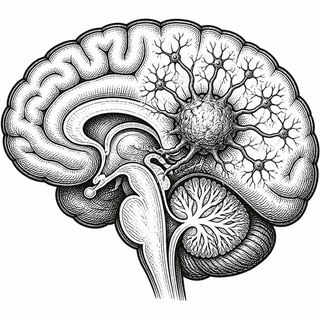
That is the world behind the new Nature Reviews Neurology interview, "Varun Venkataramani: the rise of cancer neuroscience." It is not a standard experiment with tidy bar graphs. It is more like a character intro before the boss fight: neurons, tumor cells, and electrical activity are all at the same table, and nobody is behaving.
Tumors In The Group Chat
Gliomas are tumors that arise from glial cells in the brain or spinal cord. They include glioblastoma, the final-boss version with terrible balance patches. For decades, tumors were often pictured as rogue blobs: cells dividing too fast, ignoring instructions, smashing the biological furniture.
Neurons talk through synapses, tiny message-passing junctions that are basically biological DMs with voltage. Recent work shows that glioma cells can receive synaptic input from neurons. In other words, the tumor is not just near the chat. It has joined the group chat, changed the notification settings, and started farming XP.
The Cursed Skill Tree
A major 2023 review in Cell describes cancer neuroscience as nervous system-cancer communication: chemical signals, direct electrochemical contacts, immune effects, invasion, treatment resistance, and metastasis. That is not one side quest. That is the whole map quietly rearranging itself while you check your inventory.
Venkataramani and colleagues have also written about "multicellular networks" in brain tumors. Glioma cells can extend long membrane tubes, connect with one another, resist damage, and behave less like isolated enemies and more like a coordinated raid party. Mechanically elegant. Medically infuriating.
When Brain Activity Becomes Tumor Fuel
The feedback loop is the unsettling part. Neuronal activity can promote glioma growth through molecules such as neuroligin-3 and through neuron-to-glioma synapses. Some tumors may also increase local neural excitability, feeding activity back into the tumor system. Congratulations, the brain has invented a productivity flywheel, except the product is cancer.
In 2025, a Nature Neuroscience study reported that high-grade glioma-infiltrated human cortex had more excitable pyramidal neurons than low-grade tumor tissue, and that increased neuron-glioma network activity drove glioma proliferation. That matters because it uses human tissue to connect tumor aggressiveness, excitability, synaptic activity, and growth. Not just "cells in a dish did a weird little dance," but tissue from the battlefield.
Other studies push the idea further. A Nature paper found that glioma synapses can recruit mechanisms resembling adaptive plasticity, the broad family of brain tricks involved in learning. Another found tumor-promoting GABAergic neuron-to-glioma synapses in diffuse midline gliomas. Yes, even inhibitory signaling can become suspicious. The brain is a miracle, and also apparently a rules lawyer.
Treatment Ideas, Minus The Cheat Code Fantasy
Traditional cancer treatment still matters: surgery, radiation, chemotherapy, targeted drugs, immunotherapy. Cancer neuroscience adds another possible target class: the conversation between nerves and cancer. If tumors depend partly on synaptic input, electrical activity, neurotransmitter receptors, or network connections, future therapies might try to interrupt those signals.
This is not a cheat code yet. Synapses run memory, movement, attention, language, personality, and the part of you that remembers every embarrassing thing you said in 2014. Any treatment has to avoid wrecking normal brain function while targeting cancer's hijacked wiring. No pressure.
Why The Stakes Feel So Real
Gliomas can cause seizures, cognitive changes, language problems, weakness, and personality shifts. They also infiltrate normal brain, which makes surgery brutally difficult. You cannot simply remove "the tumor" when malignant cells are threaded through tissue that may also contain someone's speech, movement, or sense of self.
If cancer neuroscience keeps holding up, it may explain why some tumors grow faster in certain brain regions, why seizures and tumor progression can be linked, and why tumor networks resist treatment. More importantly, it gives researchers new levers to pull besides "hit the cancer harder and hope the brain forgives us."
The big picture is not that tumors are secretly smart. They are not sitting there doing Sudoku. But they can exploit systems that are smart: neural circuits, plasticity, activity-dependent growth, and cellular communication. Cancer neuroscience says we should stop treating the nervous system as scenery in the cancer game. Sometimes, it is part of the engine.
Disclaimer: The image accompanying this article is for illustrative purposes only and does not depict actual experimental results, data, or biological mechanisms.
References
- Kiani L, Venkataramani V. Varun Venkataramani: the rise of cancer neuroscience. Nature Reviews Neurology. 2026. DOI: 10.1038/s41582-026-01240-9
- Winkler F, Venkatesh HS, Amit M, et al. Cancer neuroscience: State of the field, emerging directions. Cell. 2023;186(8):1689-1707. DOI: 10.1016/j.cell.2023.02.002, PMCID: PMC10107403
- Venkataramani V, Schneider M, Giordano FA, et al. Disconnecting multicellular networks in brain tumours. Nature Reviews Cancer. 2022;22(8):481-491. DOI: 10.1038/s41568-022-00475-0
- Venkataramani V, Yang Y, Ille S, et al. Cancer Neuroscience of Brain Tumors: From Multicellular Networks to Neuroscience-Instructed Cancer Therapies. Cancer Discovery. 2025. DOI: 10.1158/2159-8290.CD-24-0194
- Venkataramani V, Tanev DI, Kuner T, Wick W, Winkler F. Synaptic input to brain tumors: clinical implications. Neuro-Oncology. 2021;23(1):23-33. DOI: 10.1093/neuonc/noaa158, PMCID: PMC7850064
- McAlpine H, Rosier M, Rozario J, et al. Increased neural excitability and glioma synaptic activity drives glioma proliferation in human cortex. Nature Neuroscience. 2025. DOI: 10.1038/s41593-025-02149-0
- Taylor KR, Barron T, Hui A, et al. Glioma synapses recruit mechanisms of adaptive plasticity. Nature. 2023. DOI: 10.1038/s41586-023-06678-1
- Barron T, Yalcin B, Su M, et al. GABAergic neuron-to-glioma synapses in diffuse midline gliomas. Nature. 2025. DOI: 10.1038/s41586-024-08579-3
- Background: Wikipedia, Synapse; Wikipedia, Glioma