
The problem with studying Alzheimer's cleanup is that the brain's trash is microscopic, sticky, and weirdly persistent. Buckle up: this paper is a tiny cellular theme park ride where amyloid beta climbs onto the wrong track, microglia run maintenance, and a protein called CD5L shows up wearing a hard hat.
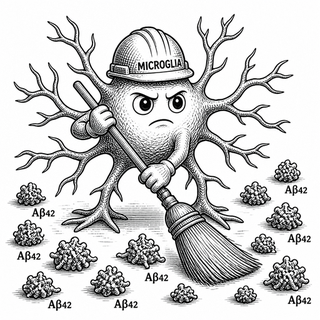
Meet the Brain's Overworked Cleanup Crew
Alzheimer's disease is best known for two messy protein characters: amyloid beta, which can clump outside neurons, and tau, which tangles inside them. Amyloid beta comes in different forms, including Aβ40 and Aβ42. Aβ42 is the clingier one, the friend who says "just one more ride" and somehow causes a three-hour line at the roller coaster.
The brain does have cleanup cells. They are called microglia, and they patrol the nervous system like security, janitors, and slightly nosy neighborhood-watch volunteers rolled into one. One job is phagocytosis, science-speak for "eat the suspicious junk." The catch is that microglia are not simple vacuum cleaners. In Alzheimer's, they can clear amyloid, inflame tissue, prune synapses, or get exhausted and weird. Microglia: helpful, moody, unionized in spirit.
The CD5L Plot Twist
Maehara and colleagues studied CD5L, also called AIM, a secreted protein associated with macrophages, the immune system's professional gobblers. Their question was direct: could CD5L help remove toxic amyloid beta and improve Alzheimer-like pathology?
In test-tube experiments, CD5L bound amyloid beta, especially Aβ42, and reduced its tendency to aggregate. That matters because amyloid is not just plaques sitting around like brain gum. Smaller soluble oligomers can be especially nasty to synapses, the message-passing contact points neurons use to keep your thoughts from turning into a buffering symbol.
Then the team looked at microglia. CD5L boosted microglial uptake of several forms of Aβ40 and Aβ42. In other words, it seemed to make amyloid more appetizing to the cells that already carry the cleanup badge.
Mice, Memory, and the T-Maze Mini-Coaster
The researchers then moved into 5xFAD mice, a fast-moving Alzheimer's mouse model engineered to produce heavy amyloid pathology. These mice are useful for testing amyloid biology, although they are not tiny humans with tiny Medicare paperwork. Mouse models are tools, not crystal balls.
Using forced CD5L expression, the team saw fewer and smaller amyloid plaques. RNA sequencing suggested that microglia in the mouse brain shifted toward more phagocytic activity. Then came the behavior test: after adeno-associated virus delivery of CD5L, mice performed better in the T-maze, a memory task that is basically "which arm of this little hallway did I already visit?" It is not the SAT, but for a mouse, it is a respectable Tuesday.
That combination gives the paper zip: CD5L did not just poke one readout. It bound amyloid, slowed aggregation, encouraged microglia to eat amyloid, reduced plaques, and improved a cognitive measure in an amyloid-heavy model.
Why This Is More Than Another Amyloid Detour
Amyloid research has had a rough public-relations ride. Recent antibody drugs that target amyloid, including lecanemab and donanemab, can slow decline for some people with early Alzheimer's, but the benefits are modest and the risks include amyloid-related imaging abnormalities, such as brain swelling or bleeding. That does not make amyloid irrelevant. It makes the ride more complicated than "remove plaque, roll credits."
This CD5L study points toward a different angle: help the brain's own immune cleanup system handle amyloid. That fits with recent work showing that microglial states are tied to amyloid clearance in immunized human Alzheimer's brains, and with studies showing that lipid-stuffed microglia lose their appetite for amyloid. Basically, if the cleanup crew is buried in paperwork and eating cold vending-machine chips, maybe do not blame the mop.
If CD5L-like strategies prove reproducible and safe, they could complement existing amyloid approaches. Instead of only tagging amyloid with antibodies, future therapies might tune local cleanup machinery, reduce toxic oligomers, and nudge microglia toward useful eating without kicking them into inflammatory chaos. That last part is the trick. Microglia with too little activity are a mess. Microglia with too much angry activity are also a mess. The therapeutic sweet spot is less "floor it" and more "please operate the ride at a responsible speed."
The Big Caveat, Wearing a Helmet
This is still preclinical mouse work. AAV delivery to the brain, long-term immune effects, dosing, timing, and whether human microglia respond the same way all need serious testing. Alzheimer's is not one broken switch. It is a control panel blinking at 2 a.m. while someone yells that the roller coaster is making a noise.
Still, the paper gives researchers a sharp new question: what if amyloid clearance is not only about attacking amyloid, but about making the cleanup job biologically easier? That is a promising thought, and frankly, the brain's janitorial department deserves better equipment.
References
- Maehara N, Hattori S, Nakamura A, et al. CD5L promotes phagocytic removal of amyloid β oligomers and improves cognitive function in a mouse model of Alzheimer's disease. Cell Reports. 2026;45(6):117468. doi:10.1016/j.celrep.2026.117468
- Brown GC, St George-Hyslop P, Paolicelli RC, Lemke G. Microglial phagocytosis in Alzheimer disease. Nature Reviews Neurology. 2026;22(1):54-69. doi:10.1038/s41582-025-01162-y
- Karran E, De Strooper B. The amyloid hypothesis in Alzheimer disease: new insights from new therapeutics. Nature Reviews Drug Discovery. 2022;21(4):306-318. doi:10.1038/s41573-022-00391-w
- van Olst L, Simonton B, Edwards AJ, et al. Microglial mechanisms drive amyloid-β clearance in immunized patients with Alzheimer's disease. Nature Medicine. 2025;31(5):1604-1616. doi:10.1038/s41591-025-03574-1 PMCID: PMC12092304
- Wu X, Miller JA, Lee BTK, Wang Y, Ruedl C. Reducing microglial lipid load enhances β amyloid phagocytosis in an Alzheimer's disease mouse model. Science Advances. 2025;11(6):eadq6038. doi:10.1126/sciadv.adq6038 PMCID: PMC11797491
- Prakash P, Manchanda P, Paouri E, et al. Amyloid-β induces lipid droplet-mediated microglial dysfunction via the enzyme DGAT2 in Alzheimer's disease. Immunity. 2025;58(6):1536-1552.e8. doi:10.1016/j.immuni.2025.04.029 PMCID: PMC12168635
Disclaimer: The image accompanying this article is for illustrative purposes only and does not depict actual experimental results, data, or biological mechanisms.