
Consider this: at 10 p.m. on a sticky June night, your body is negotiating with its internal clocks about sleep, temperature, hormones, and whether one more email counts as "urgent." Biology loves timing. It also loves location. In pancreatic cancer, a new Cell Reports study suggests that where immune cells gather after chemotherapy may matter almost as much as whether they gather at all. The surprising address? Right next to nerves.
The Tumor Has a Neighborhood Problem
Pancreatic ductal adenocarcinoma, or PDAC, is the grimly efficient kind of cancer that makes oncologists speak in careful sentences. It often hides until late, resists immune attack, and surrounds itself with dense scar-like tissue that behaves less like a welcoming lobby and more like airport security with a grudge. SEER data put overall five-year survival in the low-teens.
One strategy is neoadjuvant therapy, meaning chemotherapy before surgery. Think of it as shrinking the enemy's supply chain before sending in the surgeons. Doctors still need better ways to tell whose tumor is responding, beyond scanning, sampling, and hoping the biological stock market moves in the right direction.
Meet the Immune System's Pop-Up Lymph Nodes
Tertiary lymphoid structures, or TLSs, are organized clusters of immune cells that form outside normal lymph nodes. They can include B cells, T cells, dendritic cells, and germinal-center-like zones where immune responses get refined. In plain English, they are pop-up immune offices built inside inflamed tissue. Very bureaucratic, but useful.
Cancer researchers care because TLSs often show up where the immune system is not merely wandering around muttering into a walkie-talkie, but organizing. Reviews in Science and Nature Reviews Cancer describe TLSs as local immune hubs linked in many cancers to better prognosis or stronger therapy responses, although their function varies by tumor type and maturity. Pancreatic cancer studies have also connected mature TLSs with tumor-specific immune activity.
The Nerve Twist
Cai and colleagues studied tissue from 86 treatment-naive patients and 49 patients who had received neoadjuvant chemotherapy for PDAC. Chemotherapy was associated with more nerve density and more TLS abundance. But the sharper finding was spatial: TLSs located near nerves, which the authors call nerve-proximal TLSs or N-TLSs, looked more mature and correlated with stronger tumor regression.
This is the legal case in miniature. Claim: not all TLSs may carry the same information. Evidence: the ones parked near nerves looked more developed and tracked with treatment response. Counterargument: proximity is not proof that nerves caused the immune hubs or that the hubs caused tumor shrinkage. Resolution: location may still be useful as a biomarker, even before anyone proves the full chain of command.
That matters because tumors are not bags of bad cells. They are chaotic little economies. Cancer cells buy growth signals, stromal cells build infrastructure, immune cells enforce or ignore regulations, and nerves may quietly influence the market. Nobody elected the nerves to the board, but here we are.
Schwann Cells Enter the Chat
The study also used spatial transcriptomics around nerve regions and found chemotherapy-linked changes in Schwann cells, the support cells that wrap and maintain peripheral nerves. Schwann cells usually have a respectable day job: helping nerves conduct signals and recover from injury. After chemotherapy, their gene programs shifted, including altered myelination-related signals and more pro-inflammatory signaling.
That does not mean Schwann cells are heroically waving tiny immune flags. Biology rarely gives us villains and heroes. It gives us committees. But the Schwann cell shift lined up with TLS accumulation, maturation, and more immune infiltration around nerves. The authors argue for a neuro-immune axis after chemotherapy.
Why This Could Matter
If these findings hold up in larger cohorts, pathologists might one day score not just whether TLSs exist, but where they sit. A mature immune pop-up shop near a nerve could help identify tumors that were more chemotherapy-sensitive. That could sharpen prognosis after surgery, improve trial design, or guide follow-up.
It could also push pancreatic cancer research toward a more spatial view of treatment response. The question becomes less "Are immune cells present?" and more "Are the right cells organized in the right neighborhood at the right time?"
The catch, because science always leaves one sock in the dryer, is that this is still biomarker-level evidence. The study nominates N-TLS abundance as a histological marker of response in resected PDAC. It does not prove that inducing nerve-proximal TLSs would make chemotherapy work better.
Still, the idea is wonderfully unsettling: after chemotherapy, pancreatic tumors may reveal vulnerability not only through dead cancer cells, but through immune structures gathering near nerves. The immune system, the nervous system, and cancer are trading signals across the same messy floor.
References
- Cai S, Yang MW, Jiang L, Weng Z, Wang X, Ma X, Huo YM, Liu W, Zhang S, Jiang SH. Nerve-proximal tertiary lymphoid structures predict chemotherapy sensitivity in pancreatic cancer. Cell Reports. 2026;45(6):117496. doi:10.1016/j.celrep.2026.117496
- Teillaud JL, Houel A, Panouillot M, Riffard C, Dieu-Nosjean MC. Tertiary lymphoid structures in anticancer immunity. Nature Reviews Cancer. 2024;24:629-646. doi:10.1038/s41568-024-00728-0
- Schumacher TN, Thommen DS. Tertiary lymphoid structures in cancer. Science. 2022;375:eabf9419. doi:10.1126/science.abf9419
- Kinker GS, Vitiello GAF, Diniz AB, et al. Mature tertiary lymphoid structures are key niches of tumour-specific immune responses in pancreatic ductal adenocarcinomas. Gut. 2023;72:1927-1941. doi:10.1136/gutjnl-2022-328697
- Zou X, Lin X, Cheng H, et al. Characterization of intratumoral tertiary lymphoid structures in pancreatic ductal adenocarcinoma: cellular properties and prognostic significance. Journal for ImmunoTherapy of Cancer. 2023;11:e006698. doi:10.1136/jitc-2023-006698, PMCID: PMC10410893
- Springfeld C, Ferrone CR, Katz MHG, Philip PA, Hong TS, Hackert T, Buchler MW, Neoptolemos JP. Neoadjuvant therapy for pancreatic cancer. Nature Reviews Clinical Oncology. 2023;20:318-337. doi:10.1038/s41571-023-00746-1
- National Cancer Institute SEER Program. Cancer Stat Facts: Pancreatic Cancer. https://seer.cancer.gov/statfacts/html/pancreas.html
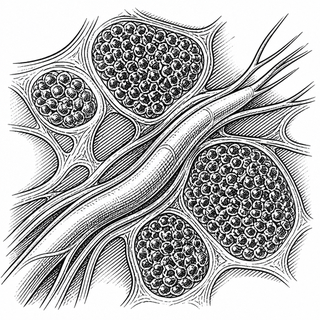
Disclaimer: The image accompanying this article is for illustrative purposes only and does not depict actual experimental results, data, or biological mechanisms.