
A neurologist walks into a bar and says, "My patients can feel a feather, find their knees with their eyes closed, and know when their lungs are full because their cells run better pressure sensors than my tires."
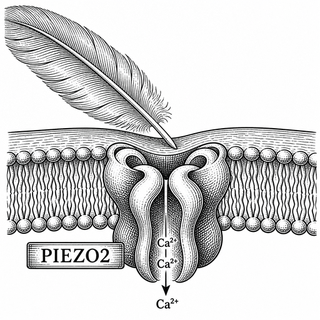
That pressure sensor is often PIEZO2: a force-gated ion channel, a tiny pore in a cell membrane that opens when tissue gets poked, stretched, or squeezed. Charged particles flow through, and a mechanical shove turns into an electrical message. That is mechanotransduction: "something moved" becomes "the wiring should know about this."
Same Engine, Different Trim
PIEZO2 helps with light touch, proprioception, lung inflation, gut movement, bladder filling, and mechanical pain. If your car's door latch also managed the brakes, radiator, and cruise control, you would ask a few questions.
One answer is alternative splicing. Cells can read the same gene and assemble different protein versions by including or skipping exons. Same engine block, different factory options: stiffer spring here, different gasket there, maybe a throttle cable that skipped coffee.
Human PIEZO2 has seven alternatively spliced regions and at least 22 known variants. Sindoni, Sharp, and Grandl wanted to know whether those variants actually change the channel's sensitivity to membrane tension, not just its paperwork (Sindoni et al., 2026).
Putting the Sensor on the Lift
The team used cell-attached pressure-clamp electrophysiology with differential interference contrast microscopy. In shop-floor English: they pulled little domes of cell membrane into glass pipettes, applied pressure, watched the membrane shape, and measured when PIEZO2 opened. This let them translate pressure into membrane tension instead of saying, "we poked it pretty good."
They compared a minimal human PIEZO2 version with most optional exons left out, hPiezo2min, against a maximal version, hPiezo2max. The max version opened at lower membrane tension. Its half-maximal activation was about 2.0 mN/m, compared with about 3.7 mN/m for the minimal version. In garage terms, one switch clicked with a feather touch; the other wanted you to lean on the panel.
Exon 35 Is the Adjustment Screw
The researchers added or removed individual exons to see which one changed the feel of the channel. Exon 35 stood out. Adding exon 35 to the minimal channel shifted it toward high sensitivity, dropping the half-activation tension to about 2.4 mN/m. It also made cells respond to shallower indentation.
That does not mean exon 35 built the whole machine. Biology rarely works that cleanly, because cells enjoy making mechanics look underqualified. But exon 35 acted like a serious adjustment screw for PIEZO2's force threshold. Other tested exons did not individually move tension sensitivity much, although exon 22 was needed for functional currents at all. Some parts tune the ride; some parts keep the wheels attached.
The tissue angle makes the story sharper. The very sensitive hPiezo2max version occurs in human dorsal root ganglia, where touch and body-position neurons live. A different physiological variant, common in human lung tissue and lacking exon 35, needed more tension and responded across a wider range. So PIEZO2 is not just an on-off button. Depending on its splice setup, it can act like a hair-trigger switch or a dashboard gauge that keeps reading as the load climbs.
Why This Matters Beyond the Bench
If these findings hold up in native tissues and living systems, they help explain how one channel family handles so many jobs without turning the body into a miswired dashboard. Skin may need a sensor that notices a shirt sleeve. Lung, gut, and bladder circuits may need sensors that track stretch over a broader range. Nobody wants a colon with a binary warning light. That is how you get meetings.
The clinical neighborhood is not quiet either. PIEZO2 loss-of-function mutations can impair touch and proprioception, while other work links PIEZO2 to tactile allodynia, where a gentle touch feels painful. Recent studies also tie PIEZO2 to gut transit and internal organ sensing (Szczot et al., 2021; Servin-Vences et al., 2023). This new paper does not deliver a treatment, and no one should start filing insurance codes for "exon 35 tune-up." But it gives researchers a cleaner parts diagram.
The next jobs: test these variants in the cells that naturally use them, learn what exon 35 physically changes, and figure out how splicing teams up with cytoskeletal tethers, accessory proteins, and lipids. The machine is still on the lift. At least now the mechanics know which bolt to stare at suspiciously.
References
- Sindoni M, Sharp W, Grandl J. Piezo2 tension sensitivity and its modulation by alternative splicing. Cell Reports. 2026;45(6):117521. DOI: 10.1016/j.celrep.2026.117521. PMID: 42247293.
- Xiao B. Mechanisms of mechanotransduction and physiological roles of PIEZO channels. Nature Reviews Molecular Cell Biology. 2024;25(11):886-903. DOI: 10.1038/s41580-024-00773-5.
- Szczot M, Nickolls AR, Lam RM, Chesler AT. The Form and Function of PIEZO2. Annual Review of Biochemistry. 2021;90:507-534. DOI: 10.1146/annurev-biochem-081720-023244. PMCID: PMC8794004.
- Handler A, Ginty DD. The mechanosensory neurons of touch and their mechanisms of activation. Nature Reviews Neuroscience. 2021;22:521-537. DOI: 10.1038/s41583-021-00489-x. PMCID: PMC8485761.
- Verkest C, Schaefer I, Nees TA, et al. Intrinsically disordered intracellular domains control key features of the mechanically-gated ion channel PIEZO2. Nature Communications. 2022;13:1365. DOI: 10.1038/s41467-022-28974-6. PMCID: PMC8924262.
- Servin-Vences MR, Lam RM, Koolen A, et al. PIEZO2 in somatosensory neurons controls gastrointestinal transit. Cell. 2023;186:3386-3399.e15. DOI: 10.1016/j.cell.2023.07.006. PMCID: PMC10501318.
Disclaimer: The image accompanying this article is for illustrative purposes only and does not depict actual experimental results, data, or biological mechanisms.