
Maya quits nicotine on a Monday, because apparently Monday needed more enemies. By Tuesday, her brain's reward desk is filing complaints, the stress department has unionized, and some tiny chemical accountant is asking why the usual supply of comfort signals has gone missing.
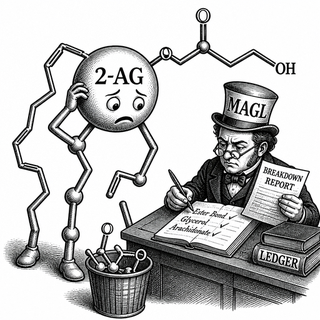
That accountant is monoacylglycerol lipase, mercifully shortened to MAGL. It breaks down 2-arachidonoylglycerol, or 2-AG, one of the brain's homemade cannabinoid molecules. Yes, your brain makes cannabis-ish compounds. No, this does not mean your hippocampus is wearing a tie-dye shirt.
The new systematic review by Jebanesan and colleagues asks a clean question: when drugs of abuse push the brain around, does MAGL matter? The answer, after 42 preclinical studies, is less "one magic addiction switch" and more "regional middle manager with surprising influence during withdrawal" Jebanesan et al., 2026.
Meet MAGL, The Signal Shredder
The endocannabinoid system works like a market for neural calm. Neurons make 2-AG when they need to send a backward message across the synapse: ease up, reduce release, stop turning this group chat into a siren. CB1 and CB2 receptors receive the message. MAGL clears 2-AG away so the signal does not hang around forever, like a meeting invite that refuses to die.
That cleanup role matters because addiction is not just "reward got too loud." It is also a supply-chain problem. Drugs can flood reward circuits, alter stress systems, and make normal pleasures feel underfunded. When the drug disappears, withdrawal can arrive with anxiety, pain sensitivity, irritability, sleep disruption, and cravings - every department sending an urgent email at once.
The Review's Big Claim: Withdrawal Is The Better Lead
Across the studies, chronic substance exposure produced only modest, region-specific shifts in MAGL protein. Alcohol increased MAGL in the hippocampus. The striatum, a reward-and-habit hub, mostly did not show big MAGL changes across substances. The prefrontal cortex, the brain's "maybe don't text your ex" region, changed mainly after repeated stimulant exposure.
So if MAGL expression itself is not dramatically changing everywhere, why care? Because manipulating MAGL function often changed behavior. Inhibiting MAGL, which raises 2-AG by slowing its breakdown, consistently reduced withdrawal-like behaviors across cannabis, opioid, and nicotine models. Effects on reward were messier: stronger for reducing opioid-related reward, less dependable elsewhere.
That distinction is the interesting part. Addiction research often chases reward, because dopamine gets the headlines and frankly has a good publicist. But withdrawal is where many people lose the negotiation. If the brain's internal economy punishes abstinence hard enough, relapse can look less like "bad choice" and more like "the central bank just set interest rates on misery."
The Opioid Plot Twist
A 2024 Science Advances study adds a useful clue. Martinez-Rivera and colleagues raised 2-AG levels with a MAGL inhibitor and found that this blunted opioid reward in mice without reducing opioid pain relief Martinez-Rivera et al., 2024, PMCID: PMC11606496. Imagine keeping analgesia while turning down the reward signal that makes opioids so dangerous. That is not a treatment plan yet. It is a promising invoice from biology that still needs legal review.
Clinical perspectives explain why researchers keep circling this system. Medication options remain thin, especially for stimulant and cannabis use disorders, and cannabis research is still playing catch-up with modern use patterns Haney, 2022. A 2026 NIH overview makes the same point: addiction treatment needs more biological targets NIH, 2026. Meanwhile, a 2026 Molecular Psychiatry review found endocannabinoid modulation in alcohol use disorder looks more consistent in preclinical models than in human studies so far, which is science politely saying, "please do not confuse a cage study with a clinic" Costa et al., 2026.
Why This Matters Without Overhyping It
The sober case for MAGL is not that it cures addiction. It is sharper: MAGL may help explain the unpleasant abstinence states that keep drug use sticky. If future studies confirm this in humans, MAGL-targeted tools could help ease withdrawal, reduce relapse pressure, or image endocannabinoid changes in the living brain.
But the counterargument matters. MAGL touches pain, stress, inflammation, memory, and mood. Push it too hard or too long and the brain may adapt in ways we do not want. Older preclinical work found chronic MAGL blockade can desensitize CB1 signaling, the brain's version of canceling the subscription because everyone overused the free trial. A 2023 Psychological Medicine review makes the same general point: this system is attractive, but clinically tricky Hosking et al., 2023.
So the verdict is not "MAGL is the answer." It is "MAGL is a serious witness." This review organizes a scattered field and suggests addiction neuroscience should spend less time treating withdrawal like an afterparty and more like a main event. The reward circuit may start the trade, but withdrawal may collect the debt.
References
Jebanesan B, Brouillette K, Browne CJ, Boileau I, Best LM. The Role of Monoacylglycerol Lipase (MAGL) in Substance Use: A Systematic Review of Preclinical Studies. Biological Psychiatry. 2026. https://doi.org/10.1016/j.biopsych.2026.06.011
Martinez-Rivera A, Fetcho RN, Birmingham L, et al. Elevating levels of the endocannabinoid 2-arachidonoylglycerol blunts opioid reward but not analgesia. Science Advances. 2024;10(48). https://doi.org/10.1126/sciadv.adq4779. PMCID: PMC11606496
Costa GPA, Cerezo-Matias MA, Funaro MC, et al. Modulating the endocannabinoid system in alcohol use disorder: A translational systematic review and meta-analysis of preclinical and human studies. Molecular Psychiatry. 2026;31:3849-3871. https://doi.org/10.1038/s41380-026-03523-5
Haney M. Cannabis Use and the Endocannabinoid System: A Clinical Perspective. American Journal of Psychiatry. 2022;179(1):21-25. https://doi.org/10.1176/appi.ajp.2021.21111138
Hosking JG, Ahmad T, Connor M, et al. The endocannabinoid system as a putative target for the development of novel drugs for the treatment of psychiatric illnesses. Psychological Medicine. 2023. https://doi.org/10.1017/S0033291723002465
Disclaimer: The image accompanying this article is for illustrative purposes only and does not depict actual experimental results, data, or biological mechanisms.