
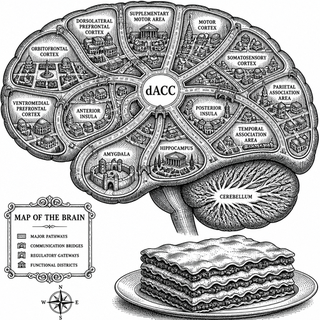
A brain is a city with neighborhoods, highways, utility pipes, and the dorsal anterior cingulate cortex is one of those downtown intersections where traffic, alarms, and lunch orders collide. It helps you push through hard tasks, notice conflict, track reward, react to fear, and season pain with emotion. It is the civic planner who also yells at the line cook. I am eating toast while writing this, which fits: this paper is about layers, heat, and refusing to treat the brain like a smoothie.
Stop Blending the Soup
For years, studying gene expression in brain tissue often meant grinding up a region and asking, "What genes are active in here?" Useful, yes. But also like pureeing an entire lasagna and then trying to identify the basil. Single-nucleus RNA sequencing reads gene activity from individual cell nuclei. Spatially resolved transcriptomics keeps the tissue map intact, so researchers can see where those molecular flavors sit in the cortical dish.
Shah and colleagues paired both methods in the human dorsal anterior cingulate cortex, using tissue from ten adult neurotypical donors. They identified cell types with single-nucleus RNA-seq, mapped gene expression back onto tissue, and used non-negative matrix factorization - a computational way to pull recurring molecular "recipes" out of a big messy pantry - to infer where those programs live in the dACC Shah et al., 2026.
The dACC Is Not Just Prefrontal Leftovers
The dACC sits in the anterior cingulate cortex, wrapped near the corpus callosum like a neural collar. The dorsal part connects with prefrontal, parietal, motor, and attention systems, which is very "I know a guy in every department." It also belongs in conversations about pain, fear, reward, effort, and error monitoring.
What makes this region extra spicy is its structure. Unlike the more neatly layered dorsolateral prefrontal cortex, the dACC is agranular, meaning it lacks a clear layer 4. It also contains von Economo neurons, large spindle-shaped cells that look like someone stretched a pyramidal neuron on a pasta machine. They are rare and hard to study, which is exactly the kind of sentence that makes neuroscientists reach for stronger coffee.
The new study compared dACC data with dlPFC data from the same donors. That matters because the dlPFC has already been mapped with single-cell and spatial methods, including a 2024 Science atlas that linked molecular domains to cell composition, cell-cell interactions, and neuropsychiatric risk signals Huuki-Myers et al., 2024. Same-donor comparisons reduce some of the "real biology or freezer archaeology?" problem.
A Molecular Mise en Place
The big idea is not that the dACC has one magic gene for grit, pain, or "please do your taxes." Brains rarely cook with one ingredient. The paper instead gives researchers a mise en place: which cells are there, where their molecular patterns sit, and how some patterns relate to connectivity or disease-risk datasets.
That is useful because psychiatric and neurological conditions often look region-wide from far away but cell-specific up close. A disorder might not "hit the dACC" evenly, any more than burning the garlic means the whole dinner is cursed. Spatial maps help scientists ask sharper questions: Which cells carry risk signals? Which subregions change most? Which circuits are simmering too hot?
This is part of a larger shift. Reviews describe how spatial tools preserve physical context instead of separating genes from their tissue addresses Moffitt et al., 2022, and practical introductions explain why pairing spatial data with single-cell data helps researchers interpret complex tissue Williams et al., 2022. Human atlases have expanded beyond cortex, too: a 2025 Nature Neuroscience hippocampus atlas used a similar strategy to map molecular organization in a region tied to cognition and mood Thompson et al., 2025.
Why This Might Matter Later
If the findings hold up in larger, more diverse samples, this kind of atlas could improve how researchers study depression, schizophrenia, chronic pain, PTSD, and conditions involving control, threat, reward, and emotional regulation. Not by producing a pill next Tuesday - science is many things, but it is not DoorDash - but by giving future experiments better coordinates.
For neuromodulation, drug discovery, and disease genetics, coordinates matter. A treatment aimed at a brain region without cell and layer context is like salting soup in the dark. Sometimes it works. Sometimes everybody politely drinks water.
The caveats are real. Ten donors is a strong start for paired human tissue work, not the final cookbook. Postmortem samples cannot show living activity in real time. Spatial transcriptomics still involves inference, and disease associations from public datasets are pointers, not verdicts. But the paper gives the dACC a richer address book, like finding the kitchen blueprint after years of blaming the smoke alarm.
References
- Shah K, Totty MS, Bach SV, et al. Spatio-molecular gene expression reflects dorsal anterior cingulate cortex structure and function in the human brain. Cell Reports. 2026;45(6):117500. https://doi.org/10.1016/j.celrep.2026.117500
- Huuki-Myers LA, Spangler A, Eagles NJ, et al. A data-driven single-cell and spatial transcriptomic map of the human prefrontal cortex. Science. 2024;384(6698):eadh1938. PMCID: PMC11398705. https://doi.org/10.1126/science.adh1938
- Moffitt JR, Lundberg E, Heyn H. The emerging landscape of spatial profiling technologies. Nature Reviews Genetics. 2022;23(12):741-759. https://doi.org/10.1038/s41576-022-00515-3
- Williams CG, Lee HJ, Asatsuma T, Vento-Tormo R, Haque A. An introduction to spatial transcriptomics for biomedical research. Genome Medicine. 2022;14(1):68. PMCID: PMC9238181. https://doi.org/10.1186/s13073-022-01075-1
- Thompson JR, Nelson ED, Tippani M, et al. An integrated single-nucleus and spatial transcriptomics atlas reveals the molecular landscape of the human hippocampus. Nature Neuroscience. 2025;28(9):1990-2004. PMCID: PMC12411265. https://doi.org/10.1038/s41593-025-02022-0
Disclaimer: The image accompanying this article is for illustrative purposes only and does not depict actual experimental results, data, or biological mechanisms.