
In the brain's white matter, take the insulated cable routes until you reach the edge of a mixed active/inactive multiple sclerosis lesion: the ragged neighborhood where myelin has gone missing, axons are trying to keep the lights on, and immune cells are loitering with clipboards.
That is where this new Cell Reports study sets up shop. The researchers looked at postmortem human brain tissue from people with multiple sclerosis (MS) and asked a deceptively simple question: are microglia just present at these lesions, or do their different states help explain whether a lesion expands or starts looking repair-friendly?
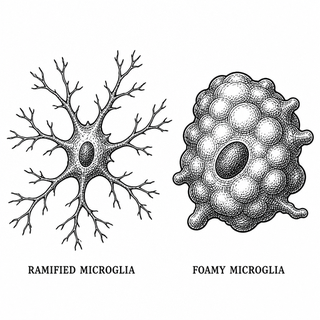
The answer: shape matters. Not because cells are vain. Though if microglia had LinkedIn, they would absolutely list "dynamic morphology" under skills.
Meet The Tiny Building Inspectors
Microglia are the brain's resident immune cells. They patrol. They clean. They remove debris. They yell molecularly when something seems off. In MS, the insulation around nerve fibers, called myelin, gets damaged. That damage forms lesions, which can interfere with signaling and contribute to symptoms like weakness, numbness, vision problems, fatigue, and the general feeling that your nervous system has opened too many browser tabs.
MS lesions do not all behave the same way. Some keep expanding. Some stabilize. Some show signs of remyelination, where the nervous system tries to replace lost myelin. That repair effort matters because myelin helps axons survive and communicate. Without it, nerve fibers are like phone chargers with the rubber chewed off: technically present, spiritually unwell.
Foamy Cells Are Not Here For A Spa Day
Aletta van den Bosch and colleagues used single-cell-resolution spatial transcriptomics, which is a fancy way of saying they measured gene activity while preserving where cells sat in the tissue. This matters. If ordinary sequencing is dumping a city into a blender and asking what businesses existed there, spatial transcriptomics keeps the street map.
They compared lesions dominated by two microglial looks: ramified microglia, which have thin branching arms, and foamy microglia, which look swollen because they have eaten lipid-rich debris, including damaged myelin.
The patterns split hard.
Lesions with ramified microglia showed gene programs linked to myelin stability and axonal support. That sounds like a neighborhood where the repair crew has found the breaker box and might actually fix something.
Lesions with foamy microglia looked much rougher. They carried signals of immune activation, immunoglobulin production, complement activity, iron dysregulation, immune-activated oligodendrocytes, and demyelination. Complement is part of the immune system's tagging-and-destroying machinery. Useful against invaders. Less charming when it starts behaving like a bouncer who has mistaken the entire building for a threat.
The study does not prove foamy microglia cause lesion expansion. It shows that foamy and ramified states sit in distinct immune-glial niches, and those niches align with damage versus repair biology. Correlation is not causation. It is, however, a suspicious person standing next to the broken window holding a brick.
Why This Is A Big Deal Without Needing Trumpets
For years, microglia in MS have been hard to label as "good" or "bad." Reviews in Nature Reviews Neuroscience and Neuron make the same point: microglia can damage myelin and axons, but they can also clear debris and support repair (Distefano-Gagne et al., 2023; Yong, 2022). That is annoying for anyone who wants a clean villain. Biology rarely provides one. Biology provides a committee.
This new paper fits into a larger shift. Chronic active MS lesions appear to involve local immune circuits, including lymphocytes, microglia, and astrocytes (Absinta et al., 2021). Spatial and single-cell studies are now mapping lesion rims, cores, vessels, glial scars, and repair zones with far more precision (Lerma-Martin et al., 2024). The message is blunt: an MS lesion is not a blob. It is a bad neighborhood with zoning laws.
The Clinical Dream, And The Cold Shower
If these findings hold up in larger studies, they could help researchers identify which lesions are more likely to expand and which are more permissive for repair. That could sharpen imaging biomarkers, guide patient stratification, and point toward therapies that calm destructive immune-glial niches while preserving the useful cleanup work. The goal is not to delete microglia. That would be like firing the janitor because the building is dirty.
The harder target is remyelination. Current MS treatments are much better at reducing inflammatory relapses than rebuilding damaged myelin or stopping quiet progression. Recent reviews argue that neurodegeneration, demyelination, and repair failure all need to be studied together, because disability does not politely stay in one mechanistic lane (Garton et al., 2024; Kuhlmann et al., 2023).
So this study gives us a sharper map, not a cure. Still, maps matter. Especially when the terrain is a human brain and the locals are microscopic immune cells with commitment issues.
References
- van den Bosch AMR, Khoo JH, Lu Z, et al. Microglial states associate with lesion dynamics in multiple sclerosis. Cell Reports. 2026;45(6):117538. doi:10.1016/j.celrep.2026.117538
- Distefano-Gagne F, Bitarafan S, Lacroix S, Gosselin D. Roles and regulation of microglia activity in multiple sclerosis: insights from animal models. Nature Reviews Neuroscience. 2023;24(7):397-415. doi:10.1038/s41583-023-00709-6
- Yong VW. Microglia in multiple sclerosis: Protectors turn destroyers. Neuron. 2022;110(21):3534-3548. doi:10.1016/j.neuron.2022.06.023
- Absinta M, Maric D, Gharagozloo M, et al. A lymphocyte-microglia-astrocyte axis in chronic active multiple sclerosis. Nature. 2021;597(7878):709-714. doi:10.1038/s41586-021-03892-7 PMCID: PMC8719282
- Lerma-Martin C, Badia-I-Mompel P, Ramirez Flores RO, et al. Cell type mapping reveals tissue niches and interactions in subcortical multiple sclerosis lesions. Nature Neuroscience. 2024;27(12):2354-2365. doi:10.1038/s41593-024-01796-z PMCID: PMC11614744
- Garton T, Gadani SP, Gill AJ, Calabresi PA. Neurodegeneration and demyelination in multiple sclerosis. Neuron. 2024;112(19):3231-3251. doi:10.1016/j.neuron.2024.05.025 PMCID: PMC11466705
- Kuhlmann T, Moccia M, Coetzee T, et al. Multiple sclerosis progression: time for a new mechanism-driven framework. The Lancet Neurology. 2023;22(1):78-88. doi:10.1016/S1474-4422(22)00289-7 PMCID: PMC10463558
Disclaimer: The image accompanying this article is for illustrative purposes only and does not depict actual experimental results, data, or biological mechanisms.