If you Google circular RNA and memory, you'll find a confusing buffet: cancer biomarkers, biotech pitches, Alzheimer’s headlines, and diagrams that look like pasta got tenure. That search is not wrong, exactly. It just hides the tastiest part: inside neurons, some circular RNAs may act less like passive genetic leftovers and more like tiny control knobs for how brain cells spend energy while learning.
Meet the RNA That Refuses to Have Ends
Most RNA is linear, with a beginning and an end, like a molecular text message that eventually gets deleted. Circular RNA, or circRNA, has its ends stitched together into a loop. That closed shape makes it unusually stable, which is handy in neurons, the cellular equivalent of remote mountain cabins with terrible delivery service.
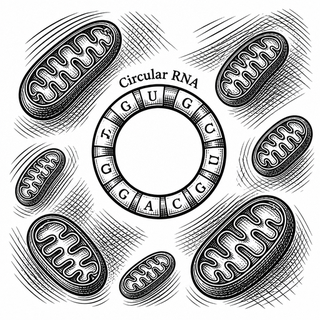
The new study by Chanda and colleagues focuses on one such loop, circSamm50, in hippocampal neurons, the kind of brain cells that spend their days helping experiences leave a dent in memory. When the researchers chemically triggered long-term potentiation, a lab model of synapses getting stronger after activity, circSamm50 rose sharply. That is already a nice clue. Neurons do not usually fire up molecular paperwork for no reason, although frankly they do enjoy making everything complicated.
The Sponge, the Message, and the Mitochondrial Kitchen
circSamm50 comes from the Samm50 gene. The regular Samm50 messenger RNA helps make SAMM50, a protein in the outer membrane of mitochondria. Mitochondria are often called powerhouses, but in neurons they are more like a kitchen, battery pack, traffic crew, and emergency snack drawer rolled into one anxious organelle.
The proposed chain is elegant. circSamm50 binds, or "sponges," a small regulatory molecule called miR-186-5p. MicroRNAs usually tone down target messenger RNAs, like tiny editors who keep stamping "too much" on genetic drafts. By soaking up miR-186-5p, circSamm50 helps preserve Samm50 mRNA levels. More stable Samm50 messaging means mitochondria have better support for their shape, movement, and energy production.
This is where the finding gets its notes of warm circuitry and a lingering finish of cellular logistics. When the team acutely depleted circSamm50 with CRISPR-Cas13, mitochondria changed shape, moved differently through neuronal compartments, and showed weaker bioenergetic performance. In a neuron, that is not a small housekeeping issue. Dendrites and synapses sit far from the cell body, so waiting for energy to drift in from headquarters is like ordering fries from another time zone.
Spines Need Fuel, Not Vibes
Dendritic spines are the tiny protrusions where many excitatory synapses land. They are small, but they are not dainty. A spine that strengthens during learning has to rearrange its internal scaffolding, adjust receptors, and sometimes grow. That takes energy and local molecular coordination.
Chanda and colleagues found that losing circSamm50 impaired excitatory synaptic transmission, reduced spine density, and weakened structural plasticity triggered by two-photon glutamate uncaging, a technique that lets scientists stimulate individual spines with the precision of a very expensive laser pointer. In plain English: when circSamm50 went missing, neurons had a harder time doing the tiny shape-shifting trick that helps synapses encode experience.
This fits a broader pattern. Recent work has shown that dendritic mitochondria are positioned and stabilized near synapses to support plasticity, and that circRNAs are unusually abundant in neuronal processes and synapse-related gene networks. The brain, it turns out, may not merely use RNA loops as decorative molecular bracelets. Some loops seem to help decide which messages stay available when a synapse asks for more power.
Why This Actually Matters
The big appeal here is not that circSamm50 is tomorrow's memory pill. Please do not start shopping for artisanal mitochondrial boosters on the internet. The study was done in neuronal systems, not in people learning French verbs under battlefield conditions.
The appeal is mechanistic. Brain disorders from Alzheimer’s disease to psychiatric illness often involve synaptic dysfunction, mitochondrial stress, or both. Those two problems usually get discussed as separate disasters, like plumbing and electrical issues in the same doomed apartment. circSamm50 suggests a bridge: an activity-regulated RNA loop that connects gene regulation to mitochondrial performance and spine remodeling.
If future work confirms this pathway in living brains and disease models, circSamm50-like mechanisms could point toward new biomarkers or therapeutic targets. The bar is high. Researchers still need to learn where circSamm50 acts, how specific the miR-186-5p interaction is, whether the same system behaves similarly in human neurons, and what happens over real learning timescales. Biology loves a promising mechanism, then immediately asks for seventeen forms of ID.
Still, this paper gives us a sharper picture of memory’s backstage flavor: not just electricity, not just genes, not just mitochondria, but a small circular RNA helping tune the kitchen lights while synapses remodel the room.
References
Chanda K, Bapat O, Wingfield JL, et al. Activity-regulated circSamm50 modulates mitochondrial dynamics and spine structural plasticity. Cell Reports. 2026;45(6):117378. doi:10.1016/j.celrep.2026.117378. PMID: 42228570.
Hatzimanolis O, Sykes AM, Cristino AS. Circular RNAs in neurological conditions: computational identification, functional validation, and potential clinical applications. Molecular Psychiatry. 2025;30:1652-1675. doi:10.1038/s41380-025-02925-1.
Kelly D, Bicker S, Winterer J, et al. A functional screen uncovers circular RNAs regulating excitatory synaptogenesis in hippocampal neurons. Nature Communications. 2025;16:3040. doi:10.1038/s41467-025-58070-4. PMID: 40155636.
Bapat O, et al. VAP spatially stabilizes dendritic mitochondria to locally support synaptic plasticity. Nature Communications. 2024;15:205. doi:10.1038/s41467-023-44233-8. PMID: 38177103.
Dong X, Bai Y, Liao Z, et al. Circular RNAs in the human brain are tailored to neuron identity and neuropsychiatric disease. Nature Communications. 2023;14:5327. doi:10.1038/s41467-023-40348-0. PMID: 37723137.
Disclaimer: The image accompanying this article is for illustrative purposes only and does not depict actual experimental results, data, or biological mechanisms.