
The road to understanding movement control is less like a clean highway and more like following a GPS that keeps insisting the laboratory mouse should turn left into a hedge. Neuroscientists have spent years asking whether mouse and primate motor cortex use the same route for skilled movement, or whether mice eventually hand the steering wheel to deeper brain circuits while cortex eats trail mix.
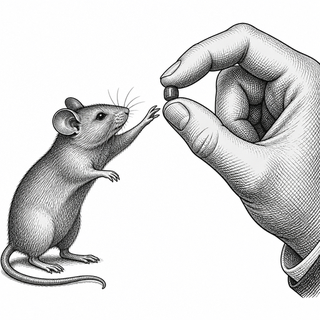
This new Cell Reports study by Aparicio and colleagues asks a practical question: what if the earlier map was drawn for the wrong trip? Gross movement and delicate grasping may look like cousins, but one is "reach toward the snack" and the other is "collect one pellet with tiny biological tweezers."
M1, the Fussy Stage Manager
Primary motor cortex, or M1, helps organize movement through descending pathways to brainstem and spinal circuits. It is not just a cartoon homunculus with a giant hand and the facial proportions of a cursed museum puppet. Modern motor cortex is messier, more overlapping, and deeply involved when fingers or forelimbs need precision.
The puzzle came from rodent studies suggesting that practice can make M1 less necessary for some learned movements. Researchers called this M1 "disengagement," which sounds like cortex unsubscribing from a group chat. But macaque work has not shown that neat exit. Were scientists comparing different motor chores and blaming the species?
The Pellet Is the Plot Twist
Aparicio and colleagues focused on prehension, the act of grasping or holding. In plain terms: getting the thing, pinching the thing, not flinging the thing into the void like a tiny trebuchet.
They compared mice and macaques on reach-to-grasp behavior and looked at what happened after M1 lesions. In macaques, broad reaching and gross motor control recovered relatively quickly, including a task built around gross movement. Fine control did not bounce back the same way. It stayed impaired. That pattern looks like rodent results when the task demands dexterity rather than simple limb transport.
The team also used detailed kinematic analysis, meaning they did not just score success like impatient referees at a snack Olympics. They examined the timing and structure of sub-movements during single-pellet reach-to-grasp tasks. The movement recipe got scrambled in similar ways.
Why This Is More Than Mouse Trivia
Animal models only work when we know what they model. A mouse is not a small, discount macaque wearing whiskers. But if gross movement recovers better than fine grasping after M1 damage across species, rodent work becomes more valuable for studying dexterity.
That stubborn part is where human rehabilitation struggles. After stroke or other motor injuries, people may regain larger arm movements before precise daily actions: buttoning a shirt, picking up coins, typing a password without summoning the security gods. Hand function is not just strength. It is timing, coordination, sensory feedback, and practice shaped by surviving circuits.
The broader literature fits. A 2021 review describes manual dexterity as a negotiation among motor commands, sensory feedback, spinal circuits, and hand biomechanics [1]. A 2023 mouse study found corticospinal activity was especially important for precise prehension, not simpler movement [2]. Neuron work showed major rat-macaque corticospinal differences [3], while a Cell study mapped cortex-to-medulla pathways for forelimb movement phases [4]. Translation: the movement system is not a single conductor. It is a committee, and several members brought clipboards.
The Takeaway With Fewer Lab Coats
The study's big message is not "mice are basically monkeys" or "M1 does everything." It is sharper: task design can make a brain region look optional or indispensable. Ask the motor system to move the limb, and backup routes may handle a lot. Ask it to perform fine prehension, and M1 looks harder to replace.
If these findings hold up, they could help researchers build better models of motor recovery and better tests for therapies. Instead of asking only whether an animal can reach the pellet, studies may need to ask how the tiny snack heist unfolds: recovered skill, or heroic compensation?
Brains are rude like that. They do not merely fail or recover. They improvise, reroute, and sometimes solve the wrong problem with theatrical confidence.
References
- Sobinov AR, Bensmaia SJ. The neural mechanisms of manual dexterity. Nature Reviews Neuroscience. 2021;22:741-757. https://doi.org/10.1038/s41583-021-00528-7
- Serradj N, Marino F, Moreno-Lopez Y, et al. Task-specific modulation of corticospinal neuron activity during motor learning in mice. Nature Communications. 2023;14:2708. https://doi.org/10.1038/s41467-023-38418-4
- Sinopoulou E, Rosenzweig ES, Conner JM, et al. Rhesus macaque versus rat divergence in the corticospinal projectome. Neuron. 2022;110:2970-2983.e4. https://doi.org/10.1016/j.neuron.2022.07.002
- Yang W, Kanodia H, Arber S. Structural and functional map for forelimb movement phases between cortex and medulla. Cell. 2023;186:162-177.e18. https://doi.org/10.1016/j.cell.2022.12.009
- Aparicio F, Ghuman H, Khanna P, et al. Conserved role of primary motor cortex in the control of prehension in mice and macaques. Cell Reports. 2026;45:117419. https://doi.org/10.1016/j.celrep.2026.117419
Disclaimer: The image accompanying this article is for illustrative purposes only and does not depict actual experimental results, data, or biological mechanisms.