
I'll admit, long-term potentiation is hard to write about because the name sounds like a supplement sold next to airport neck pillows. But stick with it, because LTP is one of the best clues we have for how a soggy three-pound organ turns "I tried that once" into "I can play the opening riff to 'Smoke on the Water,' badly but confidently."
Rodriguez-Moreno and Paulsen's new review in Physiological Reviews takes on the sprawling beast: what LTP is, how scientists study it, and why broken plasticity may sit under several brain disorders (DOI). It is not a flashy single-experiment paper. It is more like someone cleaned the neuroscience garage and labeled the drawers.
The Synapse Gets a Promotion
A synapse is the tiny meeting point where one neuron nudges another with chemical messages. Most days, this is cellular texting: "Fire?" "Maybe." "Send glutamate." Normal office chatter.
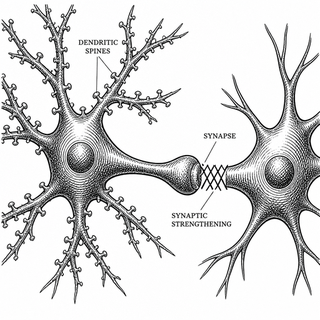
LTP happens when repeated activity makes that connection stronger for a long time. The classic version often involves NMDA receptors, calcium rushing in, CaMKII switching on, and AMPA receptors getting moved or tuned so the next signal lands harder. The synapse used to whisper, then someone handed it a microphone.
This is why LTP became a memory-mechanism celebrity. It has the right vibe: specific, durable, activity-dependent. Neurons that were active together get better at talking together. The brain hates tidy narratives, but LTP is one of the best cellular models we have.
Memory Is Not a Filing Cabinet
A useful way to think about LTP is less "saving a file" and more "changing the probability that a circuit will light up again." Your first bike ride is not sitting in a tiny hippocampal drawer labeled Trauma, Gravel, 1998. The network changes so a pattern becomes easier to replay, update, and connect.
That is where this review gets interesting: LTP is not one thing wearing one lab coat. There are presynaptic and postsynaptic versions, hippocampal forms, cortical forms, developmental forms, and astrocyte-influenced forms, because even the brain's support cells apparently demanded speaking roles. Neurons may be the stars, but astrocytes are the producers deciding whether the scene gets funded.
Recent work fills in the moving parts. Nicoll and Schulman reviewed CaMKII's dramatic relationship with synaptic memory, including why calling one molecule "the memory molecule" may be like calling one intern "the government" (DOI, PMCID). Ma and colleagues showed how neuronal activity can reach the nucleus and change gene expression, which matters for longer-lasting plasticity (DOI, PMCID).
The Molecules Start Doing Paperwork
Short-lived LTP can lean on existing proteins. Longer-lasting LTP needs new proteins, local dendritic translation, receptor trafficking, and structural changes at dendritic spines. Translation: the synapse does not just turn up the volume. It rearranges the furniture.
That is why studies of dendritic protein synthesis and receptor organization matter. Hacisuleyman and colleagues showed that activity can rapidly reprogram local translation in dendrites, where many synapses live (DOI, PMCID). Connor and Siddiqui reviewed synapse-organizing proteins as molecular codes that help determine how synapses form, function, and change (DOI).
The hard part is connecting beautiful slice experiments, where researchers zap pathways with precision, to real life, where you learn Spanish, smell toast, worry about taxes, and remember one embarrassing thing from 2007 all before breakfast.
When Plasticity Gets Too Plastic
If LTP helps circuits learn, bad plasticity can make circuits learn the wrong thing or fail to learn at all. Too little strengthening may contribute to cognitive decline. Too much or misdirected strengthening can show up in epilepsy, addiction, chronic pain, and fear learning that refuses to clock out.
That is the real-world hook. If these maps hold up as labs expand them, researchers could target useful plasticity without turning the brain into a rave with no exits: better rehabilitation after injury, sharper Alzheimer's and neurodevelopmental targets, and smarter noninvasive brain stimulation. In Alzheimer's models, restoring hippocampal metabolism rescued cognition across several pathologies, a reminder that synapses are not floating magic. They need fuel and a neighborhood that is not on fire (DOI, PMCID).
The Takeaway, Minus the Lab Coat
Rodriguez-Moreno and Paulsen's review treats LTP as both a classic idea and an unfinished puzzle. Sixty years after researchers first saw long-lasting synaptic strengthening, the field has moved from "Whoa, synapses can do that?" to "Which synapses, under what conditions, using which molecular machinery, in which disease, and please be specific because the brain has lawyers."
So yes, long-term potentiation has a terrible name. But the concept is gorgeous: experience leaves traces by changing the strength of conversation between cells. Your memories are not tiny movies in storage. They are living negotiations between excitable cells. For electrically active pudding, that is pretty good work.
References
Rodriguez-Moreno A, Paulsen O. Long-term potentiation in the brain: A synaptic memory mechanism. Physiological Reviews. 2026. https://doi.org/10.1152/physrev.00028.2025
Nicoll RA, Schulman H. Synaptic memory and CaMKII. Physiological Reviews. 2023;103(4):2877-2925. https://doi.org/10.1152/physrev.00034.2022. PMCID: PMC10642921
Ma H, Khaled HG, Wang X, et al. Excitation-transcription coupling, neuronal gene expression and synaptic plasticity. Nature Reviews Neuroscience. 2023;24(11):672-692. https://doi.org/10.1038/s41583-023-00742-5. PMCID: PMC12024187
Connor SA, Siddiqui TJ. Synapse organizers as molecular codes for synaptic plasticity. Trends in Neurosciences. 2023;46(11):971-985. https://doi.org/10.1016/j.tins.2023.08.001
Hacisuleyman E, Hale CR, Noble N, et al. Neuronal activity rapidly reprograms dendritic translation via eIF4G2:uORF binding. Nature Neuroscience. 2024;27(5):822-835. https://doi.org/10.1038/s41593-024-01615-5. PMCID: PMC11088998
Minhas PS, Jones JR, Latif-Hernandez A, et al. Restoring hippocampal glucose metabolism rescues cognition across Alzheimer's disease pathologies. Science. 2024;385(6711):eabm6131. https://doi.org/10.1126/science.abm6131. PMCID: PMC12313320
Disclaimer: The image accompanying this article is for illustrative purposes only and does not depict actual experimental results, data, or biological mechanisms.