
What if the best way to understand a neuron is not to ask what it is, but who it keeps texting at 2 a.m.? Counterintuitive answer: yes, apparently. A neuron's identity is not just its genes, shape, or general vibe under a microscope. It is also where its axon sends messages, like a socially anxious group-chat admin with strong opinions.
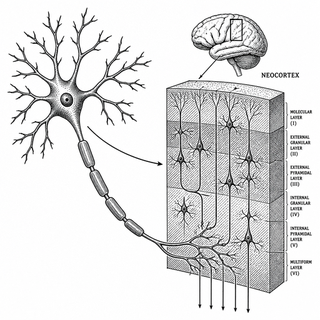
That is the idea behind a new Cell Reports study by Wang and colleagues: map whole neurons, pair those maps with genetic identity, and see whether cortical cell types make more sense when you stop judging them from the neck up.
The Neuron Has Receipts
The neocortex, the wrinkly outer layer doing much of the brain's high-end nonsense, contains many excitatory neurons. These cells push other neurons toward firing, like the enthusiastic friend who says, "We should start a band," despite owning no instruments.
For years, scientists have classified neurons by molecular markers, cell shape, electrical behavior, and where they live in the cortex. Useful? Absolutely. Complete? Not quite. A neuron can look similar to its neighbor and express similar genes, but send its axon to a totally different target. That is the difference between texting your dentist and texting your ex.
Wang and colleagues combined whole-neuron morphology reconstructions with paired genetic identities across 15 mouse cortical areas. Instead of just asking, "What genes does this cell express?" they asked, "Where does the entire cell go?" Dendrites, axons, long-range projections, the whole anatomical resume.
Ten Types Walk Into a Cortex
The team identified 10 stable excitatory cell types with conserved morphology and strong genetic correspondence. In plain English: full cellular shape plus genetic identity made certain neuron groups pop out.
That matters because neurons are not decorative houseplants. Their branches define what information they receive, and their axons define where they can send it. Dendrites are the inbox. Axons are the outbox. Synapses are the situationships where nobody fully knows what the signal means, but everyone is affected.
The study also found four output architectures, meaning these neurons use different strategies for broadcasting information. Some mostly talk within cortex. Others reach subcortical targets. Some patterns converge on downstream structures like friends recommending the same restaurant with suspicious intensity. Others follow spatial rules that differ when a pathway stays corticocortical versus heads out through corticofugal routes.
Why Bulk Maps Can Lie to Your Face
Older brain connectivity maps often use bulk tracing: inject a label into a region, watch where it goes, then infer the wiring. Useful, but it can blur individual neurons into one messy average. It is like understanding a dinner party by listening through the wall. You know people are talking. You do not know who is flirting, who is fighting, and who is explaining cryptocurrency without consent.
Single-neuron work fixes part of that problem. Peng and colleagues reconstructed 1,741 neurons and found major projection types with molecular correspondence, while showing that fine-grained morphology can escape simple transcriptomic bins (Nature, 2021; PMCID: PMC8494643).
Other projects pushed the scale harder. A 2022 Nature Neuroscience study mapped 6,357 prefrontal cortex projection neurons and identified 64 projectome-defined subtypes (doi:10.1038/s41593-022-01041-5). A 2024 Science paper reconstructed 10,100 hippocampal single-neuron projectomes and found 43 projection subtypes (doi:10.1126/science.adj9198). By 2025, Nature Methods studies used connectivity itself to classify subtypes and reconstruct single-neuron-scale mouse brain networks (doi:10.1038/s41592-025-02621-6; doi:10.1038/s41592-025-02784-2).
This new paper sits right in that momentum and adds a sharp point: whole-neuron morphology is not just pretty anatomy. It is a serious axis for defining cortical cell types.
The Payoff Is Better Brain Grammar
If these findings hold up and expand, they could improve how scientists build connectomes, the brain's wiring diagrams. Disorders of cognition, movement, perception, and mood do not happen in vague brain fog. They happen in cells, circuits, pathways, and timing. The amygdala may be the ex who overreacts to everything, but the real story usually involves whole networks redirecting signals.
This work does not hand doctors a new treatment tomorrow morning. Mouse cortical anatomy is not a prescription pad. But it gives neuroscience a cleaner vocabulary. Instead of saying "neurons from this region project over there, probably," researchers can ask which cell types send which axonal patterns to which targets.
That is the difference between a subway map and a rumor.
Still Messy, Because Brain
The hard part is scale. Whole-neuron reconstruction is technically demanding. Matching morphology to genetics across many areas is harder. Then comes the classic neuroscience tax: mouse findings need careful translation before anyone makes claims about human brains.
Still, the direction is exciting. The brain is not just cells. It is a city of specialized messengers whose identities include their routes. Wang and colleagues are helping name those routes, one neuron at a time.
References
Wang Y, Kuo HC, Kuang X, et al. Whole-neuron morphology and genetic identity define cell types and reveal principles of brain-wide connectivity. Cell Reports. 2026. doi:10.1016/j.celrep.2026.117469
Peng H, Xie P, Liu L, et al. Morphological diversity of single neurons in molecularly defined cell types. Nature. 2021;598:174-181. doi:10.1038/s41586-021-03941-1. PMCID: PMC8494643
Gao L, Liu S, Gou L, et al. Single-neuron projectome of mouse prefrontal cortex. Nature Neuroscience. 2022;25:515-529. doi:10.1038/s41593-022-01041-5
Qiu S, Hu Y, Huang Y, et al. Whole-brain spatial organization of hippocampal single-neuron projectomes. Science. 2024;383:eadj9198. doi:10.1126/science.adj9198
Liu L, Yun Z, Manubens-Gil L, et al. Connectivity of single neurons classifies cell subtypes in mouse brains. Nature Methods. 2025;22:861-873. doi:10.1038/s41592-025-02621-6
Xiong F, Liu L, Peng H. Reconstruction of a connectome of single neurons in mouse brains by cross-validating multi-scale multi-modality data. Nature Methods. 2025;22:2670-2683. doi:10.1038/s41592-025-02784-2
Disclaimer: The image accompanying this article is for illustrative purposes only and does not depict actual experimental results, data, or biological mechanisms.