
We still don't know why the mammalian cortex wires itself into the maddeningly specific mess it becomes. But this paper gets us closer. Neuroscience remains a leaking renovation with Latin labels, but closer is closer.
The new Cell study by Normand and colleagues asks a simple question: what if the brain's wiring diagram is less custom art project and more building code? A connectome maps which brain regions connect to which others. Those connections are not a tidy grid. They are not random spaghetti either. They sit in the annoying middle zone, where biology parks its broken equipment.
The Cortex Has a Floor Plan
For years, scientists have explained connectomes with rules like "shorter wires are cheaper" and "some hubs are worth the cable bill." Axons are not free. Long-distance neural wiring costs space, energy, and developmental effort. Your brain, despite behaving like a basement circuit panel at 2 a.m., is under brutal construction constraints.
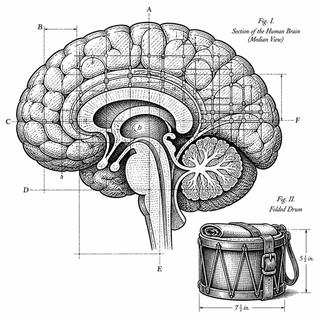
But the Cell paper adds a sharper idea. The authors used a model from neural field theory, which treats brain activity less like isolated little light bulbs and more like waves moving through a sheet of tissue. In their model, cortical locations preferentially connect when those connections help excite resonant geometric modes of the cortex. Translation: the shape of the brain may help decide which wiring patterns are useful, the way the shape of a room decides where echoes pile up and where your neighbor's terrible bass line becomes a legal problem.
This builds on earlier work showing that human brain activity can be reconstructed using geometric modes derived from brain shape, not just from the connectome itself. Pang and colleagues reported that many activity patterns look like resonances of the brain's geometry. So the cortex may not be only a switchboard. It may also be a weirdly folded drum. A wet drum. Inside your skull.
They Checked More Than One Mammal
The impressive part is scale. Normand's team tested the model across humans, chimpanzees, macaques, marmosets, and mice. They compared diffusion MRI, which estimates white-matter pathways noninvasively, with viral tract tracing, which is more direct but makes grant managers age visibly.
Across those species and methods, their geometry-first model outperformed existing approaches at reproducing both topology and topography. Topology is the broad network shape: hubs, clusters, paths. Topography is the where: which cortical locations have which connection profiles. Previous models captured some wiring economy, but often missed spatial detail. This one says the cortical floor plan carries more of the design brief.
The authors argue that this principle has been conserved across roughly 90 million years of mammalian evolution. That does not mean every mammal got the same brain. It means evolution may have reused a basic physical rule while remodeling the building for different tenants.
Why This Is More Than Brain Trivia
If this result holds up and expands, it could make connectome science more predictive. Instead of treating every brain map as a bespoke wiring disaster, researchers could start with geometry as a baseline constraint, then ask what genes, development, learning, disease, or injury add on top. That could help in disorders where wiring and dynamics go sideways, including neurodevelopmental conditions, epilepsy, and psychiatric illness. Not a treatment tomorrow. But better physical models can improve MRI interpretation, brain-stimulation simulations, and theories of why damage in one place echoes through a network.
It also gives the field a reality check. Diffusion MRI can miss connections or invent phantom pipes. Tract tracing is powerful but limited across species and scales. Some connectome models become so complicated they look like plumbing diagrams drawn during a fire drill. A simple geometric rule that explains a lot tells researchers which parts of the mess may be inevitable.
The brain is still not solved. It remains a damp electrical construction site with feelings. But this paper makes a clean point: before we ask why every wire goes where it goes, we should look hard at the shape of the building.
References
Normand F, et al. Geometric constraints on the architecture of mammalian cortical connectomes. Cell. 2026. doi:10.1016/j.cell.2026.05.048
Pang JC, et al. Geometric constraints on human brain function. Nature. 2023;618:566-574. doi:10.1038/s41586-023-06098-1; PMCID:PMC10266981
Oldham S, et al. Modeling spatial, developmental, physiological, and topological constraints on human brain connectivity. Science Advances. 2022;8:eabm6127. doi:10.1126/sciadv.abm6127; PMCID:PMC9166341
Koller DP, Schirner M, Ritter P. Human connectome topology directs cortical traveling waves and shapes frequency gradients. Nature Communications. 2024;15:3570. doi:10.1038/s41467-024-47860-x; PMCID:PMC11053146
Sydnor VJ, et al. Neurodevelopment of the association cortices: patterns, mechanisms, and implications for psychopathology. Neuron. 2021;109:2820-2846. doi:10.1016/j.neuron.2021.06.016; PMCID:PMC8448958
Disclaimer: The image accompanying this article is for illustrative purposes only and does not depict actual experimental results, data, or biological mechanisms.