
Before this study, the sympathetic nerves running into the head looked like a general alarm system with dramatic hobbies: widen the pupils, tighten blood vessels, raise the hair, cut saliva, report for chaos. After it, the operation looks more like a command map, with individual nerve cells assigned to specific targets like tiny officers guarding absurdly small strategic assets.
Situation Report: The Neck Has a Switchboard
The superior cervical ganglion, or SCG, sits high in the neck and sends sympathetic nerve fibers into the head and face. It helps control pupil dilation, blood vessel tone, salivary glands, the pineal gland, and other cranial equipment that makes you look alert, startled, dry-mouthed, or ready to negotiate with a dentist.
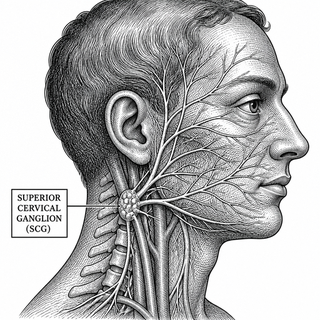
Researchers knew the SCG mattered. They did not know, at high resolution, how its neurons were organized. Did one neuron command several targets? Did molecular cell types map neatly onto jobs? Filing cabinet, or government office after a printer outage?
Senturk and colleagues attacked that question with neuronal tracing and transcriptomics. Tracing shows where a neuron sends its axon. Transcriptomics reads which genes a cell is using, like intercepting its internal logistics memo. The team combined single-cell sequencing with spatial transcriptomics, which keeps location information instead of blending everything into biological soup Senturk et al., 2026.
Mission Objective: Find Out Who Reports Where
The headline finding is clean: each SCG neuron innervated a single effector organ. One neuron, one target. No freelance side missions. That matters because "fight or flight" is useful enough for textbooks and blunt enough to make neuroscientists twitch.
Real sympathetic control is more selective. Your body does not always need the whole emergency parade. Sometimes it needs pupil dilation without a full-body panic opera. Sometimes it needs blood vessel constriction in one zone while another system keeps calm and carries a clipboard.
This paper supports that modular view. Projection-defined neuron groups, or P-types, formed two broad compartments in the ganglion. But individual target classes mixed together. The map has structure, but not the kind that lets you draw one neat border and go home early.
Execution: Genes Did Not Obey the Seating Chart
The transcriptomic side produced another useful complication. Mature gene-expression types, or T-types, emerged after birth and showed front-to-back biases in the ganglion. Some T-types appeared enriched among neurons projecting to certain targets.
But the match was not one-to-one. A projection target did not equal a single molecular identity. Instead, cranial sympathetic effectors seem to receive control from combinations of transcriptomic neuron types. That is the fun part, if your definition of fun includes cells refusing to fit a spreadsheet.
This fits a broader shift in autonomic neuroscience. Recent reviews argue that the autonomic nervous system contains diverse motor neurons, not two cartoon levers labeled "panic" and "nap" Wang et al., 2025. Sympathetic neurons also diversify to meet organ demands Scott-Solomon et al., 2021.
Assessment: Why the Finding Has Teeth
If these results hold up beyond mice, they could sharpen how we think about autonomic symptoms in humans. The SCG sits near surgical territory in the neck and contributes to signs clinicians see, including altered pupil control and Horner syndrome when sympathetic pathways fail. That is the nervous system leaving a sticky note on the face.
The work also matters for emotion research. Pupils, facial blood flow, salivation, and hair movement help create the body-side display of arousal. Nobody should read this as "scientists found the fear neuron." They did not. The brain does not run emotions with one intern and a label maker. But the team did identify a peripheral command layer with more routing precision than old models implied.
The same logic appears outside the head. A Nature paper found organ-specific sympathetic populations that regulate visceral functions Wang et al., 2025. A Science study linked cardiac disease to immune-mediated loss of pineal-projecting sympathetic neurons and sleep disruption, showing how target-specific sympathetic damage can matter in real life Ziegler et al., 2023.
Final Orders: Respect the Complexity
The challenge now is translation. This study used mice. Human ganglia may share principles, but they also bring human complications, because apparently evolution enjoys paperwork. Researchers still need to test these SCG cell types during stress, disease, injury, and repair.
Still, the operational takeaway is strong. The cranial sympathetic system is not a single siren. It is a routed network with target-specific lines and mixed molecular crews. Each neuron reports to one destination, but the command structure uses combinations. That is elegant. Also mildly annoying. Biology often is.
The face has supply lines. The SCG helps run them. Somewhere in your neck, a neuron may be treating pupil dilation like a classified operation. Honestly, fair.
References
Senturk G, Driscoll S, Osseward PJ, Gullo M, Lettieri K, Pfaff SL. Circuit organization and transcriptomic heterogeneity of sympathetic circuits innervating cranial structures. Cell Reports. 2026;45(6):117446. DOI: 10.1016/j.celrep.2026.117446. PMID: 42241285.
Wang T, Tufenkjian A, Ajijola OA, Oka Y. Molecular and functional diversity of the autonomic nervous system. Nature Reviews Neuroscience. 2025;26:607-622. DOI: 10.1038/s41583-025-00941-2. PMID: 40610604.
Scott-Solomon E, Boehm E, Kuruvilla R. The sympathetic nervous system in development and disease. Nature Reviews Neuroscience. 2021;22:685-702. DOI: 10.1038/s41583-021-00523-y. PMCID: PMC8530968.
Wang T, Teng B, Yao DR, Gao W, Oka Y. Organ-specific sympathetic innervation defines visceral functions. Nature. 2025;637:895-902. DOI: 10.1038/s41586-024-08269-0. PMID: 39604732.
Ziegler KA, Ahles A, Dueck A, et al. Immune-mediated denervation of the pineal gland underlies sleep disturbance in cardiac disease. Science. 2023;381(6655):285-290. DOI: 10.1126/science.abn6366. PMID: 37471539.
Blum JA, Klemm S, Shadrach JL, et al. Single-cell transcriptomic analysis of the adult mouse spinal cord reveals molecular diversity of autonomic and skeletal motor neurons. Nature Neuroscience. 2021;24:572-583. DOI: 10.1038/s41593-020-00795-0. PMCID: PMC8016743.
Disclaimer: The image accompanying this article is for illustrative purposes only and does not depict actual experimental results, data, or biological mechanisms.