In five years, this discovery might mean we stop treating motor cortex like the brain's bicycle pedal and start treating it like a tiny, damp customs office deciding which stimulus gets stamped "lick left" and which gets marched to "lick right." Shen and colleagues ask a bar-napkin question: how does a brain use the same cue to do different things depending on context? If you can shift behavior at a funeral, karaoke bar, and budget meeting with the same face, congratulations, you own the mammalian version of this problem.
Meet ALM, The Tongue Bureaucrat
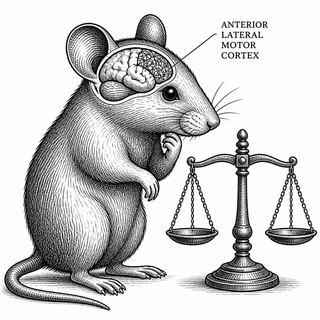
The anterior lateral motor cortex, or ALM, sits in mouse frontal motor territory. Its old job description was tidy: help plan movements, especially little face and tongue movements. Small clipboard.
But ALM keeps turning up where tidy stories get inconvenient. In this study, mice played an odor game that sounds simple until you imagine doing it with your nose, your tongue, and no coffee. First came a context odor, then a delay, then a test odor. Depending on the earlier context, the same test odor meant "lick left" or "lick right" for water. The instruction was the pair: "pineapple means password, unless Gerald wears the blue hat."
Watching The Committee Vote
The researchers used two-photon calcium imaging, which lets scientists watch many neurons flicker while an animal behaves. Calcium signals are not neuron speech exactly, but they reveal which cells are getting loud in the committee meeting.
ALM did not contain one generic blob of decision mush. The team found distinct populations encoding context odors, test odors, and the eventual choice. Then they used optogenetic silencing, temporarily quieting targeted brain tissue with light. When they silenced ALM during the context and delay periods, the mice made more mistakes. That timing matters. The test odor had not arrived, so ALM was not merely yanking the tongue lever like a disgruntled arcade machine. It was configuring the rule before the final cue.
The Plot Twist Is Not Abstraction
A tempting theory says ALM might compress different context odors into a clean abstract rule: these odors mean mapping A, those odors mean mapping B. Elegant. Minimalist. The sort of theory that wears black turtlenecks.
The data were messier and more interesting. Context odors that instructed the same stimulus-response mapping still appeared in separate neural populations. Their effects converged later, at choice-selective neurons. A special subset responded to both context and choice, so the authors call them "contingency neurons." Think switchboard operators, except wet, microscopic, and not giving you a receipt.
That suggests ALM supports flexible behavior by dynamically reconfiguring local circuits. It does not simply label a situation with a neat rule and hand it off. It changes how sensory information routes toward action. Same odor, different consequence. Same button, different episode of this niche mouse game show.
Why This Is Bigger Than Mouse Sniffing
This fits a broader shift in neuroscience. Motor areas do not just wait politely for the "real" cognitive regions to finish thinking. They help maintain plans, combine evidence, and bias choices. Recent work links ALM and related frontal circuits to thalamic input, multisensory decisions, memory-guided movement, and strategy choices shaped by supposedly task-irrelevant experience. The motor system, it turns out, is less "press button" and more "middle manager with suspiciously broad access permissions."
That matters because flexible behavior is one of the great daily miracles we barely notice. You stop at a red light, but not at a red apple. You hear your name at a dinner table, but ignore it if a movie character says it. You use context constantly, and your neurons somehow avoid filing a formal complaint.
The current challenge is that context-dependent decisions mix memory, sensory input, rules, timing, and action. Signals smear across circuits. Neurons behave like tiny gossip networks that took statistics but refuse to label the axes. This paper gives a sharper picture: ALM can route the same sensory cue toward different motor outcomes depending on what came before.
No, this is not a treatment for cognitive rigidity arriving next Tuesday in a tiny lab coat. These are mice, odors, licking, and controlled experiments. But if the findings replicate and expand, they could improve models of cognitive flexibility in disorders where adapting behavior goes sideways, including impulsivity, compulsive behavior, addiction, and some psychiatric or neurological conditions. The near-term payoff is not "zap the motor cortex and become wiser." It is better circuit maps, better behavioral tasks, and better questions about where flexible control breaks.
For now, ALM looks less like the brain's final movement button and more like a rule-sensitive routing room. A little motor cortex office, full of contingency neurons, deciding whether today's pineapple means left, right, or please stop making mice do smell algebra.
References
-
Shen J, Rungratsameetaweemana N, Sharma P, Peterka DS, Wu HZ, Shadlen MN. Anterior lateral motor cortex enables contextual decision-making via dynamic reconfiguration of local circuits. Cell Rep. 2026;45(6):117456. doi:10.1016/j.celrep.2026.117456
-
Maristany de Las Casas E, Killmann K, Druke M, et al. Tuft dendrites in frontal motor cortex enable flexible learning. Science. 2026;392(6798):eadx4358. doi:10.1126/science.adx4358
-
Yang W, Tipparaju SL, Chen G, Li N. Thalamus-driven functional populations in frontal cortex support decision-making. Nat Neurosci. 2022;25(10):1339-1352. doi:10.1038/s41593-022-01171-w; PMCID: PMC9534763
-
Coen P, Sit TPH, Wells MJ, Carandini M, Harris KD. Mouse frontal cortex mediates additive multisensory decisions. Neuron. 2023;111(15):2432-2447.e13. doi:10.1016/j.neuron.2023.05.008; PMCID: PMC10957398
-
Chen S, Liu Y, Wang ZA, et al. Brain-wide neural activity underlying memory-guided movement. Cell. 2024;187(3):676-691.e16. doi:10.1016/j.cell.2023.12.035; PMCID: PMC11492138
-
Schreiner DC, Cazares C, Renteria R, Gremel CM. Information normally considered task-irrelevant drives decision-making and affects premotor circuit recruitment. Nat Commun. 2022;13:2134. doi:10.1038/s41467-022-29807-2; PMCID: PMC9018678
-
Guzulaitis R, Godenzini L, Palmer LM. Neural basis of anticipation and premature impulsive action in the frontal cortex. Nat Neurosci. 2022;25(12):1683-1692. doi:10.1038/s41593-022-01198-z
-
Wolff M, Halassa MM. The mediodorsal thalamus in executive control. Neuron. 2024;112(6):893-908. doi:10.1016/j.neuron.2024.01.002
Disclaimer: The image accompanying this article is for illustrative purposes only and does not depict actual experimental results, data, or biological mechanisms.