
You stub your toe on the bed frame at 2 a.m. A pressure-sensitive nerve ending in your skin fires, and a signal sprints up a thin fiber into your dorsal root ganglion (DRG), a little cluster of sensory neuron cell bodies parked just outside your spinal cord. From there the message hops to the spinal cord and up to your brain, which helpfully informs you, several milliseconds too late, that the bed frame won. That whole relay is a chain of switches flipping in sequence. And it turns out one of those switches has a secret job nobody expected: it spends its day clutching a piece of DNA-packing protein like a kid refusing to share a toy.
A molecule moonlighting against its own resume
Meet MLKL. If you've heard of it, you know it as the executioner of necroptosis, a form of programmed cell death where MLKL drills holes in the cell membrane and the cell bursts. Its entire reputation is "the protein that kills cells." So you'd expect to find it loitering near the membrane, sharpening its knives.
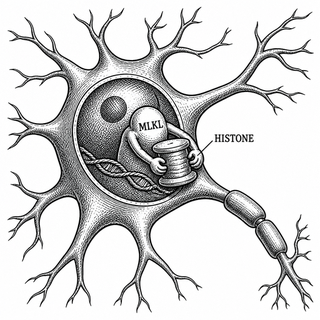
Instead, a team led by Han Meng and colleagues, writing in Cell Reports, found MLKL sitting calmly in the nucleus of nociceptive (pain-sensing) neurons, doing the opposite of killing. It was holding hands with histone H3, one of the spool proteins your DNA wraps around. Think of histones as the bobbins in a sewing kit; without them, two meters of DNA per cell would be an ungovernable tangle. MLKL, it seems, was keeping a particular bobbin politely in its box.
Here is the pattern that delighted me. The same molecule, two completely different addresses, two opposite jobs. In math you call this a context-dependent function: same input symbol, different output depending on which room it's standing in. Biology loves this trick, and it keeps surprising us anyway.
Inflammation kicks open the box
Now add inflammation. When the team triggered peripheral inflammation, the MLKL/H3 partnership broke up. MLKL packed its bags and translocated to the cytoplasm, and histone H3 got released, first out of the nucleus, then out of the neuron entirely.
Loose extracellular histones are bad houseguests. They're famously cytotoxic and proinflammatory, the molecular equivalent of leaving the toolbox open on the stairs. Here, the freed H3 did three things, and they compound like interest:
- It made the pain neurons hyperexcitable, lowering the bar for what counts as "ouch" (hello, hyperalgesia).
- It summoned neutrophil extracellular traps (NETs), those sticky webs of DNA and protein that neutrophils fling out like Spider-Man having a bad day.
- The NETs fed back into more inflammation, more histone, more pain. A loop.
The receptors doing the dirty work appear to be P2X7 and TLR4, the cell's "something is very wrong" alarm bells. Knock out TLR4 and the histone-driven NETs largely vanish, which is a satisfyingly clean result for a system this messy.
The counterintuitive punchline
Here's where your intuition should brace itself. If MLKL's day job is killing cells, you'd guess that deleting it from neurons would be protective. Wrong direction. When the researchers depleted Mlkl specifically in nociceptive neurons, the animals got more pain and more NETs, not less. And this happened independent of cell death, so MLKL wasn't moonlighting as an undertaker here at all. It was a gatekeeper. Remove the gatekeeper, the histone escapes, the loop runs hot.
It's a small inversion with a big lesson: the thing labeled "destroyer" was, in this room, the one holding the line.
Why you should care (besides the elegance)
Chronic inflammatory pain is a genuinely hard, expensive, undertreated problem, and our blunt tools (opioids, NSAIDs) come with their own bills. This work hands us three fresh levers, and each one is the kind you can actually grab with a drug: neutralize the loose histone with an anti-histone antibody, dissolve the NET scaffolding with DNase I, or coax MLKL back into the nucleus where it belongs. Each one broke the pain loop in mice.
None of this is a prescription yet. It's mice, it's mechanism, and the road from "elegant in a dish" to "helps a human" is long and littered with promising molecules that didn't make it. But the shape of the idea is clean: pain isn't only neurons shouting, it's neurons leaking the wrong protein and immune cells answering the alarm. Fix the leak, quiet the room.
Your 2 a.m. toe will still lose to the bed frame. But somewhere in that DRG, a protein you'd have bet on as a villain was quietly trying to keep the volume down.
Disclaimer: The image accompanying this article is for illustrative purposes only and does not depict actual experimental results, data, or biological mechanisms.
References
-
Meng H, Hu W, Kang E, et al. Nociceptive neurons inhibit neutrophil extracellular trap formation via MLKL-licensed histone release. Cell Reports. 2026. DOI: 10.1016/j.celrep.2026.117457 | Full text
-
Silvestre-Roig C, et al. Targeting extranuclear histones to alleviate acute and chronic inflammation. Trends in Pharmacological Sciences. 2024. Article
-
Kim TS, et al. Neutrophil extracellular traps and extracellular histones potentiate IL-17 inflammation in periodontitis. Journal of Experimental Medicine. 2023;220(9):e20221751. DOI: 10.1084/jem.20221751
-
Histone H4 directly stimulates neutrophil activation through membrane permeabilization. J Leukoc Biol. 2020. PMCID: PMC7461478
-
Activated platelets induce MLKL-driven neutrophil necroptosis and release of neutrophil extracellular traps in venous thrombosis. PMCID: PMC6060161