
Here's a party trick: a worm with 302 neurons can still use serotonin from glia to decide whether a nose bump deserves a dramatic retreat. That is Tuesday in C. elegans research, where a microscopic comma keeps making neuroscience look overdressed.
Touch sounds simple until you ask a cell to do it. Something presses on you, and your nervous system has to turn that pressure into an electrical or chemical signal. This conversion is called mechanotransduction, which is a large word for "the cell felt a poke and filed paperwork."
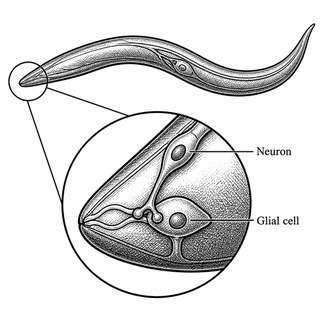
In C. elegans, nose touch makes the worm back up. The response involves sensory neurons such as ASH, but neurons are not alone at the tip of the nose. They sit with glia, support cells long typecast as nervous-system stagehands. Except stagehands sometimes run the whole production.
Glia Grab the Brush
Logan and colleagues report that amphid sheath glia, called AMsh glia, do something surprisingly direct: they release serotonin during nose-touch responses Logan et al., 2026. Using live Ca2+ and serotonin imaging plus behavior tests, the team found that AMsh glia release serotonin through dense-core vesicles. Think tiny sealed paint pots, except the paint changes a nearby neuron's sensitivity. The brain is an art supply closet with opinions.
That glial serotonin activates SER-5 receptors on ASH neurons, helping those neurons respond to touch. At the same time, it engages MOD-1 receptors on the glia themselves, creating feedback so the signal does not become a sensory group chat with all caps. The tuning also runs through cAMP and Ca2+ pathways, so concentration matters. A little can sharpen the sketch. Too much may smear the lines.
Not Just Neuron Gossip
This matters because touch receptors are not just naked wires. A 2021 review in Nature Reviews Neuroscience emphasized that tactile end organs include non-neuronal cells that may help shape how force becomes neural activity Handler and Ginty, 2021. Recent mouse work points the same way: sensory Schwann cells help set touch thresholds and mechanical pain sensitivity Ojeda-Alonso et al., 2024.
The new worm study also builds on earlier work from the same neighborhood. In 2022, researchers showed that a glial chloride channel supports nose touch by controlling glial GABA signaling and ASH excitability Fernandez-Abascal et al., 2022. So the picture now has at least two glial colors: GABA and serotonin. The old cartoon of glia as packing foam around neurons is looking less like science and more like a bad hiring decision.
Serotonin itself is also not just the "mood molecule," despite what supplement ads keep whispering from the internet bushes. In C. elegans, serotonin helps organize behavior across the whole tiny nervous system, as shown in brain-wide mapping work Dag et al., 2023. Here, though, serotonin is local and tactile: a glial signal at the nose that helps decide whether the worm backs away.
Why a Worm Nose Might Matter
No, this does not mean glial serotonin explains why your sweater tag feels like a medieval punishment device. Worms are not tiny humans wearing lab coats. But if these findings hold up and expand, they sharpen a useful idea: sensory thresholds may be tuned by nearby support cells, not only by neurons.
That could matter for pain, hypersensitivity, numbness, and other problems where touch is miscalibrated. Current treatments often aim at neurons after the system is already shouting. Glia and accessory cells might offer a quieter control panel closer to the sensory surface. Not a cure, not yet a therapy, not a TED Talk with a laser pointer - just a better map of where the levers may be.
The lovely part is how small the scene is. A worm nose. A glial cell. A puff of serotonin. A neuron deciding whether to panic politely. Biology keeps doing this: hiding big principles in tiny corners, then waiting for someone patient enough to notice the brushstrokes.
References
Logan DR, Oliva CD, Wang L, et al. Glia-released serotonin drives nose touch responses in Caenorhabditis elegans. Cell Reports. 2026;45(6):117553. https://doi.org/10.1016/j.celrep.2026.117553
Handler A, Ginty DD. The mechanosensory neurons of touch and their mechanisms of activation. Nature Reviews Neuroscience. 2021;22(9):521-537. PMCID: PMC8485761. https://doi.org/10.1038/s41583-021-00489-x
Fernandez-Abascal J, Johnson CK, Graziano B, Wang L, Encalada N, Bianchi L. A glial ClC Cl- channel mediates nose touch responses in C. elegans. Neuron. 2022;110(3):470-485.e7. PMCID: PMC8813913. https://doi.org/10.1016/j.neuron.2021.11.010
Ojeda-Alonso J, Calvo-Enrique L, Paricio-Montesinos R, et al. Sensory Schwann cells set perceptual thresholds for touch and selectively regulate mechanical nociception. Nature Communications. 2024;15:898. PMCID: PMC10847425. https://doi.org/10.1038/s41467-024-44845-8
Dag U, Nwabudike I, Kang D, et al. Dissecting the functional organization of the C. elegans serotonergic system at whole-brain scale. Cell. 2023;186(12):2574-2592.e20. PMCID: PMC10484565. https://doi.org/10.1016/j.cell.2023.04.023
Disclaimer: The image accompanying this article is for illustrative purposes only and does not depict actual experimental results, data, or biological mechanisms.