
The experiment was supposed to sort amyloid-beta into a tidy story, and, naturally, the molecules behaved like wine-tasting guests who all brought suspiciously labeled bottles. Same peptide, same reaction, different time points - and suddenly the brain slices gave different answers. That is the deliciously annoying truth in a new Cell Reports study: amyloid-beta 1-42, the sticky protein fragment tied to Alzheimer's disease, does not produce one villain. It produces a tasting flight of trouble: calcium panic, microglial mood swings, and a lingering finish of synaptic dread.
The Usual Suspect Has Layers
Amyloid-beta is a short peptide clipped from a larger protein called APP. In Alzheimer's disease, one form, Abeta42, folds badly and clumps together. People hear about amyloid plaques, but smaller soluble assemblies along the way may be the real mischief-makers. Think less "boulder in the road" and more "glitter in the carpet." You can see the boulder. The glitter is everywhere, and now your vacuum has trust issues.
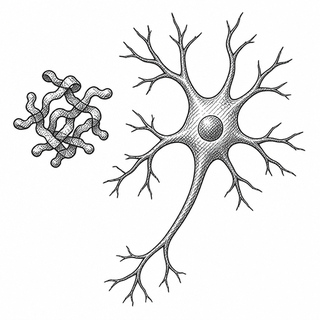
Metodieva and colleagues asked: what if amyloid toxicity changes depending on when you catch the clumps forming? They used single-molecule imaging to characterize Abeta42 aggregates, then tested them in mouse organotypic hippocampal slices - thin living brain tissue preparations that preserve some local circuitry without pretending a dish is a whole person.
Early Clumps: Calcium With a Side of Bad Memory Chemistry
The early "lag phase" aggregates were not dramatic in the Hollywood sense. No exploding neurons. No tiny cellular car chase. Instead, they raised baseline neuronal Ca2+ levels and weakened long-term potentiation, or LTP, which helps synapses strengthen after activity. LTP is one candidate for "how experience leaves a mark," meaning your neurons keep receipts.
Neurons treat calcium like a very intense group chat. A little signal says, "do the thing." Too much background chatter and the conversation gets sticky, hot, and hard to interpret. Early Abeta aggregates seemed to add that noise while nudging microglia - the brain's resident immune cells - away from housekeeping and toward a disease-associated microglia, or DAM, state.
Later Clumps: The Immune System Starts Throwing Chairs
The later "growth phase" aggregates had a different personality. They pushed microglia into inflammatory behavior through TLR4, a danger-sensing receptor. The result included cytokine production, complement activation, synaptic engulfment, and severe disruption of neuronal activity.
Complement is useful when it tags cellular debris for cleanup. In the wrong context, it can make synapses look like leftovers at closing time. Microglia then clear connections neurons may still be using, which is awkward in the way demolishing a bridge during rush hour is awkward.
This split is the point. One amyloid reaction produced structurally distinct aggregates that engaged different cellular pathways. Early species tasted like electrical instability. Later species had a stronger inflammatory bouquet, full-bodied TLR4, and a finish of "who authorized the synapse removal crew?"
Why This Changes the Amyloid Conversation
The amyloid field has spent years arguing over whether amyloid is the culprit, a bystander, a trigger, or an expensive biological red herring. Current anti-amyloid drugs such as lecanemab and donanemab can slow decline in selected people with early Alzheimer's disease, but the effects are modest, monitoring is burdensome, and safety issues like amyloid-related imaging abnormalities remain part of the bargain. That is complexity wearing a lab coat and asking for another grant.
This paper helps explain why "remove amyloid" may be too blunt. If different aggregate species cause damage through different routes, timing and combination therapy make more sense. A treatment aimed at early calcium disruption might not calm later microglial inflammation. A TLR4-focused approach might miss the first synaptic wobble. The enemy is not just amyloid; it is amyloid's changing texture over time.
The Useful Caveat, Served Chilled
These experiments used mouse brain slices, not living human brains. Human Alzheimer's unfolds over years with aging, tau pathology, vascular changes, genetics, metabolism, sleep, immune history, and several biological plot twists still waiting smugly in the hallway.
Still, the study gives researchers a better map. Instead of treating Abeta42 aggregates as one toxic blob, it separates them by stage, structure, and cellular consequence. If these findings hold up, future therapies could pair the right intervention with the right toxic species at the right disease moment. Precision medicine, but with fewer inspirational posters and more molecular receipts.
The brain, inconveniently, is not a soup with one bad ingredient. It is a simmering, overconnected, electrically seasoned stew. This study suggests amyloid-beta changes the flavor as it cooks. Catch it early and you taste calcium static. Let it keep going and the immune system arrives with a clipboard, a flamethrower, and the confidence of middle management.
Disclaimer: The image accompanying this article is for illustrative purposes only and does not depict actual experimental results, data, or biological mechanisms.
References
-
Metodieva V, Marchese S, Esposito P, et al. Divergent toxicity mechanisms of amyloid-beta aggregates arising from a single aggregation reaction. Cell Reports. 2026;45(7):117595. https://doi.org/10.1016/j.celrep.2026.117595
-
Leng F, Edison P. Neuroinflammation and microglial activation in Alzheimer disease: where do we go from here? Nature Reviews Neurology. 2021;17(3):157-172. https://doi.org/10.1038/s41582-020-00435-y
-
Rueda-Carrasco J, Sokolova D, Lee SE, et al. Microglia-synapse engulfment via PtdSer-TREM2 ameliorates neuronal hyperactivity in Alzheimer's disease models. The EMBO Journal. 2023;42(19):e113246. https://doi.org/10.15252/embj.2022113246 PMCID: PMC10548173
-
van Dyck CH, Swanson CJ, Aisen P, et al. Lecanemab in early Alzheimer's disease. New England Journal of Medicine. 2023;388(1):9-21. https://doi.org/10.1056/NEJMoa2212948
-
Sims JR, Zimmer JA, Evans CD, et al. Donanemab in early symptomatic Alzheimer disease: the TRAILBLAZER-ALZ 2 randomized clinical trial. JAMA. 2023;330(6):512-527. https://doi.org/10.1001/jama.2023.13239 PMCID: PMC10352931
-
Hampel H, Elhage A, Cho M, Apostolova LG, Nicoll JAR, Atri A. Amyloid-related imaging abnormalities (ARIA): radiological, biological and clinical characteristics. Brain. 2023;146(11):4414-4424. https://doi.org/10.1093/brain/awad188 PMCID: PMC10629981