
Spring 2026 has been unusually busy for pain-circuit news: a Nature study mapped a brain-spinal loop that can keep chronic pain running after injury, while a 2026 oncology trial found duloxetine did not prevent oxaliplatin-related nerve damage Wang et al., 2026; Smith et al., 2026. Pain science is having a "we found the wiring closet" moment, and the closet is somehow full of thalamus.
The Ice Cube That Files a Complaint
Cold allodynia means a normally harmless cold stimulus feels painful. Not "ugh, winter" painful. More like your nervous system has mistaken a refrigerator handle for a hostile political regime. This can happen after nerve injury and in chemotherapy-induced peripheral neuropathy, where cold drinks, cold air, or chilled objects can become genuinely unpleasant.
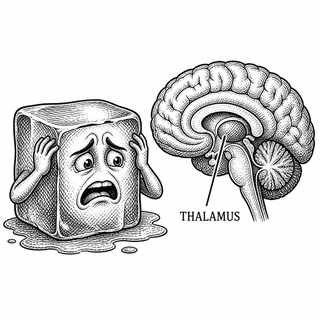
The new Cell Reports study by Reddy and colleagues asks a wonderfully specific question: when cold becomes pain, which brain circuit turns that signal into both "that hurt" and "I hate this, make it stop"? The team used mouse circuit-mapping tools that amount to "follow the wires, watch them light up, and poke the system with fancy instruments" Reddy et al., 2026.
Meet the Brainstem Alarm Desk
The lateral parabrachial nucleus, or LPBN, sits in the brainstem and has a reputation as a general alarm hub. Pain, threat, body-state weirdness, "something is wrong with the plumbing" - the LPBN is the region likely forwarding the memo with too many exclamation points.
Reddy's team found that LPBN neurons send direct, one-synapse inputs to the parafascicular nucleus, or PF, a medial thalamus region involved in attention, salience, movement, and pain-related behavior. The thalamus is often called a relay station, but that undersells it. It is more like a bouncer deciding which signals get into the club and how dramatic their entrance should be.
The key result: PF neurons receiving LPBN input became active during nociceptive stimulation, were sensitized after peripheral neuropathy, and were acutely aversive when activated. Turning on this LPBN-to-PF pathway helped drive both the sensory side of cold allodynia and the affective-motivational side. In human terms, that maps roughly onto "this is cold pain" plus "absolutely not, I am leaving."
Two Nearby Thalamus Rooms, Different Jobs
The study also compared PF with another medial thalamic neighbor, the centromedian nucleus, or CM. Both receive parabrachial pain-related information. But they did not act like duplicate backup drives.
PF neurons downstream of LPBN seemed to carry a broader package: sensory detection plus aversive motivation. CM neurons downstream of LPBN leaned more toward the affective-motivational side. That matters because chronic pain is not just an over-loud signal. It grabs attention, changes choices, and teaches your body to avoid things. Neurons, those tiny gossip networks, do not merely report pain. They help decide the next move.
This fits a larger shift in pain research. A 2022 Neuron review argued that pain circuits may split into branches for fast external threats versus ongoing internal body distress, which is a polite way of saying the field has been overusing quick reflex tests to understand slow suffering Ma, 2022. Other recent work puts the parabrachial nucleus near the center of persistent and nociplastic pain, with specific neuron groups able to sustain pain-like states or quiet down when hunger or threat takes priority Goldstein et al., 2025; Condon et al., 2024.
Why This Is More Than Mouse Brain Cartography
For people with chemotherapy-induced neuropathy or other chronic pain states, the practical problem is brutally simple: treatments often underperform. ASCO's guideline update identified duloxetine as the only medication with enough evidence for established painful chemotherapy-induced peripheral neuropathy, while also noting that the benefit is limited Loprinzi et al., 2020. That is not exactly a victory parade. More like a cautious thumbs-up from a pharmacist standing in the rain.
Circuit studies like this do not give us a pill tomorrow. They do something earlier and necessary: they separate the wires. If PF and CM help different parts of cold allodynia, future therapies might aim at the suffering and avoidance machinery without flattening normal protective pain. That is the dream: keep the smoke alarm, stop it from screaming every time someone makes toast.
There are caveats. These experiments were in mice. Mouse cold allodynia is not the full lived experience of a cancer survivor avoiding the freezer aisle like it owes them money. And brain circuits do not become treatments just because a diagram looks satisfying. Still, this study gives pain researchers a sharper map of how brainstem danger signals reach the medial thalamus and split into sensation, aversion, and motivation.
Pain is not just a message. It is a negotiation between body, brain, memory, and threat. This paper catches one small but meaningful committee meeting in progress.
References
Reddy P, Rani M, Prajapati JN, Koul S, Babu NP, Jabin N, Okuda T, Samineni V, Jain A, Barik A. Parabrachial inputs to the parafascicular thalamus drive sensory and affective-motivational responses to cold-allodynia in mice. Cell Reports. 2026;45(7):117581. DOI: 10.1016/j.celrep.2026.117581. PMID: 42360876.
Ma Q. A functional subdivision within the somatosensory system and its implications for pain research. Neuron. 2022;110(5):749-769. DOI: 10.1016/j.neuron.2021.12.015. PMCID: PMC8897275.
Goldstein N, Maes A, Allen HN, Nelson TS, Kruger KA, Kindel M, et al. A parabrachial hub for need-state control of enduring pain. Nature. 2025;647(8090):689-697. DOI: 10.1038/s41586-025-09602-x. PMCID: PMC12630001.
Condon LF, Yu Y, Park S, Cao F, Pauli JL, Nelson TS, et al. Parabrachial Calca neurons drive nociplasticity. Cell Reports. 2024;43(4):114057. DOI: 10.1016/j.celrep.2024.114057. PMCID: PMC11210282.
Wang Q, Lee JH, Nachtrab G, Yuan Y, Yuan L, Qi W, et al. Deconstruction of a spino-brain-spinal cord circuit that drives chronic pain. Nature. 2026;654(8117):142-151. DOI: 10.1038/s41586-026-10296-y. PMCID: PMC13078944.
Smith EML, Lee M, Scott MR, Liu H, Hillman S, Rieken T, et al. Alliance A221805: Duloxetine to Prevent Oxaliplatin-Induced Chemotherapy-Induced Peripheral Neuropathy: A Randomized, Double-Blind, Placebo-Controlled Phase II Study. JCO Oncology Advances. 2026;3(1). DOI: 10.1200/OA-25-00107.
Loprinzi CL, Lacchetti C, Bleeker J, Cavaletti G, Chauhan C, Hertz DL, et al. Prevention and management of chemotherapy-induced peripheral neuropathy in survivors of adult cancers: ASCO guideline update. Journal of Clinical Oncology. 2020;38(28):3325-3348. DOI: 10.1200/JCO.20.01399.
Disclaimer: The image accompanying this article is for illustrative purposes only and does not depict actual experimental results, data, or biological mechanisms.