
The smell of toast hits your nose, hops through sensory wiring, gets tagged by memory, and then lands in brain systems that help decide what to do next: eat, ignore it, crave it, avoid it, or stare at it like it just sent a passive-aggressive email. Most days, this works quietly. In eating disorders and obsessive-compulsive disorder, though, the brain's decision machinery can start acting less like a helpful assistant and more like a tiny compliance department with fluorescent lighting.
That is the setup for a new Cell Reports study by Breen and colleagues: do eating disorders and OCD merely look similar from the outside, or do they share molecular fingerprints inside the human brain?
The Brain Regions With Opinions
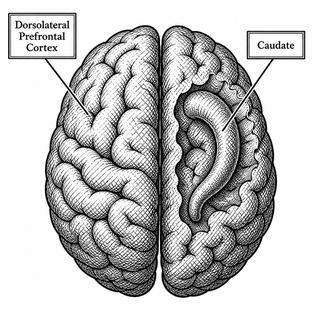
The researchers studied postmortem brain tissue from 86 controls, 57 people with eating disorders, and 27 people with OCD. They focused on two regions: the dorsolateral prefrontal cortex, which helps with planning and self-control, and the caudate, a striatal region involved in habits and action selection. Basically, one region helps write the rules, and the other helps decide whether the rules become routines. A dangerous office romance, neurologically speaking.
Instead of looking at DNA as a static recipe book, the team looked at the transcriptome: which genes were being actively read into RNA. If DNA is the cookbook, RNA is the stack of stained recipe cards currently on the counter. Transcriptomics asks, "What is the kitchen actually making right now?"
The Shared Molecular Mischief
The eating disorder group showed clear gene-expression changes: 102 differentially expressed genes in the dorsolateral prefrontal cortex and 222 in the caudate, using a strict false discovery rate under 1%. OCD, on its own, did not show strong single-cohort gene hits. That could sound like a nothingburger, except science loves making you wait through three caveats before the plot appears.
When the authors compared gene-expression effects across the whole transcriptome, ED and OCD moved in strikingly similar directions. The correlation was 0.67 in the dorsolateral prefrontal cortex and 0.75 in the caudate. In brain biology, that is not a polite nod across the room. That is two disorders showing up in matching jackets and insisting it was not planned.
When the researchers combined ED and OCD signals, they found 233 differentially expressed genes in the dorsolateral prefrontal cortex and 815 in the caudate. The implicated systems included GABAergic signaling, neuroendocrine regulation, mitochondrial metabolism, and CHD8-associated networks. Translation: inhibition, stress-and-hormone signaling, cellular energy, and gene-control machinery all walked into the same molecular meeting and nobody brought snacks.
Why This Is More Than Gene Bingo
Clinicians have long noticed overlap between eating disorders and OCD. Intrusive thoughts, ritualized behaviors, rigidity, checking, avoidance, and the grim little bargain of "I will feel better if I do the thing exactly right" can appear in both. Recent clinical reviews argue that we may need dimensional models, not just tidy diagnostic boxes, to understand why these symptoms cluster together.
This study gives that idea a biological shove. It suggests that the overlap is not only psychological vocabulary getting reused. It may reflect shared changes in cortico-striatal circuits, the brain loops that help convert thoughts, goals, threats, and habits into action.
The chromosome 3 finding adds another breadcrumb trail. The team identified five genes - WDR6, NCKIPSD, P4HTM, DALRD3, and SHISA5 - with convergent genetically regulated expression across disorders and brain regions. That does not mean these are "the genes for OCD and eating disorders," because biology refuses to be that convenient. It means they are candidate signposts in a crowded genomic neighborhood worth investigating.
The Treatment Dream, With Responsible Adult Supervision
If these findings hold up in larger and more diverse samples, they could help researchers think beyond diagnosis-specific treatments. A therapy or medication that targets shared circuit biology might help people whose symptoms straddle current categories. That matters because comorbidity is common, messy, and very rude to clean textbook chapters.
But the brakes matter too. This was postmortem tissue, which is precious and powerful but cannot show how symptoms changed over time. Eating disorders can also affect the whole body, including hormones, nutrition, and metabolism, so teasing apart cause, consequence, and adaptation will take more work. The OCD sample was smaller, and molecular signals in psychiatric disorders tend to be subtle, because the brain apparently files its complaints in 14 overlapping departments.
Still, the study is intriguing because it takes a familiar clinical observation - ED and OCD often travel together - and asks whether the brain's molecular machinery agrees. In this dataset, it does. Not perfectly, not finally, but enough to make old diagnostic borders look less like stone walls and more like chalk lines in a windstorm.
References
- Breen MS, Tao R, Yang A, et al. Convergent molecular signatures across eating disorders and obsessive-compulsive disorder in the human brain. Cell Reports. 2026;45(6):117514. doi:10.1016/j.celrep.2026.117514. PMID:42295976
- Levinson CA, Kapadia A, Sandoval-Araujo LE, Vanzhula IA, Machry K. Movement Toward Dimensional Symptom Models of Comorbid Obsessive-Compulsive Disorder and Eating Disorders. Annual Review of Clinical Psychology. 2025;21:407-438. doi:10.1146/annurev-clinpsy-081423-020831.
- Piantadosi SC, McClain LL, Klei L, et al. Transcriptome alterations are enriched for synapse-associated genes in the striatum of subjects with obsessive-compulsive disorder. Translational Psychiatry. 2021;11:171. doi:10.1038/s41398-021-01290-1. PMCID:PMC7961029
- Strom NI, Soda T, Mathews CA, Davis LK. A dimensional perspective on the genetics of obsessive-compulsive disorder. Translational Psychiatry. 2021;11:401. doi:10.1038/s41398-021-01519-z.
- National Institute of Mental Health. Eating Disorders: What You Need to Know. NIMH.
Disclaimer: The image accompanying this article is for illustrative purposes only and does not depict actual experimental results, data, or biological mechanisms.