
A good soup changes after a night in the fridge: the salt settles down, the onions stop shouting, and yesterday's leftovers suddenly taste like they hired a consultant. Acute social isolation may do a smaller, stranger version of that in the brain. In a new mouse study, Kang and colleagues found that one lonely day nudged a tiny region called the lateral habenula toward familiar company, as if the brain looked at novelty and said, "Not tonight, chef" [1].
The Bitter Spoon in the Brain
The lateral habenula, or LHb, is a tiny brain hub with a talent for noticing when life serves disappointment instead of dessert. It talks to dopamine and serotonin systems, so it can season motivation, mood, and learning with either hope or a suspicious squint. More recent work places it in the social-behavior kitchen too, not just the disappointment pantry [1,2].
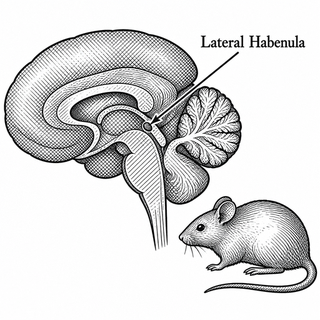
That makes it a good place to look when social balance gets knocked sideways. Social homeostasis is the brain's contact thermostat. Too little connection and the system can start behaving like neglected sourdough: technically alive, but making choices.
Isolation Turns the Heat Up
Kang's team isolated male mice for 24 hours, then looked inside the LHb. The standout change was an increase in serotonin receptor 4, usually shortened to 5-HT4R. Serotonin is not "the happy chemical," despite what internet bumper stickers keep trying to sell us. It is a many-spiced pantry, with different receptors doing different jobs.
Here, the 5-HT4 receptor seemed to change how LHb synapses learned from experience. In grouped mice, low-frequency stimulation could produce long-term depression, or LTD, which weakens synaptic signaling. After isolation, LTD was impaired, while long-term potentiation, or LTP, became easier to trigger. In kitchen terms, the reduction sauce got too concentrated: every social signal came out darker, sharper, and harder to balance.
Then came the useful twist. Activating 5-HT4R pharmacologically restored the altered synaptic plasticity in slices from isolated mice. It helped reset the cooking temperature.
Familiar Mice Become Comfort Food
Behaviorally, grouped mice did the usual mouse thing: they preferred investigating a stranger over a familiar cage mate. Tiny social food critics, apparently.
Isolated mice flipped that pattern. They spent more time with the familiar mouse. The team checked that this was not simply a memory problem, then targeted the LHb directly. Activating 5-HT4R in the LHb restored social novelty preference after isolation. Blocking the receptor in grouped mice pushed them toward the isolation-like familiar preference [1].
That is the intriguing part: the study links a specific receptor in a specific brain region to a shift in social value. The mouse did not merely "feel lonely" in a poetic, staring-out-a-rainy-window way. Its brain appeared to reweight familiar versus novel social options. Comfort food won.
This Is Not a Loneliness Pill
Now for the cold splash of seltzer, which I am drinking because coffee number four is frowned upon by both cardiology and common sense. These are mice. The intervention went into a tiny brain region. The stressor was acute isolation, not months of loneliness, trauma, poverty, remote work, or seeing "we should catch up soon" become a calendar fossil.
Still, the work matters because social withdrawal cuts across depression, anxiety, autism spectrum conditions, schizophrenia, PTSD, and everyday stress. The World Health Organization now treats loneliness and social isolation as public-health problems, estimating that roughly one in six people worldwide experiences loneliness. If these LHb findings generalize and expand, they could help researchers design better ways to understand who retreats from novelty, when that retreat protects, and when it traps.
Recent studies fit the same bigger recipe. Serotonin release in the habenula can shape resilience during emotional contagion [3], basal forebrain inputs to the LHb can drive maladaptive social behavior [4], and central amygdala neurons can help animals decide whether strangers are worth approaching [5]. Social behavior is a tasting menu run by an overcaffeinated committee.
The Takeaway
This study gives us a sharper hypothesis: after acute isolation, the LHb may bias social choices toward the known and away from the new by altering 5-HT4R-linked plasticity. That could be adaptive in the short term. After stress, maybe the familiar face is the neural equivalent of rice porridge: bland, safe, exactly what the system ordered.
The challenge is learning when that comfort becomes a rut. Future work needs female mice, chronic isolation models, cell-type maps, safer targeting strategies, and human studies that do not pretend a mouse in a three-chamber box is basically a person deciding whether to attend a birthday dinner. The brain is in the kitchen, but we still have to read the recipe before prescribing the sauce.
References
- Kang M, Song S, Kim B, Kim K, Jeong T, Um S, Chae S, Kim J. Lateral habenula 5-HT4 receptor signaling restores social novelty preference after acute isolation. Cell Reports. 2026;45(6):117458. https://doi.org/10.1016/j.celrep.2026.117458
- Li H, Zhao Z, Jiang S, et al. Brain circuits that regulate social behavior. Molecular Psychiatry. 2025;30:3240-3256. https://doi.org/10.1038/s41380-025-03037-6
- Mondoloni S, Molina P, Lecca S, et al. Serotonin release in the habenula during emotional contagion promotes resilience. Science. 2024;385(6713):1081-1086. https://doi.org/10.1126/science.adp3897
- Wang J, Yang Q, Liu X, et al. The basal forebrain to lateral habenula circuitry mediates social behavioral maladaptation. Nature Communications. 2024;15:4013. https://doi.org/10.1038/s41467-024-48378-y
- Soya S, Toda K, Sakurai K, et al. Central amygdala NPBWR1 neurons facilitate social novelty seeking and new social interactions. Science Advances. 2025;11(3):eadn1335. https://doi.org/10.1126/sciadv.adn1335
Disclaimer: The image accompanying this article is for illustrative purposes only and does not depict actual experimental results, data, or biological mechanisms.